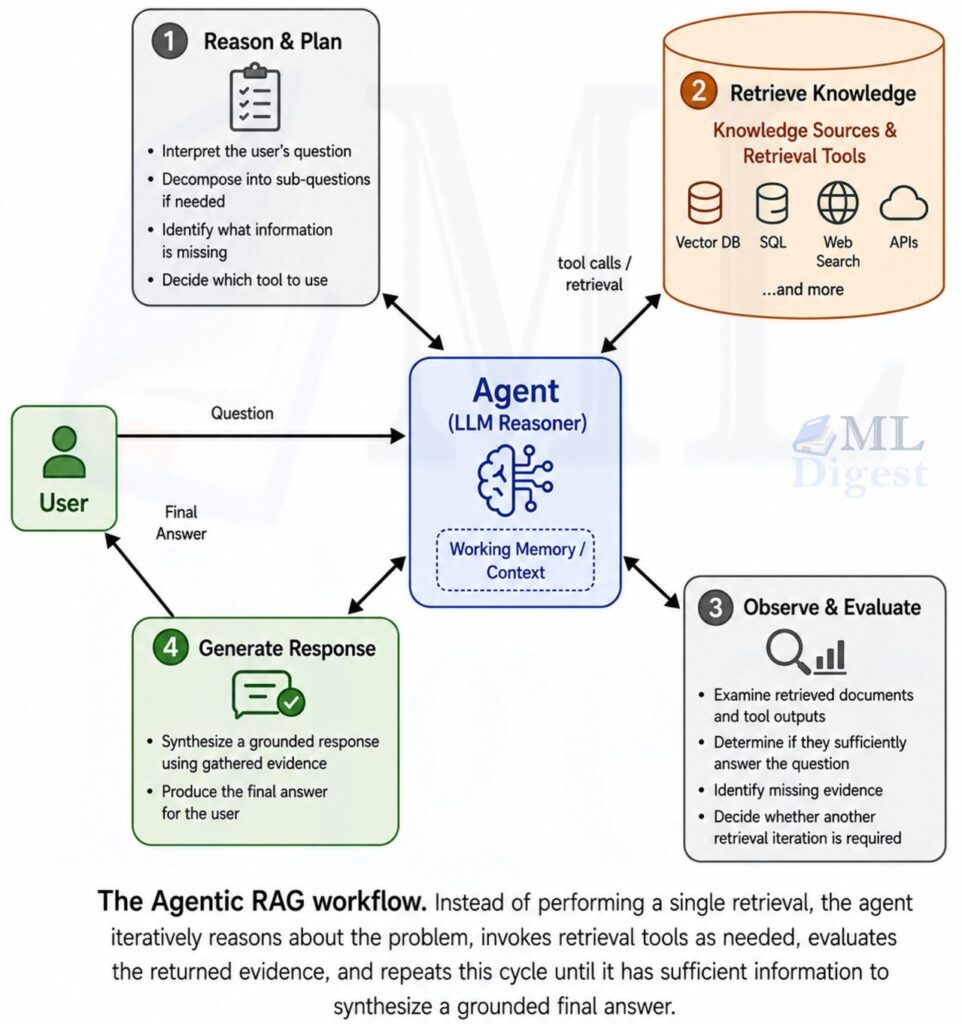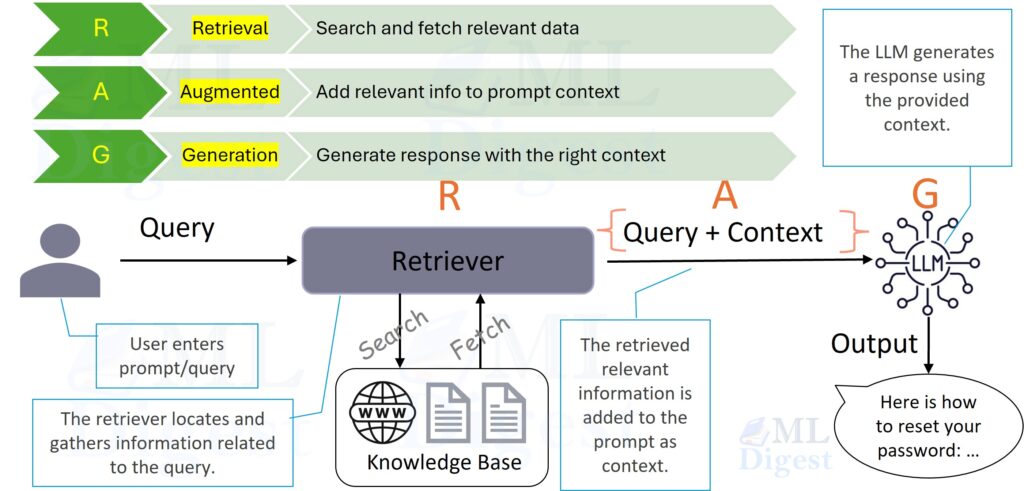
Imagine you are fixing a restaurant order pipeline. A customer says, “My order is wrong.” That sentence alone does not tell you whether the waiter misheard the order, the kitchen used stale ingredients, plates swapped, or the bill printer attached the wrong table number.
Debugging a Retrieval-Augmented Generation (RAG) workflow feels similar. A bad answer is only the visible symptom. The real defect may live in query rewriting, metadata filters, chunking, retrieval recall, reranking, prompt construction, context truncation, or the model’s final grounding behavior.
This article is a practical field guide for debugging RAG systems. We will build a stage-by-stage mental model, define the metrics that actually isolate faults, and walk through a concrete debugging checklist. Before debugging implementation details, it is also worth confirming that RAG is the right architecture for the use case, since a poor architectural fit can look like a retrieval defect.
1. Why RAG Debugging Is Hard
RAG failures are deceptively expensive to diagnose because several components can produce the same visible symptom.
For example, when the final answer is wrong, the root cause might be any of the following:
- The right document never made it into the index.
- The document was indexed, but chunking split the key fact across boundaries.
- The right chunk existed, but a metadata filter removed it.
- The chunk survived filtering, but dense retrieval ranked it too low.
- The chunk was retrieved, but reranking demoted it.
- The chunk reached the prompt, but context packing truncated the useful sentence.
- The evidence was present, but the model ignored it and answered from parametric memory.
That is why strong RAG teams do not debug the final answer first. They debug the pipeline stage that controls the answer.
2. A Useful Mental Model: Treat RAG as a Measurable Pipeline
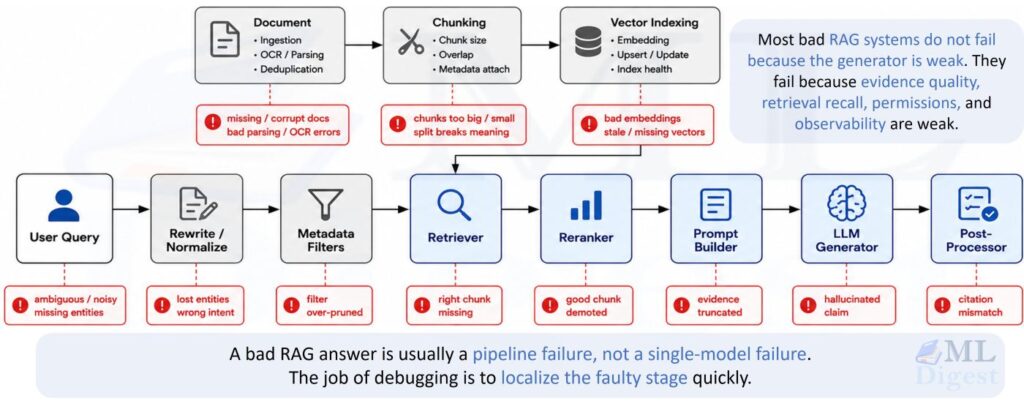
The most productive way to debug RAG is to stop treating it like one black box. Break it into stages with explicit inputs and outputs.
Indexing / Pre-processing (offline):
- Document ingestion loads raw documents into the system.
- Chunking splits documents into retrievable segments with metadata.
- Vector indexing embeds chunks and stores them in a dense index.
Query / Retrieval (online):
- User query enters the system.
- Query normalization or rewriting may modify it.
- Metadata filters narrow the candidate set.
- Retrieval returns top-$N$ candidates from the vector index.
- Reranking or selection compresses them into top-$k$ evidence chunks.
- Prompt assembly packages the evidence into the model context.
- The generator produces a grounded answer.
- Post-processing adds citations, guardrails, formatting, or validation.
The important shift is this: each stage should be inspectable and falsifiable.
3. Start with a Failing Query Set, Not a Vibe
Many teams say, “RAG quality feels worse this week.” That observation may justify an investigation, but it is not a reproducible debugging input.
Build a compact failure set that you can replay after every retrieval, prompt, or model change. A spreadsheet works for early review; a version-controlled JSON Lines file is usually easier to run in an evaluation harness. Include fields such as:
query_iduser_queryexpected_answer_summaryacceptable_source_doc_idsmust_include_entitiestime_scopeevaluation_timestampexpected_abstentionnotes_on_failure
Use expected_answer_summary as an acceptance criterion, not as a single required wording. Likewise, allow more than one supporting document when several sources can validly answer the question. This avoids marking a correct, well-grounded answer as a retrieval failure merely because it cites a different acceptable source.
The set serves two purposes. First, it prevents evaluation from drifting toward random prompts that change from run to run. Second, it makes retrieval evaluation concrete. If you know the acceptable supporting document IDs, you can determine whether a failure began in retrieval before inspecting generation.
For each replay, record the corpus or index version, embedding model, retrieval and reranker settings, prompt version, and generator model. Without these versions, a query can be replayed but its result may not be comparable. Start with a small set of high-impact failures, then expand it with representative successful queries, ambiguous questions that should trigger abstention, and known edge cases. A failure-only set is useful for debugging, but insufficient for detecting regressions in cases that previously worked.
This source-aware approach complements a broader RAG evaluation workflow: use the replay set to separate evidence-retrieval failures from answer-quality failures, rather than collapsing both into one opaque score.
If your corpus is time-sensitive, this is also where point-in-time correctness becomes critical. A query can fail because the system retrieved a newer or older policy than the one valid at the question timestamp. That is a data and filtering issue, not an LLM reasoning issue.
4. The Stage-by-Stage Debugging Checklist
4.1 Query and rewrite debugging
Start by capturing the original query and the exact rewritten query, if your system uses rewriting, decomposition, expansion, or agentic planning.
Things to inspect:
- Did the rewritten query preserve the critical nouns, IDs, error codes, and dates?
- Did it accidentally broaden a precise question into a vague semantic query?
- Did it remove terms that BM25 or TF-IDF would have needed for exact lexical matching?
- Did decomposition create sub-queries that are individually reasonable but collectively incomplete?
This is one of the most common hidden failures. A rewrite that looks more fluent to a human can be less searchable to your index.
For example, the raw query: “What changed in refund policy for enterprise customers after March 2025?” can become a bad rewrite like: “Summarize updated refund rules for large customers”
That rewrite lost the exact date boundary and the formal product segment term enterprise, both of which might be important filter keys.
4.2 Filter debugging
Metadata filters deserve their own inspection step because they fail silently.
Always log:
- the filter expression
- candidate count before and after filtering, when the retrieval system exposes those counts
- top removed document IDs when possible
Many vector databases apply filters before approximate nearest-neighbor search, so a meaningful pre-filter candidate count may not exist. In that case, log the filter, the returned count, and enough index or metadata statistics to explain the scope. If the filtered result set becomes suspiciously small, the retriever may never have had a useful candidate set.
This is also the place to verify security and governance constraints. If a system is designed to apply access control or policy segmentation, do not “fix” bad results by disabling filters globally. Debug whether the metadata is wrong, stale, or incomplete.
4.3 Retrieval debugging
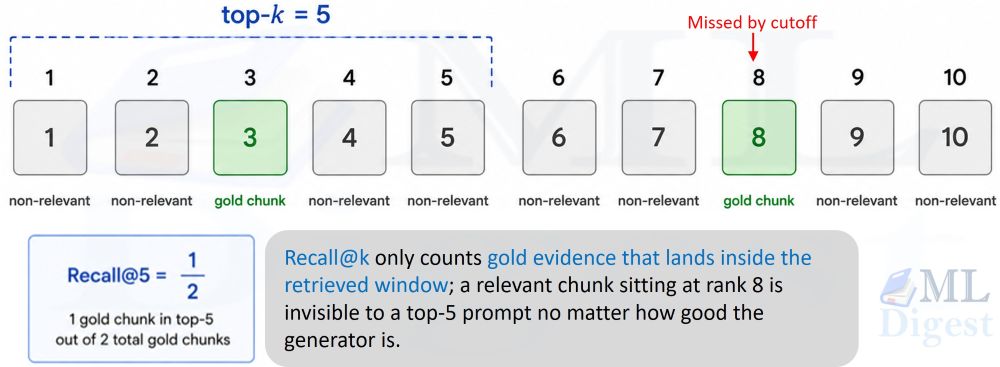
This is the first stage where you can use formal metrics to isolate the problem. Label gold evidence at the same granularity as the result list: compare gold document IDs with retrieved document IDs, or gold chunk IDs with retrieved chunk IDs, but do not mix the two.
Let $G$ be the set of gold supporting chunks or document IDs for a query, and let $R_k$ be the top-$k$ retrieved results.
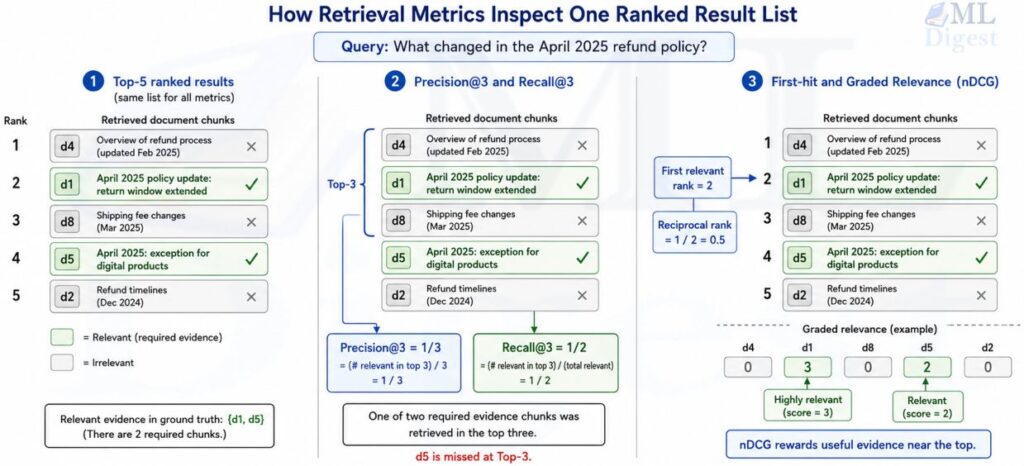
The most useful first metric is retrieval recall at $k$:
$$
\mathrm{Recall@}k = \frac{|G \cap R_k|}{|G|}
$$
If $\mathrm{Recall@}k = 0$, the answer generation stage is not your first problem. The system never surfaced the evidence.
For ranking-sensitive debugging, Mean Reciprocal Rank (MRR) is also useful:
$$
\mathrm{MRR} = \frac{1}{|Q|} \sum_{i=1}^{|Q|} \frac{1}{\mathrm{rank}_i}
$$
where $\mathrm{rank}_i$ is the rank position of the first relevant retrieved item for query $i$. For a query with no relevant retrieved item in the evaluated list, define its reciprocal-rank contribution as $0$.
When your gold set assigns graded relevance rather than binary labels, Normalized Discounted Cumulative Gain (NDCG) provides finer signal:
$$
\mathrm{nDCG@}k = \frac{\mathrm{DCG@}k}{\mathrm{IDCG@}k}, \quad \mathrm{DCG@}k = \sum_{i=1}^{k} \frac{2^{r_i} – 1}{\log_2(i+1)}
$$
where $r_i$ is the relevance grade at rank position $i$ and IDCG is the score of the ideal ordering. When all gold documents are equally relevant, $\mathrm{Recall@}k$ and MRR are usually sufficient; reserve nDCG for cases where some chunks are significantly more directly answerable than others.
In practice, ask three direct questions:
- Is the right document in top-$50$?
- Is the answerable chunk in top-$10$?
- Is the best chunk high enough to survive the evidence budget?
If the answer is no at top-$50$, the issue is often indexing quality, chunking, embedding choice, or missing sparse retrieval. In dense systems, also inspect the embedding and nearest-neighbor search configuration; the companion guide to k-nearest-neighbor search provides useful background for that layer.
If the answer is yes at top-$50$ but no at top-$5$, the issue is often ranking quality, hybrid fusion, or reranking.
4.4 Reranking and evidence selection debugging
Many teams improve retrieval candidate quality and still fail because the evidence selector sends the wrong chunks to the model.
Inspect these fields for each trace:
- raw retriever rank
- reranker rank
- reranker score
- selected or dropped flag
- token length of each chunk
Common reranking failure patterns:
- Highly similar duplicate chunks crowd out complementary evidence.
- A long chunk with broad semantic overlap beats a short chunk with the exact answer sentence.
- Query-dependent terms like dates, product families/SKUs, or version numbers are underweighted.
- A late-interaction retriever such as ColBERT would help, but the current stack relies only on a coarse bi-encoder and a weak final selection rule.
Maximal Marginal Relevance (MMR) can help diversify evidence, but only if the underlying candidate set already contains the right chunk.
4.5 Prompt assembly and truncation debugging
This is the stage many teams forget to inspect. They see relevant chunks in logs and assume the model saw them. Sometimes it did not.
You should log the exact final prompt, or at minimum:
- chunk order after packing
- token count per chunk
- total prompt tokens
- truncated chunk IDs or truncated suffix lengths
If your best chunk is present but the final sentence containing the answer was clipped off, that is a prompt-packing bug.
A second, less obvious failure is an overly permissive system prompt. A template that does not explicitly prioritize the retrieved context can make unsupported answers more likely. An explicit evidence-only instruction and abstention rule can reduce this risk, but neither guarantees that a generative model will follow them. A citation requirement helps auditing only when citations are validated against the evidence.
However, one cannot guarantee that a generative model will not use parametric knowledge. This masks retrieval failures: the model compensates with general knowledge and may score acceptably on familiar topics, but the answer cannot be traced back to any retrieved source.
Treat the template as a versioned artifact; prompt development, externalization, and management makes it possible to compare a prompt change against the same replay set. This is where context budgeting matters more than adding more retrieval. Treat prompt templates as measurable artifacts: prompt quality evaluation can help distinguish a prompt-contract regression from a retrieval regression.
4.6 Generation and grounding debugging
If the evidence is in the prompt and the answer is still wrong, now you are finally debugging generation.
At this stage, inspect:
- whether the answer quotes or paraphrases supported claims correctly
- whether the answer adds unsupported claims not present in evidence, a form of hallucination
- whether the system prompt explicitly instructs the model to abstain when evidence is insufficient
- whether the model is mixing retrieved evidence with stale parametric knowledge
One useful diagnostic is a simple support rate:
$$
\mathrm{SupportRate} = \frac{\text{# supported claims}}{\text{# total factual claims}}
$$
This metric is not perfect: its value depends on a consistent definition of an atomic factual claim and a reliable support assessment. It nevertheless forces the right question: how much of the answer is actually grounded?
If your model often answers beyond the evidence, strengthen the prompt contract and post-answer validation. Articles such as guardrails for LLMs and the section on prompt injection are relevant here because grounding is not only a quality issue, it is also a safety issue.
4.7 Post-processing and citation debugging
Sometimes the answer text is mostly correct, but the final user experience is still broken:
- citations point to the wrong source
- chunk IDs and source URLs are mismatched
- a formatter strips quotation marks or headings
- a safety filter removes the evidence-backed answer and leaves an empty fallback
Do not stop at “the model answered correctly in the notebook.” Production systems fail in the glue code too.
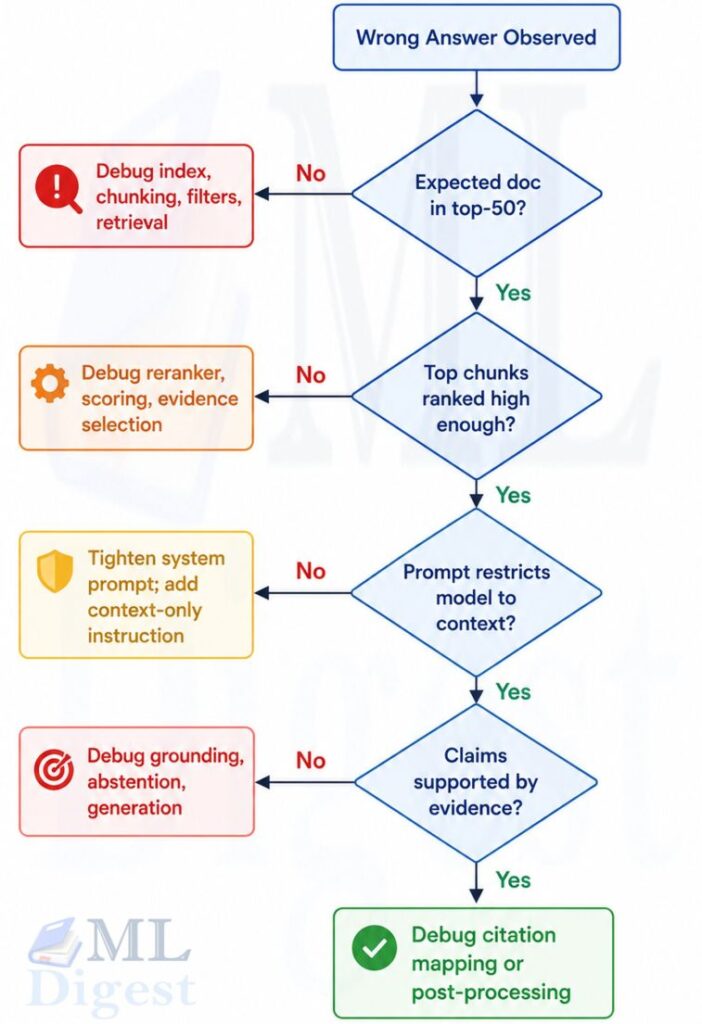
5. A Practical Decision Tree for Fast Triage
When a query fails, do not read everything first. Use this short triage sequence.
- Check whether the expected document appears in top-$50$ or top-N retrieval results.
- If not, debug indexing, filters, chunking, and retriever choice.
- If yes, check whether the most relevant chunks rank high enough to survive reranking and prompt packing. Low ranking quality after retrieval usually points to the reranker or scoring function, not the retriever itself.
- If not, debug evidence selection, chunk length, redundancy, and token budgeting.
- If yes, verify that the system prompt explicitly prioritizes retrieved context and defines an abstention behavior. This reduces unsupported supplementation from parametric memory, but does not eliminate it; validate grounding against the evidence.
- If prompting is tight, compare the final answer against the evidence and inspect unsupported claims.
- If the answer is grounded but the output is still wrong, inspect citation mapping and post-processing.
This disciplined ordering saves time because it prevents you from prompt-tuning a retrieval bug.
6. What to Instrument in Production
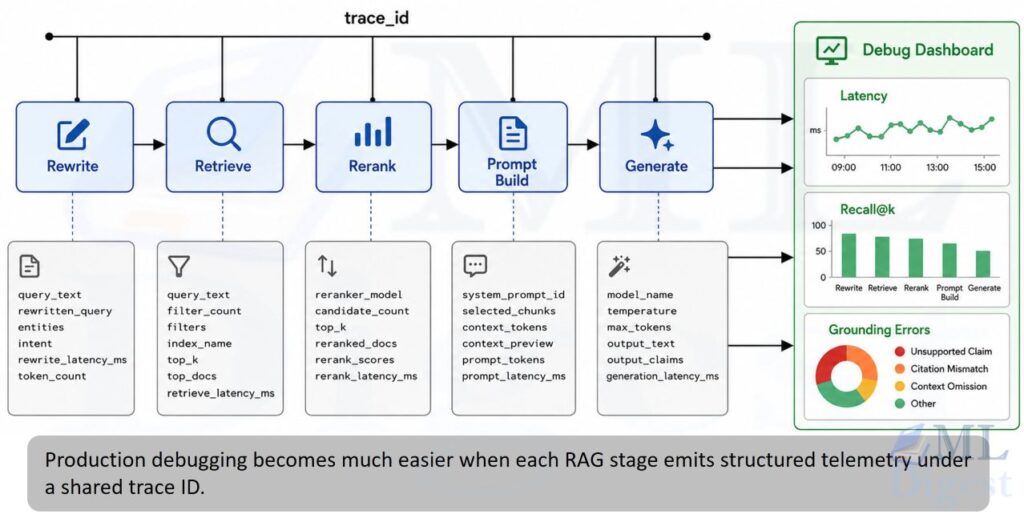
Good RAG debugging depends on traces, not screenshots.
At minimum, each query trace should capture:
- query ID and timestamp
- original user query
- rewritten or decomposed queries
- metadata filters applied
- candidate count before and after filtering
- top-$K$ retriever results with scores
- reranked results with scores
- selected prompt chunks in order
- final prompt token count
- model output
- citations emitted
- latency by stage
If you already use OpenTelemetry, treat each RAG stage as a span. That gives you stage-level timing and a replayable debugging trail. For experiment tracking across retrieval, reranking, and prompt changes, MLflow can complement these request-level traces with runs and evaluation artifacts.
One very practical habit is to attach a stable trace_id to every answer shown to users. When a stakeholder reports a bad answer, you should be able to replay the exact pipeline state instead of trying to reproduce it from memory.
7. Retrieval Metrics That Actually Help
Some teams only track final answer quality. That is too late and too noisy.
For RAG, you want at least two classes of metrics:
7.1 Stage metrics
Recall@kfor document and chunk retrievalMRRfor early-rank qualitynDCG@kwhen graded relevance scores are available- candidate count after filters
- prompt token utilization
- percentage of traces with truncation
7.2 End-to-end grounding metrics
- support rate for factual claims
- citation accuracy
- abstention correctness when evidence is insufficient
- answer faithfulness judged by human review or an evaluation harness
If you need a general refresher on measurement principles, evaluation metrics in machine learning is a useful companion article. For LLM-specific concerns, how to measure the performance of LLM is also relevant.
8. Common Root Causes and What Usually Fixes Them
8.1 The right fact is nowhere in top-$N$
Likely causes:
- poor chunking
- missing sparse retrieval
- weak embedding model for domain language
- stale or incomplete index
- overly aggressive filters
Useful fixes:
- add hybrid retrieval, commonly dense retrieval plus a sparse lexical method such as BM25
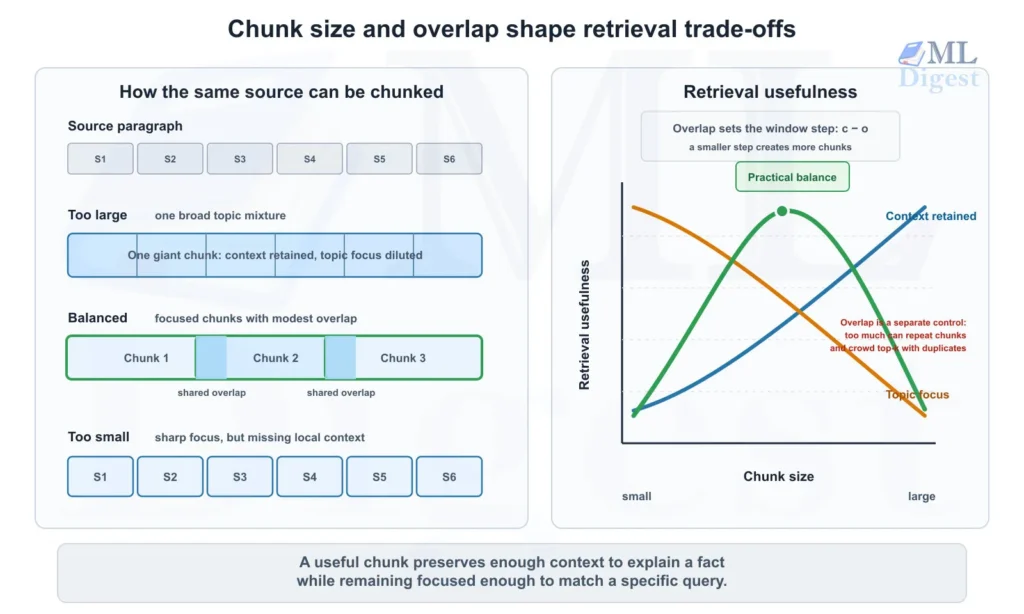
- revise chunk boundaries and overlap
- improve metadata quality
- backfill indexing failures and duplicates
8.2 The right document is retrieved, but the answerable chunk is not
Likely causes:
- chunk size too large or too small
- no passage-level reranking
- duplicate chunks crowding the evidence budget
Useful fixes:
- re-chunk into answerable units
- rerank top-$N$ candidates with a stronger selector
- diversify evidence before prompt packing
8.3 The right chunk is in the prompt, but the answer is still wrong
Likely causes:
- weak grounding instruction
- prompt asks for synthesis beyond available evidence
- answer generation mixes evidence with parametric memory
Useful fixes:
- strengthen the grounded-answer contract
- require evidence-backed citations so unsupported claims are easier to detect and audit
- add answer validation for unsupported claims
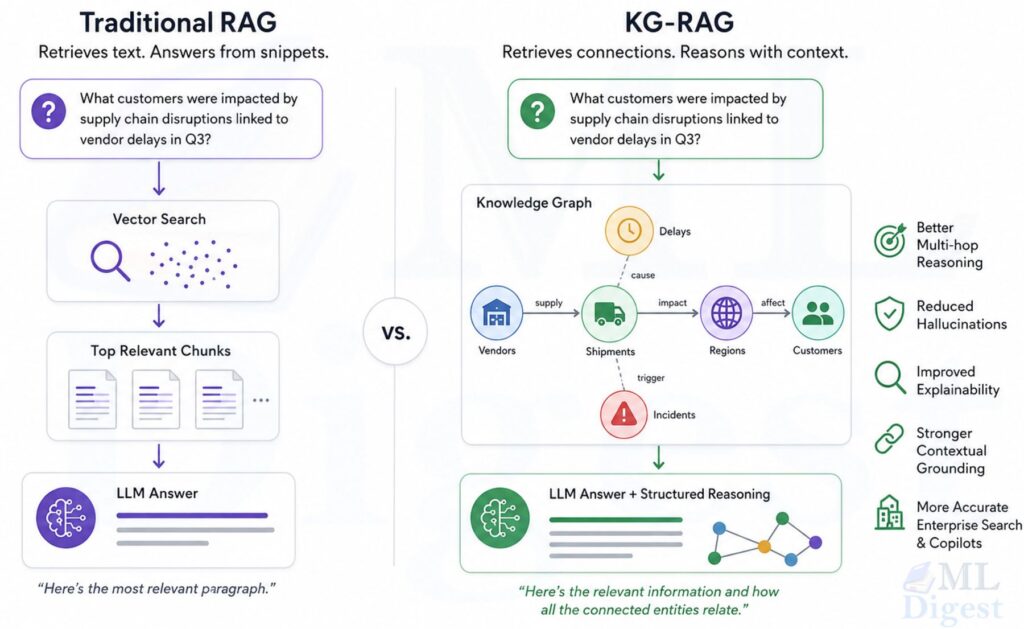
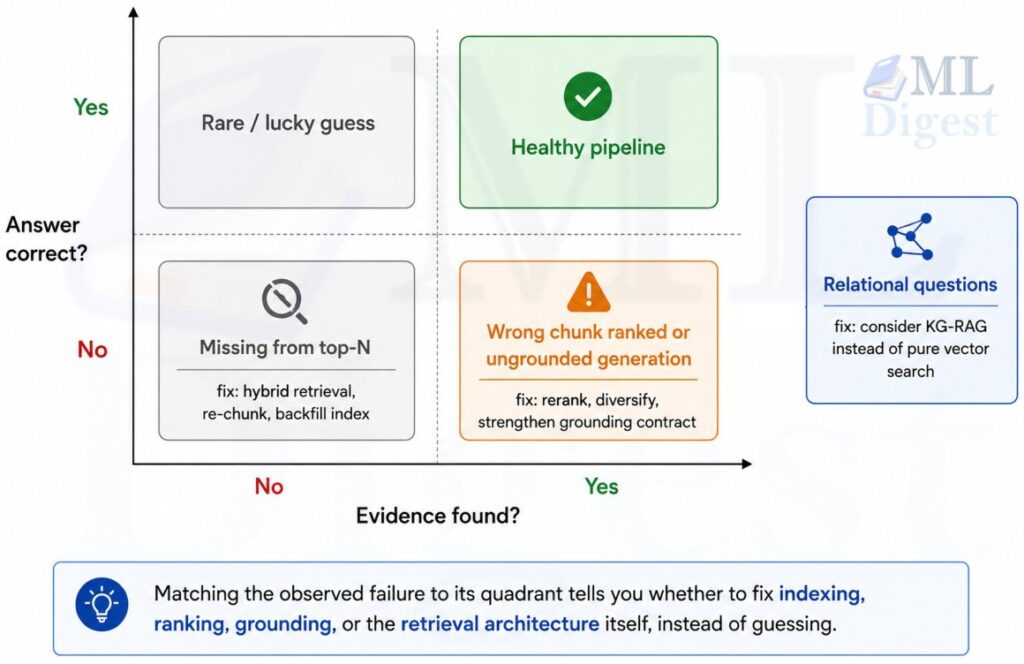
8.4 The system is doing too much work for relational questions
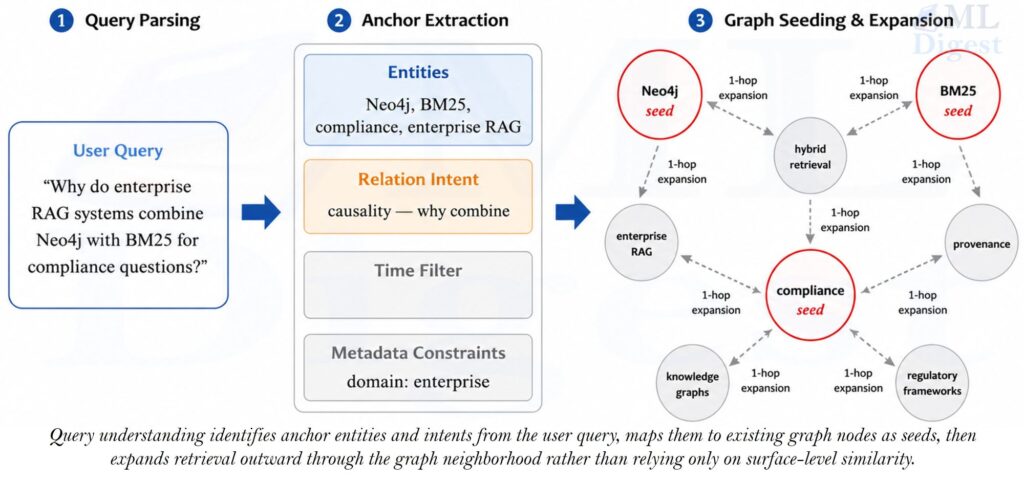
Sometimes the root issue is architectural. If the question depends on graph relationships, joins, or explicit entities and links, plain vector retrieval may be the wrong primitive. That is where knowledge-graph-based RAG or the companion piece on when to use KG-RAG becomes relevant.
9. How I Would Debug a Real Failure
Suppose a user asks, “What is the enterprise refund policy after March 2025?” and the system answers with the older 30-day policy.
I would not start by changing the prompt.
I would inspect the trace in this order:
- Verify the query rewrite did not remove
enterpriseorMarch 2025. - Check whether the date filter or product filter excluded the new policy document.
- Look at top-$N$ retrieval results to see whether the 2025 policy appears at all.
- If it appears but ranks below the 2024 document, inspect chunk text and retriever type.
- If the right chunk is retrieved, inspect prompt order and token packing.
- Only then inspect whether the model ignored the better evidence.
This ordering matters because the wrong old answer is often a retrieval or filtering defect disguised as a generation defect.
10. Best Practices That Prevent RAG Debugging Pain
- Keep a small gold query set with expected sources.
- Log original queries and rewritten queries separately.
- Measure retrieval quality before answer quality.
- Store prompt chunk IDs and final prompt token counts.
- Make filtering visible, especially for time, tenant, and ACL constraints.
- Use stable trace IDs that let you replay one answer end to end.
- Prefer small controlled changes, because changing chunking, embeddings, prompts, and rerankers simultaneously teaches you nothing; the same experiment discipline is useful when testing machine learning code.
- Re-evaluate architecture when the data is relational, heavily tabular, or workflow-driven. Plain vector search is not always the right retrieval primitive.
Summary
Practical RAG debugging is mostly about localization. You are not asking, “Why is the model bad?” You are asking, “Which pipeline stage removed, distorted, or failed to use the evidence?”
If you take one habit from this article, make it this: first check whether the expected evidence appears high enough in retrieval to reach the prompt. That single check separates a large class of retrieval bugs from a large class of generation bugs.
If you want to go deeper, the next useful step is to build a small replay set, instrument traces per stage, and measure Recall@k before you touch prompts. That discipline will save you more time than any clever prompt tweak.

Happy is a seasoned ML professional with over 15 years of experience. His expertise spans various domains, including Computer Vision, Natural Language Processing (NLP), and Time Series analysis. He holds a PhD in Machine Learning from IIT Kharagpur and has furthered his research with postdoctoral experience at INRIA-Sophia Antipolis, France. Happy has a proven track record of delivering impactful ML solutions to clients. Check more about him here: https://sites.google.com/site/slhappyin/

Silpa brings 5 years of experience in working on diverse ML projects, specializing in designing end-to-end ML systems tailored for real-time applications. Her background in statistics (Bachelor of Technology) provides a strong foundation for her work in the field. Silpa is also the driving force behind the development of the content you find on this site.
Subscribe to our newsletter!