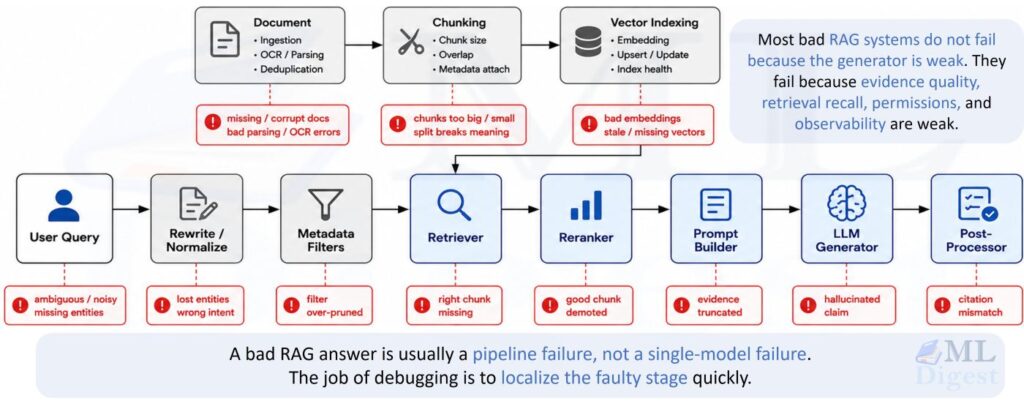
Retrieval-augmented generation (RAG) promises answers grounded in an external knowledge base. In practice, an answer can be wrong because the system retrieved the wrong documents, ranked useful evidence too low, discarded it while assembling context, misread it during generation, attached an irrelevant citation, or answered when it should have refused. These failures can produce the same disappointing final response, but they require very different fixes.
That is why final-answer accuracy alone is not enough. Effective RAG evaluation examines the full pipeline: whether the right evidence was found, whether it reached the model, whether each claim is supported, and whether the result is useful for the user.
This article presents a practical framework for evaluating RAG systems and using the results for debugging RAG workflows. It covers retrieval and ranking metrics, grounding and citation checks, end-to-end answer quality, evaluation-dataset design, implementation, and production monitoring.
For broader LLM evaluation topics, including perplexity, BLEU, ROUGE, human evaluation, safety, and latency, see Measuring LLM Performance.
1. Why RAG Evaluation Is Different
At a high level, RAG combines search with generation. The retriever tries to find useful evidence from an external corpus, and the generator turns that evidence into an answer. This means you are evaluating a compound system, not just a model.
The original RAG paper writes the answer distribution as a retrieval-weighted generation process:
$$
p(a \mid q, \mathcal{D}) \approx \sum_{d \in \operatorname{TopK}(q)} p_\eta(d \mid q, \mathcal{D}) \; p_\theta(a \mid q, d)
$$
Here, $q$ is the query, $\mathcal{D}$ is the document collection, $p_\eta$ is the retrieval model, and $p_\theta$ is the generator.
In practice, this can be rewritten in a simpler way. Let:
- $R$ mean the system retrieved enough evidence.
- $F$ mean the final answer is faithful to that evidence.
- $U$ mean the answer is useful, complete, and follows the task instructions.
Then the probability of a successful answer can be thought of as:
$$
P(S \mid q) \approx P(R \mid q) \cdot P(F \mid R, q) \cdot P(U \mid F, R, q)
$$
This is not a strict probabilistic factorization, but it is an excellent debugging frame. If $P(R \mid q)$ is weak, improving the prompt will not save you. If retrieval is strong but $P(F \mid R, q)$ is weak, the generator is drifting beyond the evidence. If both are strong but usefulness is still poor, the problem is often answer formatting, compression, or refusal policy.
Two concrete scenarios illustrate why this separation matters in practice.
Scenario 1: retriever fails, model answers from memory. Suppose a user asks “When was PostgreSQL 17 released?” and the retriever surfaces chunks about PostgreSQL 14 and 15 but nothing about version 17. The generator still answers “PostgreSQL 17 was released in September 2024” because the fact was encoded in its pretraining data.
- A traditional end-to-end evaluation would score this highly.
- A RAG evaluation would immediately flag low $P(R \mid q)$ and zero faithfulness: the answer is not grounded in any retrieved evidence, so the system cannot be trusted once the base model’s knowledge becomes stale.
Scenario 2: retriever succeeds, generator drifts. Now suppose the retriever returns the correct chunk: “PostgreSQL 17 was released on September 26, 2024.” The generator answers “PostgreSQL 17 was released in October 2024.” Retrieval succeeded; generation failed. Without a separate grounding check you would misattribute the error to the retriever and spend effort tuning the wrong component.
2. What Exactly Should You Evaluate?
Before choosing metrics, define what object you are evaluating. In production, you are evaluating at least five moving parts:
- The corpus, including freshness, duplication, and metadata quality.
- The retriever, which may use sparse search such as BM25, dense embeddings, TF-IDF, or hybrid search.
- The ranking and filtering layer, such as a cross-encoder reranker or metadata filters.
- The prompt assembly logic, which decides how much of each chunk reaches the LLM. Prompt design and prompt quality evaluation can therefore affect measured RAG performance even when retrieval is unchanged.
- The generator and answer policy, including citations, refusal behavior, and output formatting.
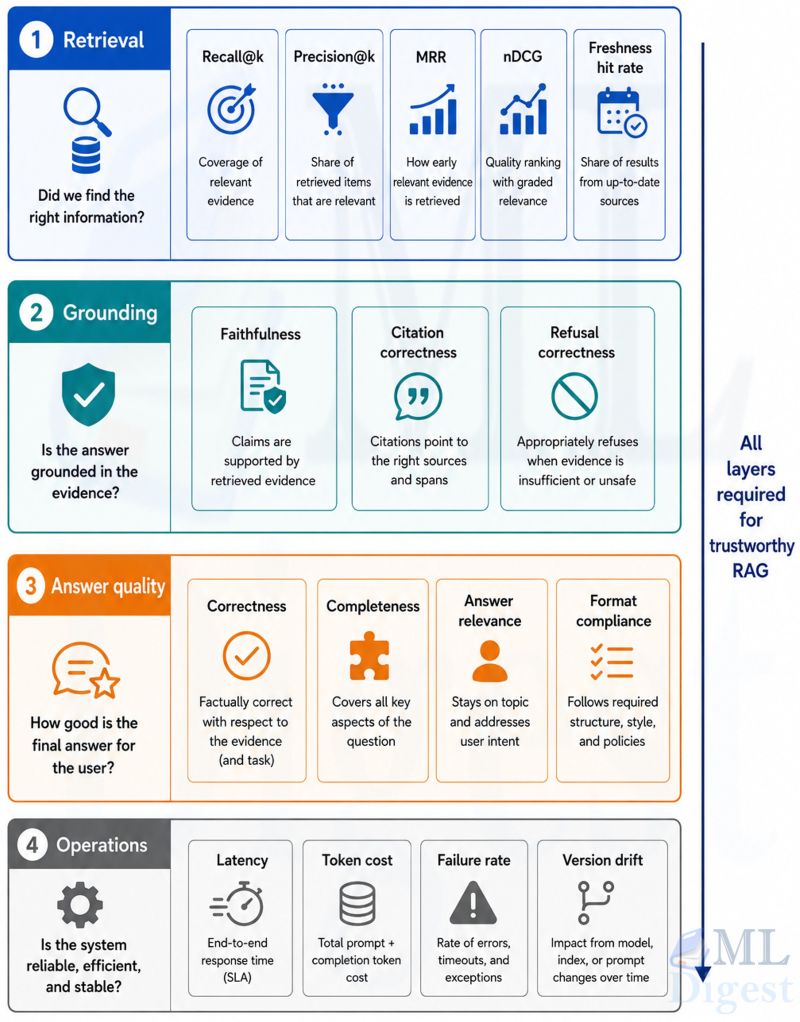
That is why a good RAG evaluation plan usually answers five separate questions:
- Did the system retrieve the right source material?
- Did it place the right material high enough in the ranking?
- Did the final prompt preserve the important evidence?
- Did the answer stay grounded in the evidence?
- Did the system answer or refuse appropriately for the use case?
If your workload is temporal, add one more question: was the retrieved evidence valid at the time the question should be answered? This matters for financial, legal, operational, and policy systems, and it is closely related to point-in-time correctness.
The table below summarizes how RAG evaluation extends traditional LLM evaluation rather than replacing it.
| Evaluation dimension | Standard LLM evaluation | RAG evaluation |
|---|---|---|
| Reasoning quality | ✓ | ✓ |
| Helpfulness and instruction following | ✓ | ✓ |
| Fluency and format compliance | ✓ | ✓ |
| Hallucination | ✓ | ✓ (conditioned on retrieved context) |
| Retrieval quality | — | ✓ |
| Document ranking | — | ✓ |
| Chunk and embedding quality | — | ✓ |
| Grounding and faithfulness | Rarely | ✓ |
| Citation correctness | Rarely | ✓ |
| Diagnosing pipeline stage failures | Limited | ✓ |
Now that you have a clear evaluation plan, the next step is to choose metrics that answer each question. First, we will look at retrieval metrics, which are usually the most actionable for debugging. Then we will look at grounding and answer metrics, which are often more expensive to compute but more directly tied to user trust. We will also cover the holistic RAG metrics that combine retrieval and grounding into a single score.
3. Retrieval Metrics
Retrieval metrics tell you whether the search side of the system is doing its job. They are usually the fastest way to debug chunking, indexing, embedding choice, hybrid retrieval, and reranking. For broader background on choosing and interpreting evaluation measures, see evaluation metrics in machine learning.
3.1 Precision@k and Recall@k
Suppose a query has a gold set of relevant chunks $G$, and the retriever returns the top-$k$ results $D_k$. Then:
$$
\mathrm{Precision@}k = \frac{|D_k \cap G|}{k}
$$
$$
\mathrm{Recall@}k = \frac{|D_k \cap G|}{|G|}
$$
These two metrics answer different questions.
- Precision@k asks, “How much of what I retrieved is actually useful?”
- Recall@k asks, “Did I retrieve enough of the evidence I needed?”
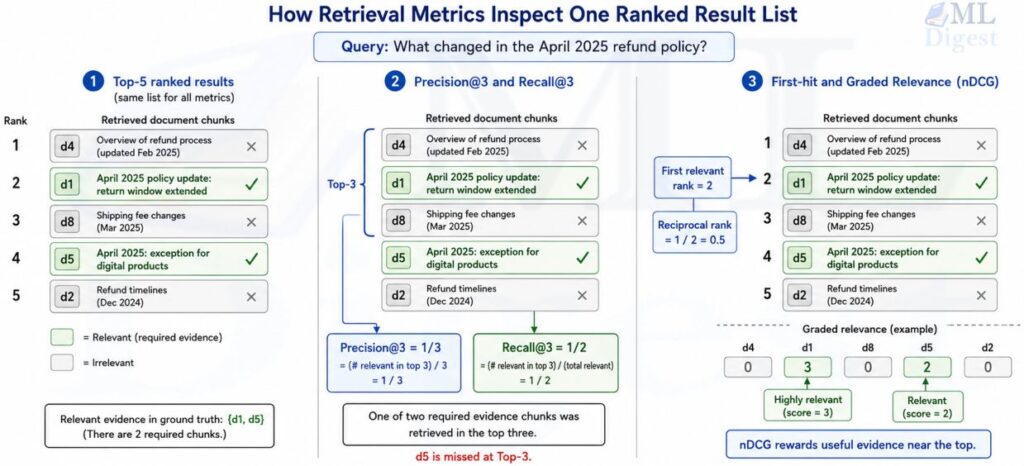
For many RAG systems, recall is the first bottleneck. If the evidence never enters the candidate set, the generator has no chance to answer correctly. But precision matters too, because low precision wastes prompt budget and increases the chance that the model anchors on irrelevant text.
3.2 Mean Reciprocal Rank
When there is a single most important supporting chunk, Mean Reciprocal Rank is often more revealing than raw recall:
$$
\mathrm{MRR} = \frac{1}{N} \sum_{i=1}^{N} \frac{1}{r_i}
$$
Here, $r_i$ is the rank position of the first relevant result for query $i$. MRR rewards systems that place the first good chunk near the top. In practice, a retriever with the same Recall@10 as another model can still feel much better if its first relevant chunk appears at rank 1 instead of rank 8.
3.3 nDCG for Graded Relevance
Some retrieval tasks are not binary. One chunk may be a perfect answer source, another may be only partially helpful, and a third may provide background but not the decisive fact. In that setting, normalized discounted cumulative gain is useful:
$$
\mathrm{DCG@}k = \sum_{i=1}^{k} \frac{2^{\mathrm{rel}_i} – 1}{\log_2(i+1)}
$$
$$
\mathrm{nDCG@}k = \frac{\mathrm{DCG@}k}{\mathrm{IDCG@}k}
$$
where $\mathrm{rel}_i$ is the graded relevance of the item at rank $i$, and $\mathrm{IDCG@}k$ is the ideal DCG for that query.
nDCG is especially helpful when you care about ranking quality beyond the first hit. That is common in long-form question answering, multi-document summarization, and knowledge-graph-based RAG, where multiple partially relevant pieces must be combined.
3.4 Retrieval Diagnostics Beyond Ranking
Classic ranking metrics are necessary, but they are not sufficient. Strong RAG teams also track diagnostics that expose failure patterns more directly:
- Chunk hit rate: how often the gold document is retrieved, even if the exact gold chunk is missed.
- Evidence coverage: how much of the required supporting information is present across the retrieved set.
- Source diversity: whether the top results collapse onto near-duplicate chunks from one source.
- Freshness hit rate: whether time-sensitive queries retrieve current rather than stale documents.
- Filter accuracy: whether metadata constraints, such as tenant, region, product, or date range, are applied correctly.
These are the metrics that tell you whether chunking is too fine, too coarse, too redundant, or too stale.
4. Generation and Grounding Metrics
Once retrieval is good enough, the next question is whether the model used the evidence correctly. This is where many teams discover that “good retrieval” and “good RAG” are not the same thing.
4.1 Answer Correctness
The first metric is still answer correctness. If you have a clean reference answer, you can use exact match, token-level F1, or a semantic similarity metric. Those general methods are already covered in Measuring LLM Performance, so I will not repeat them in detail here.
The important RAG-specific point is this: answer correctness alone is not enough. A RAG system can produce a correct answer for the wrong reason, perhaps because the base model already knew the fact from pretraining. If you only score correctness, you can overestimate the value of retrieval.
4.2 Faithfulness and Groundedness
For RAG, a stronger question is whether each claim in the answer is supported by retrieved evidence. This is usually called faithfulness or groundedness.
If an answer $a$ contains $m$ atomic claims $c_1, \dots, c_m$, a simple claim-support view is:
$$
\operatorname{Faithfulness}(a, E) = \frac{1}{m} \sum_{i=1}^{m} \mathbf{1}[\mathrm{supported}(c_i, E)]
$$
where $E$ is the retrieved evidence set.
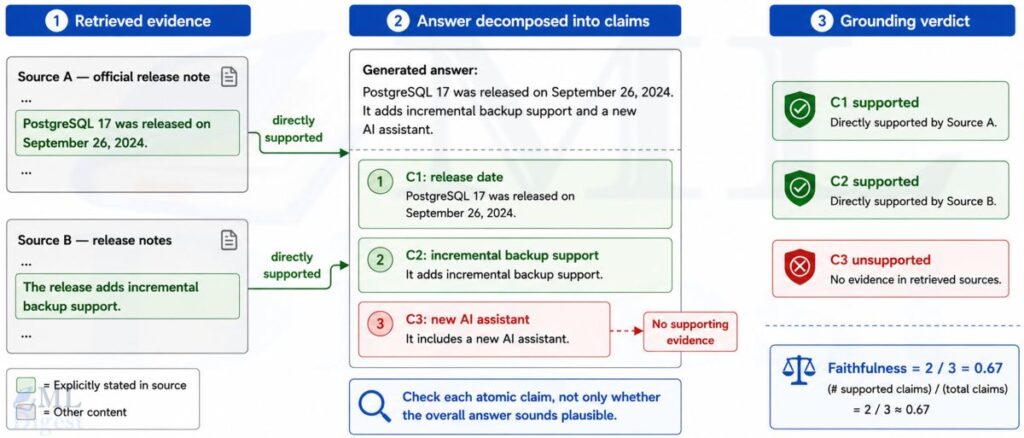
This metric is more diagnostic than answer correctness because it tells you whether the model is inventing facts, merging incompatible passages, or adding unsupported details. In practical terms:
- A correct but unfaithful answer is dangerous because it hides reliance on model memory instead of current evidence.
- A faithful but incomplete answer usually points to retrieval coverage or prompt compression problems.
- A fluent but unfaithful answer is the classic RAG hallucination.
4.3 Citation Accuracy
If your system emits citations, do not stop at “citation present”. Measure whether the cited span actually supports the claim.
You can evaluate citation quality at three levels:
- Citation presence: did the answer attach any citation?
- Citation correctness: does the cited passage support the local claim?
- Citation sufficiency: does the cited evidence fully justify the claim, not just loosely relate to it?
A simple metric is the fraction of claims that are both faithful and correctly cited. A more detailed metric is the fraction of claims that are faithful, correctly cited, and sufficiently supported.
This matters a lot in domains where traceability is part of the product value, such as enterprise search, customer support, legal QA, or regulated analytics.
4.4 Refusal Correctness
A strong RAG system should answer when the corpus contains sufficient evidence and refuse when it does not. That means you need unanswerable queries in your evaluation set.
Typical failure modes are:
- The system answers confidently even though retrieval found no supporting evidence.
- The system refuses too often even though the evidence is present.
- The system cites tangential text to justify a weak answer.
This is where calibration matters. If the system exposes confidence or support scores, evaluate whether higher confidence actually correlates with higher correctness. For a deeper treatment of calibration concepts, see model calibration.
5. RAG-Specific Holistic Metrics
Several evaluation frameworks package the previous ideas into RAG-specific metrics. One widely used example is Ragas, which focuses directly on common RAG failure modes.
The four metrics you will see most often are:
- Faithfulness: is the answer supported by retrieved context?
- Answer relevance: does the answer actually address the question?
- Context precision: how much of the retrieved context was relevant?
- Context recall: did the retrieved context contain the information needed to answer correctly?
This quartet is helpful because it separates retrieval failure from grounding failure. For example:
- High answer relevance but low context precision usually means the system answered the question, but wasted retrieval budget on noisy chunks.
- High context recall but low faithfulness means the right evidence was present, but the model still drifted.
- High faithfulness but low answer relevance often means the system stayed grounded but addressed the wrong sub-question.
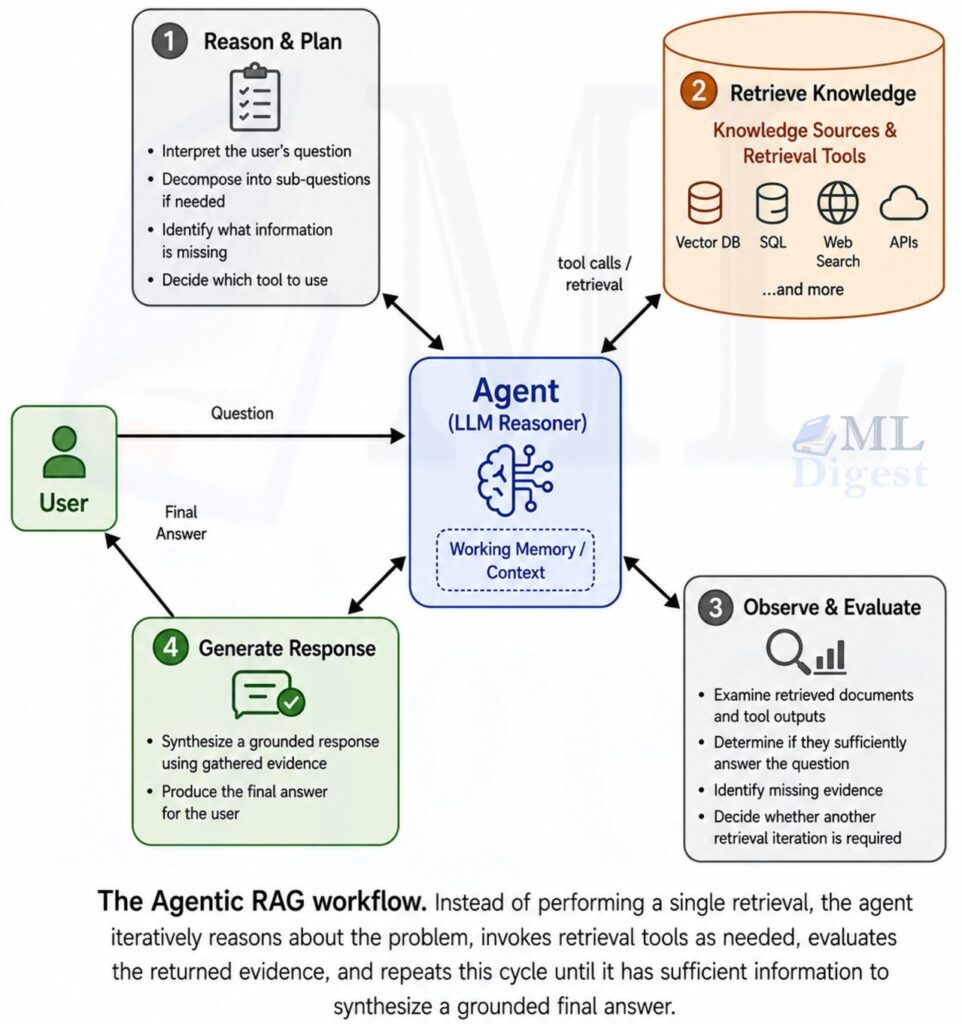
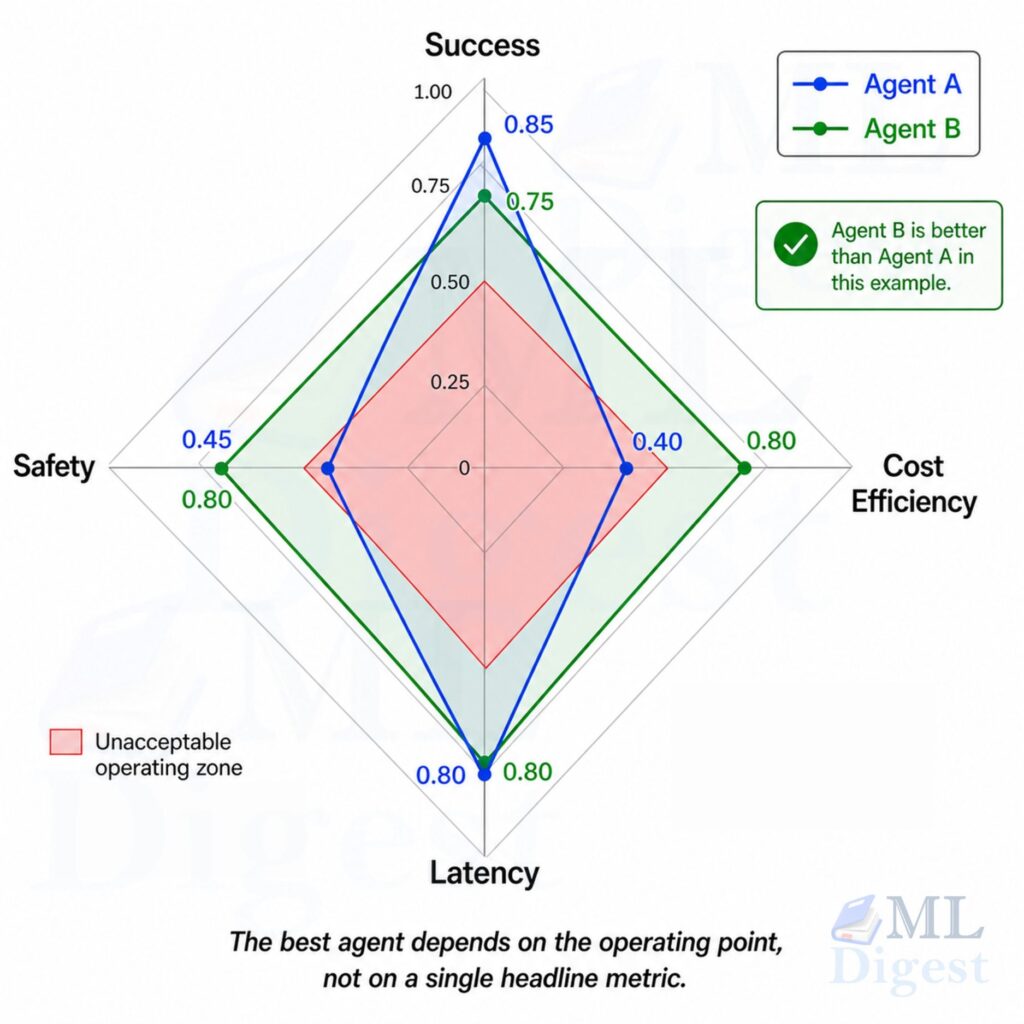
Other tools such as TruLens, LangSmith, and DeepEval can instrument similar evaluations, often with trace inspection and production monitoring. If your pipeline becomes more agentic, for example with query rewriting, tool loops, or multi-step retrieval, the evaluation surface starts to overlap with agentic system evaluation.
6. Build the Right Evaluation Dataset
Metrics are only as good as the data you evaluate on. The hardest part of RAG evaluation is usually not the formula, it is building a dataset that reflects the real workload.
6.1 Include Several Query Types
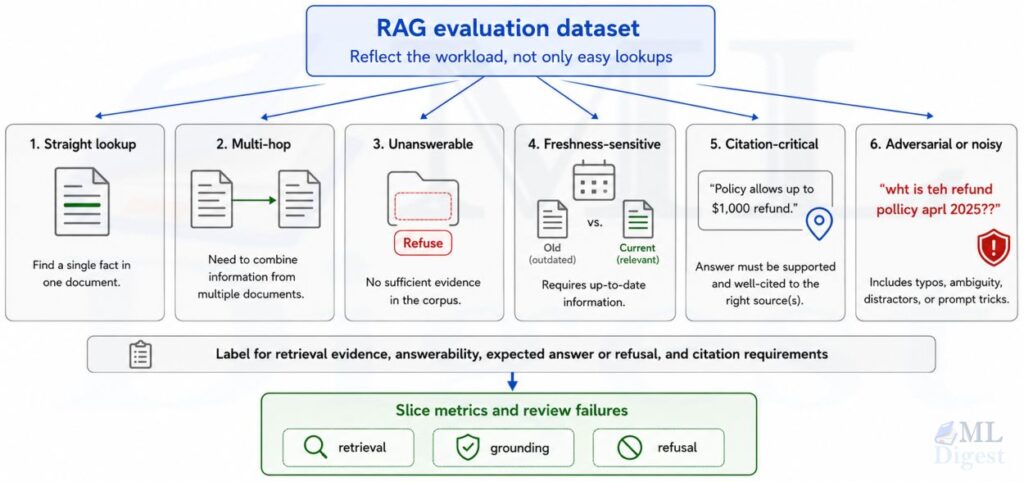
A good RAG evaluation set should contain at least these slices:
- Straight lookup questions, where one chunk contains the answer.
- Multi-hop questions, where evidence must be combined across documents.
- Unanswerable questions, where the system should refuse or ask for clarification.
- Freshness-sensitive questions, where date validity matters.
- Citation-critical questions, where provenance is part of the requirement.
- Adversarial or noisy questions, including typos, vague wording, or prompt injection attempts.
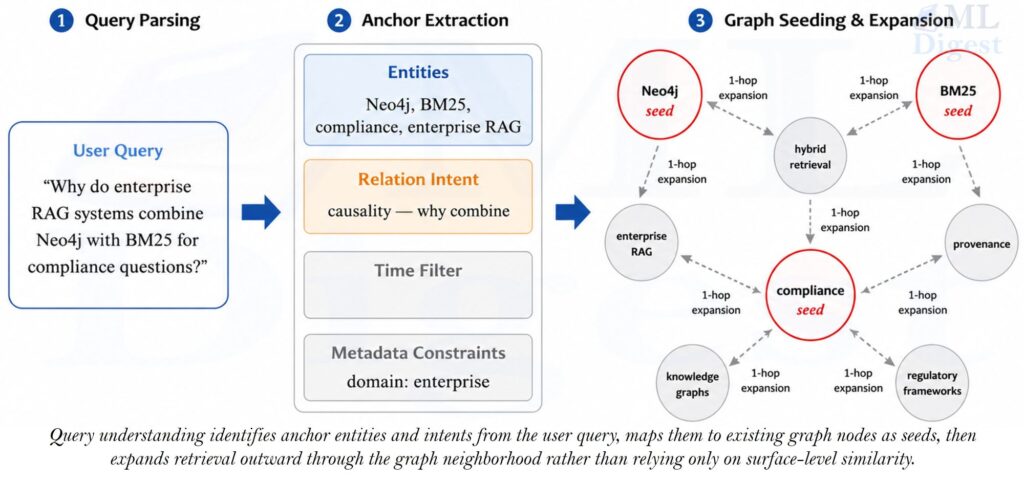
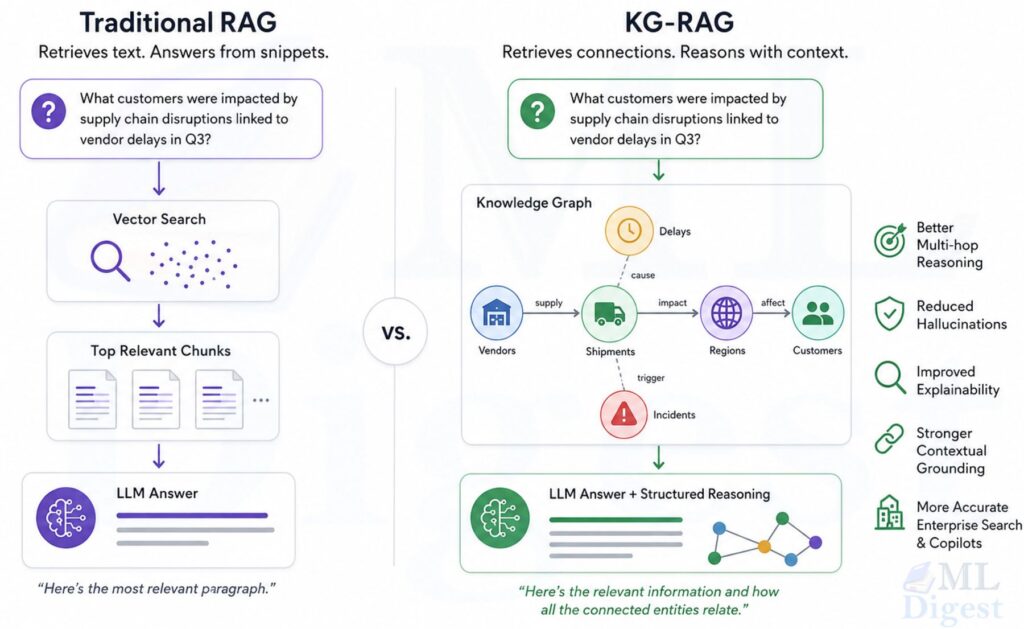
If the workload is relation-heavy, evaluate graph-aware or path-aware retrieval separately. That is the situation where when to use KG-RAG becomes a practical design question rather than an academic one.
6.2 Separate Representative and Stress Sets
One of the most common mistakes is reporting one average score over one dataset. That hides too much.
In practice, you usually want:
- A representative set sampled from real queries.
- A hard set made from previously observed failures.
- A safety set for hostile or policy-sensitive prompts. This complements runtime guardrails for LLMs: offline safety cases reveal whether protections still work after changes to retrieval or prompting.
- A regression set that stays fixed across releases. Treat it like a focused machine-learning test suite: every reviewed production failure that could recur should become a stable, labeled case.
That structure gives you both realism and comparability.
6.3 Use Public Benchmarks Carefully
Public benchmarks can help, but they are rarely enough by themselves.
- BEIR is useful for retrieval benchmarking across domains.
- HotpotQA is useful for multi-hop QA.
- MuSiQue is useful when you want compositional reasoning over multiple supporting paragraphs.
These are useful baselines, but product evaluation should still use your own corpus, your own chunking strategy, and your own answerability criteria.
7. Online Evaluation and Monitoring
Offline evaluation is necessary, but production RAG systems still drift. Corpora change, embeddings are replaced, chunkers are reconfigured, and retrieval traffic shifts over time. Distinguishing data drift from concept drift helps determine whether the evaluation set, the corpus, or the task definition needs attention.
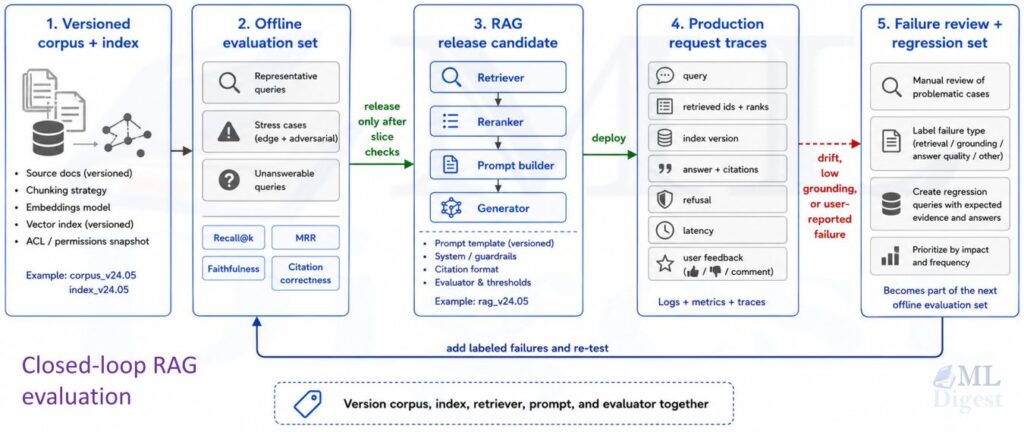
What should you log for each request? Structured traces, often emitted through OpenTelemetry, make these fields comparable across releases and services.
- The raw user query and any rewritten query.
- Retrieved chunk ids, document ids, ranks, and scores.
- Corpus version and index version.
- The exact prompt or a safely redacted prompt template plus retrieved evidence ids. Keeping these artifacts versioned follows the same prompt externalization and management discipline used for production prompt changes.
- Final answer, citations, refusal flag, and latency.
- User feedback, escalation, click-through, or downstream task completion when available.
With that trace, you can compute slice-based metrics such as:
- Retrieval recall by query type.
- Grounding score by corpus version.
- Refusal accuracy on low-evidence queries.
- Latency and token cost by retrieval depth.
This is where MLOps discipline matters. Evaluation results should be versioned the same way model prompts, indexes, and corpora are versioned.
8. Common Mistakes in RAG Evaluation
- Only Scoring the Final Answer: If you only measure end-to-end correctness, you cannot tell whether the fix belongs in retrieval, ranking, prompt assembly, or generation. Always keep at least one retrieval-level metric and one grounding metric.
- Letting the Base Model Hide Retrieval Weakness: Large models often answer correctly from pretraining memory even when retrieval failed. This is why groundedness and citation checks matter. Otherwise, the retriever can look stronger than it is.
- Using Easy Benchmarks Only: A benchmark dominated by single-hop lookup questions can make a weak RAG stack look fine. Real systems need hard negatives, stale documents, incomplete evidence, and multi-hop cases.
- Ignoring Corpus Quality: Sometimes the retriever is fine and the corpus is the real problem. Duplicate chunks, stale policies, conflicting versions, and broken metadata will all show up downstream as “LLM errors” unless you inspect the evidence layer carefully.
- Reporting One Global Average: Average score hides too much. Always report at least a few slices: short versus long queries, answerable versus unanswerable, recent versus historical facts, single-hop versus multi-hop, and high-risk versus low-risk tasks.
9. Practical Best Practices
If you want a compact checklist, these are the practices that usually give the biggest return:
- Start with a strong lexical baseline such as BM25 before claiming dense retrieval gains.
- Keep retrieval metrics and answer metrics separate so you can localize failures.
- Add unanswerable queries and measure refusal behavior explicitly.
- Evaluate citation correctness, not just citation presence.
- Slice results by query type, time sensitivity, and business risk.
- Version the corpus, index, retriever, prompt, and evaluator together.
- Calibrate LLM-as-a-judge scores with human review instead of trusting them blindly.
- Re-run a fixed regression set after every chunking, reranking, or prompt change.
Final Takeaway
Evaluating RAG is really about answering two questions in sequence: did the system retrieve the right evidence, and did it use that evidence correctly? If you collapse those into one final score, you lose the information you need to improve the system. If you separate retrieval quality, grounding quality, answer usefulness, refusal correctness, and operational cost, RAG evaluation becomes much more actionable.
If you are building your own evaluation stack, start simple: label a small set of queries, compute Recall@k and MRR, add a faithfulness check, and review the failures manually. Once that loop is working, you can add richer metrics, judge models, online monitoring, and workload-specific slices. That is when RAG stops being a demo with citations and starts becoming a system you can trust.

Happy is a seasoned ML professional with over 15 years of experience. His expertise spans various domains, including Computer Vision, Natural Language Processing (NLP), and Time Series analysis. He holds a PhD in Machine Learning from IIT Kharagpur and has furthered his research with postdoctoral experience at INRIA-Sophia Antipolis, France. Happy has a proven track record of delivering impactful ML solutions to clients. Check more about him here: https://sites.google.com/site/slhappyin/

Silpa brings 5 years of experience in working on diverse ML projects, specializing in designing end-to-end ML systems tailored for real-time applications. Her background in statistics (Bachelor of Technology) provides a strong foundation for her work in the field. Silpa is also the driving force behind the development of the content you find on this site.
Subscribe to our newsletter!