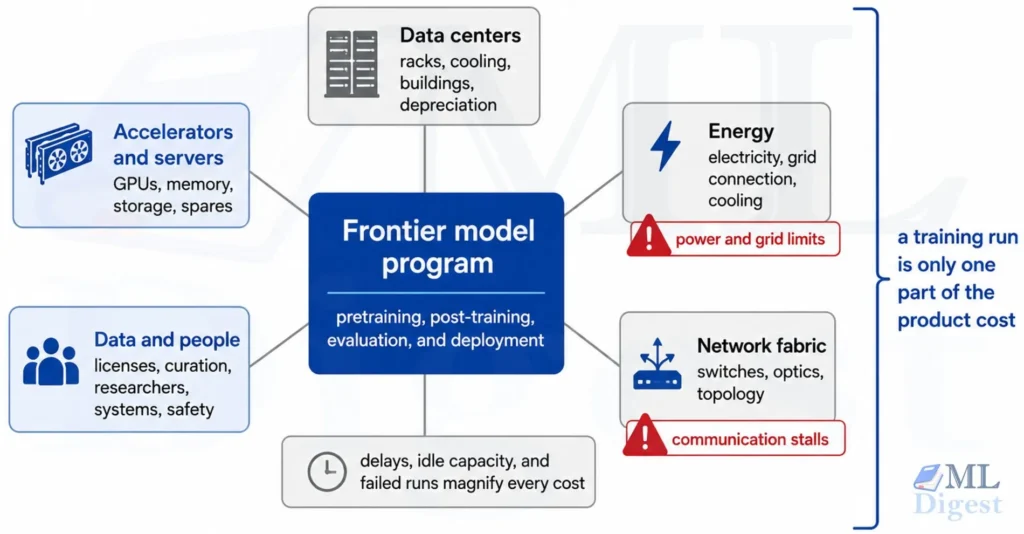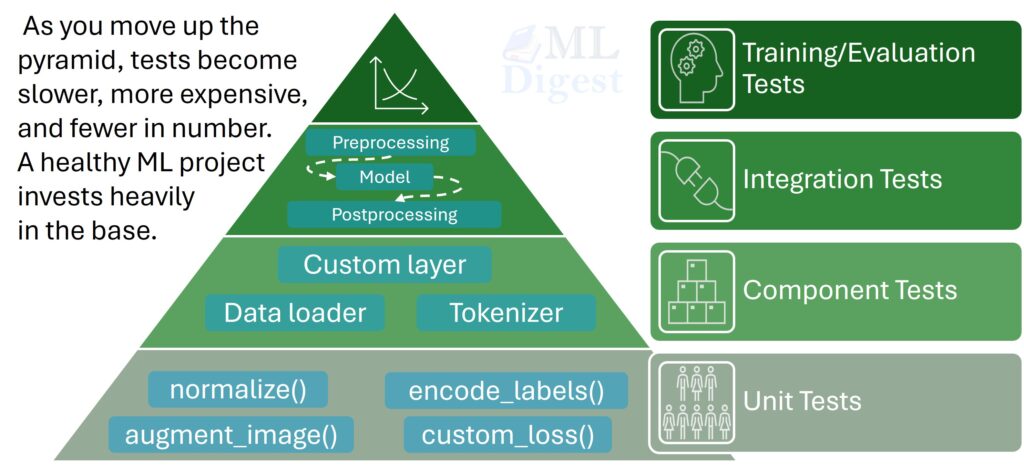
A model can be accurate in a demo and still fail in the product. It may respond too slowly for a safety action, stop working when connectivity drops, send sensitive data across a forbidden boundary, or become too expensive as usage grows. Deployment determines whether model capability becomes a reliable user experience.
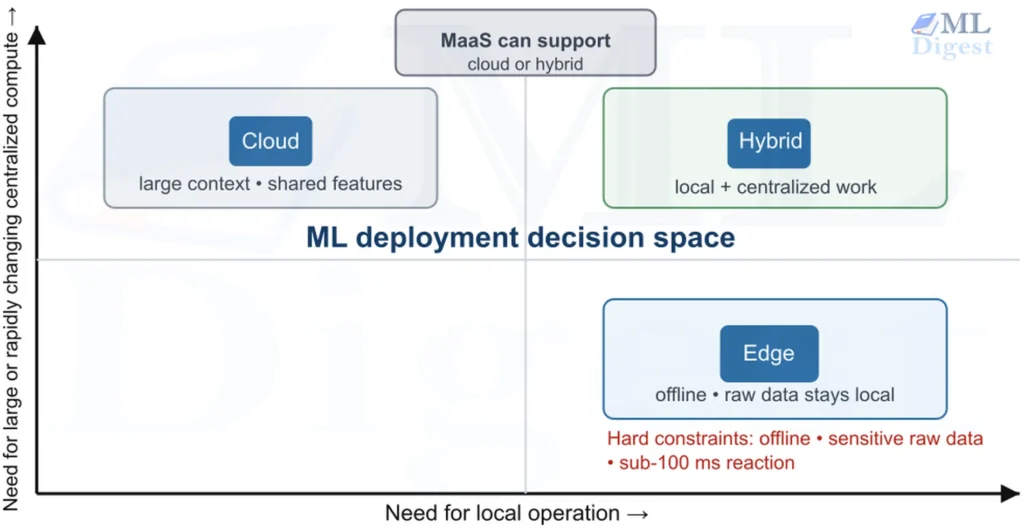
Three choices shape that outcome. Edge deployment runs a model close to the data source—on a phone, camera, browser, factory gateway, or vehicle. Cloud deployment runs it in remotely managed infrastructure. Model as a service (MaaS) consumes a provider-hosted model through an API, such as OpenAI, Anthropic, or Google Vertex AI. MaaS describes who operates the model, not where the computation physically happens; the endpoint commonly runs in a cloud region.
These are not mutually exclusive paths. A compact custom model can make routine decisions on-device while MaaS handles difficult cases. An open-weight model can run in a managed cloud endpoint today and move to a private service later. The real question is not, “Which option is best?” It is, “Which combination meets the product constraints with the lowest total risk and cost?”
This guide gives a practical way to answer that question. It compares cost, expertise, delivery time, security, governance, and operational burden; explains when the MaaS-to-in-house break-even point is meaningful; and lays out an evidence-based path for changing architectures only when the product justifies it.
1. Start With the Product Constraint, Not the Model
Teams often begin with a favorite model or vendor and then try to justify it. Start from the user journey instead. A good decision is usually obvious once the non-negotiable constraints are written down.
The five questions that remove most ambiguity: Answer these questions before selecting infrastructure:
- Latency: What end-to-end response time can a user or downstream system tolerate at p95 and p99?
- Connectivity: Must the feature continue working with weak or no network access?
- Data boundary: May raw inputs, embeddings, prompts, or outputs leave the device, site, tenant, or region?
- Capability: Does the task require a large general-purpose model, fresh centralized data, or specialized local reasoning?
- Economics and ownership: What will the feature cost at expected and peak volume, and which parts must your organization control?
For example, an automated camera safety stop has a hard local latency and availability requirement. A cloud-only request path is usually unacceptable, regardless of how capable the remote model is. A document assistant that needs to reason over long text may instead favor a hosted LLM at launch, because capability and time to market dominate. A fraud score that uses recent account activity, device reputation, and transaction history naturally favors cloud inference because the necessary features are centralized.
Before committing to an architecture, define the failure behavior. If a model is slow, unreachable, uncertain, or incorrect, should the product deny the action, use a rule, return a cached answer, defer to a human, or silently omit the feature? This is a product decision, not an afterthought.
2. Separate the Three Decisions That Are Commonly Mixed Up
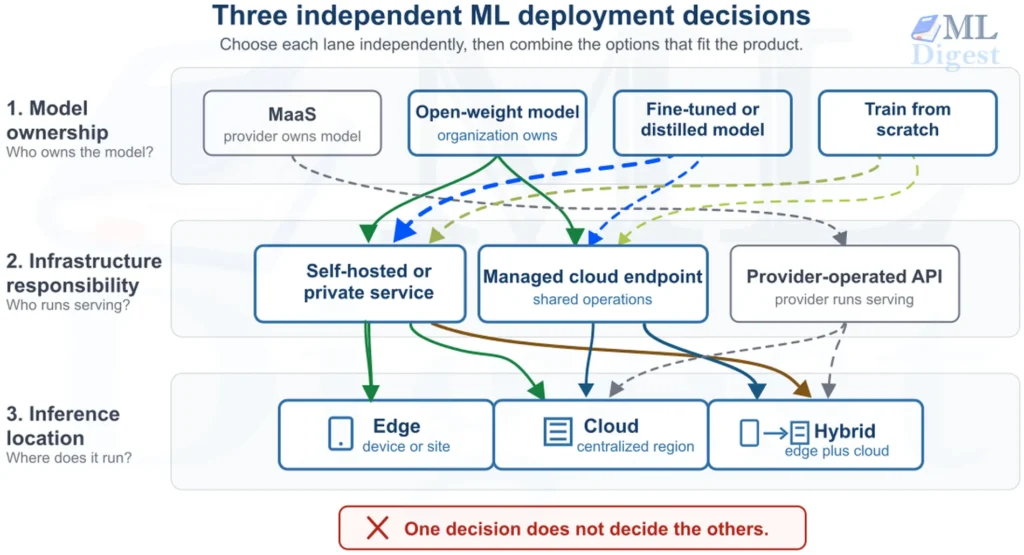
There are three independent architectural decisions. Deciding to customize a model does not decide where it runs or how much infrastructure the team must operate.
| Decision | Main question | Common options |
|---|---|---|
| Model ownership and operation | Who builds, hosts, updates, and carries the model risk? | Provider-hosted MaaS, self-hosted open-weight model, custom fine-tuned model, model trained from scratch |
| Infrastructure responsibility | If the model is yours, who operates the serving platform? | Managed cloud endpoint, self-hosted cloud service, private or on-premises service |
| Inference location | Where does computation happen? | Edge, cloud, hybrid |
This distinction prevents several bad comparisons. A custom computer-vision model can be deployed at the edge. An open-weight model can run on a managed cloud endpoint or be self-hosted in the cloud. A MaaS endpoint can be used behind a cloud API, and a hybrid product may use it only as an escalation path. The architecture has more than one dial.
2.1 The four realistic ownership levels
“In-house” covers several very different efforts. Treating them as the same creates unrealistic budgets and timelines.
| Level | What the team owns | Typical use |
|---|---|---|
| MaaS | Application logic, prompts, evaluation, routing, and data policy | Fast validation of a generative or general-purpose task |
| Open-weight model | Model selection, evaluation, safety controls, versioning, and a serving strategy | Predictable volume, data control, or a need for runtime control |
| Fine-tuned or distilled model | The chosen model, labeled data, training, evaluation, and retraining | A narrow repeated task where adaptation creates measurable value |
| Model trained from scratch | Architecture, pretraining corpus, compute cluster, alignment, evaluation, and the entire lifecycle | Rare cases with unusual data, scale, capital, and strategic need |
For most organizations, the practical alternative to MaaS is not training a frontier model from scratch. It is selecting a capable open-weight model, deploying it safely, then using fine-tuning or prompt and retrieval strategies only if evaluation shows a material gap. For many classical ML tasks, a compact custom model is inexpensive to train and can outperform a general endpoint because it is optimized for a specific target.
2.2 Four common deployment paths
The combinations below are common starting points, not a fixed maturity ladder. A team may move among them as traffic, regulation, and product requirements change.
| Model approach | Serving approach | What the team primarily owns | Typical reason to choose it |
|---|---|---|---|
| MaaS | Provider cloud API | Application behavior, evaluation, and integration | Validate a feature quickly with broad model capability |
| Custom or open-weight model | Managed cloud endpoint | Data, model artifact, evaluation, and product integration | Obtain cloud-scale serving without operating the full inference platform |
| Custom or open-weight model | Self-hosted cloud or private service | The full serving stack, capacity, and operational controls | Gain runtime control at sustained, predictable demand |
| Compact custom model | Edge device or local site | Artifact optimization, device integration, and fleet lifecycle | Meet local latency, offline, or data-locality requirements |
3. Edge Deployment: Put the Model Next to the Data
In edge deployment, prediction occurs on the device or local site. The input avoids the round trip to a remote service, which makes edge systems attractive for tight response budgets, intermittent connectivity, and privacy-sensitive inputs.
3.1 When edge is the strong default
Choose edge-first or edge-required deployment when one or more of the following are true:
- The feature must work offline or during network outages.
- A network round trip would violate the user-experience or safety latency budget.
- Data privacy: Raw data should remain on a phone, browser, medical device, camera, factory, or customer site.
- Sending every input to the cloud would create excessive bandwidth cost.
- The task can be completed by a model that fits the device’s memory, power, and thermal budgets.
Examples include wake-word detection, keyboard suggestions, camera autofocus, local image classification, document scanning, industrial anomaly detection, and first-pass video filtering. A device may still send high-confidence alerts, summaries, or only the difficult cases to the cloud later.
3.2 The edge latency and resource budget
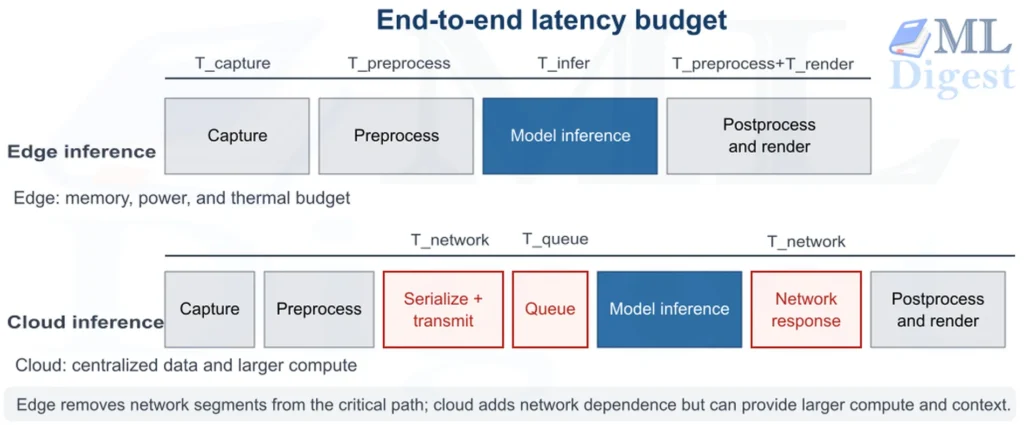
The model’s inference time alone is not the user-visible latency. The actual path is:
$$
T_{total}=T_{capture}+T_{preprocess}+T_{infer}+T_{postprocess}+T_{render}
$$
Network time is absent from this expression only when the complete decision is local. For a cloud-backed flow, add serialization, queueing, network transit, and server-side work:
$$
T_{cloud}=T_{capture}+T_{preprocess}+T_{network}+T_{queue}\\
+T_{infer}+T_{network}+T_{postprocess}+T_{render}
$$
A model that takes 20 ms to infer is not automatically a 20 ms feature. Camera decode, image resize, tokenization, memory copies, and rendering often dominate the end-to-end path. Measure p50, p95, and p99 on real hardware under sustained load, not only one warm benchmark on a developer laptop.
Peak memory is similarly broader than the model file:
$$
M_{peak}\approx M_{weights}+M_{activations}+M_{runtime}+M_{input/output\ buffers}
$$
The device also has a power budget. A useful first approximation is:
$$
E_{inference}\approx P_{average}\times T_{total}
$$
Continuous vision and audio applications must be tested after minutes or hours of operation, because heat can cause throttling and change both latency and battery impact.
3.3 What edge actually costs
Edge inference can reduce central GPU spending, but it does not make cost disappear. Include:
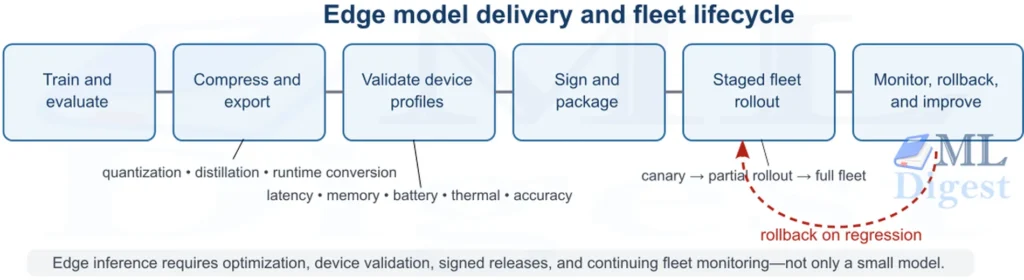
- Model engineering: Compression, quantization, distillation, device-specific export, and accuracy regression testing. Post-training quantization and knowledge distillation can make deployment feasible, but each can introduce quality trade-offs.
- Client engineering: Runtime integration, preprocessing parity, storage, secure model loading, fallbacks, and user-experience integration.
- Hardware variation: Test devices, OS versions, chipsets, accelerators, memory limits, and browser or mobile runtime differences.
- Release and support: Signed model packages, staged distribution, rollback, compatibility tracking, telemetry, and support for devices that cannot run a new model.
- Opportunity cost: A slower release cycle can cost more than infrastructure if it delays validation of the product.
At high request volume, the marginal inference cost is often low because customer hardware performs the work. However, device battery, CPU, memory, and network use are still product costs imposed on the customer. Treat them as part of feature quality rather than as a free resource.
3.4 Edge expertise and time requirements
A credible edge team needs mobile, browser, embedded, or systems expertise in addition to ML. It needs to understand model conversion, memory profiling, performance tracing, device security, offline data handling, safe updates, and hardware delegates.
For a model that already fits a supported runtime, a focused proof of concept may take two to six weeks. A robust consumer or industrial release often takes two to six months because the work is testing, optimization, release engineering, and failure handling. Building a new compact model, gathering representative data, and supporting a fragmented device fleet can extend this substantially.
The developer guide to ML deployment and the guide to deploying ONNX models provide useful background on export, serving, and runtime choices.
4. Cloud Deployment: Centralize Compute and Control
Cloud deployment hosts inference in a centrally operated environment. A client or backend sends a request to a model service, and the service returns a prediction. This can mean your own containerized service, a managed endpoint around your artifact, or a self-hosted open-weight model.
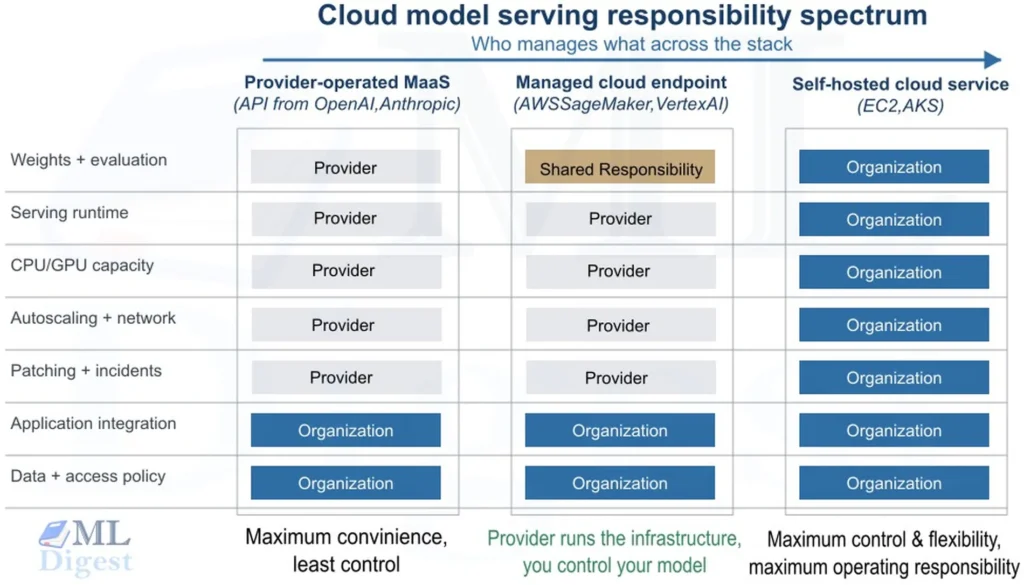
4.1 Managed cloud vs self-hosted cloud
Managed cloud serving is the middle path that is often missed in MaaS versus self-hosting discussions. A managed endpoint can package, deploy, scale, and monitor a model artifact while the cloud platform operates much of the underlying serving infrastructure. It is useful when a team needs to control the model, region, or runtime configuration but does not yet need to operate GPU nodes, container orchestration, and autoscaling policies directly.
Self-hosting provides the most control, but it also transfers more responsibility. The team must select and operate the inference server, provision capacity, manage model rollout, patch images and dependencies, observe performance, and handle incidents. GPU drivers, optimized runtimes such as NVIDIA TensorRT, and distributed serving become relevant only when the chosen model and scale require them. Do not add this complexity by default.
4.2 When cloud is the strong default
Cloud is usually the better deployment location when:
- Inference needs fresh centralized features, such as inventory, user history, graph relationships, fraud signals, or a shared vector index.
- The model needs more memory, GPUs, accelerators, or context length than target devices can offer.
- Models change frequently and need fast rollback, experimentation, or centralized governance.
- The workload is batch-oriented, asynchronous, or must process shared organizational data.
- Device coverage is broad and there is no realistic way to ensure the client runtime is capable.
Cloud is not synonymous with high latency. A well-designed regional service can be fast. But it can never offer the same disconnected availability as an entirely local decision, and it inherits dependency on a network path.
4.3 The cloud cost model
Cloud costs are easy to underestimate because the endpoint price is only one line item. Account for:
- Compute and capacity: CPU, GPU, accelerator, memory, autoscaling headroom, and idle capacity for latency-sensitive workloads.
- Managed serving or platform fees: Endpoint uptime, model registry, load balancing, logging, and private networking.
- Data movement: Internet egress, cross-region transfer, feature retrieval, object storage, and request payloads.
- Operations: Observability, incident response, security patches, on-call coverage, capacity planning, and disaster recovery.
- Model lifecycle and data: Data collection or licensing, labeling and curation, experiment tracking, retraining, registry, evaluation, rollouts, and rollback.
- Risk and compliance: Audits, regional controls, access logs, retention policy, and remediation of data leaks or incorrect decisions.
For GPU-backed services, average utilization matters as much as hourly price. Paying for an always-on accelerator that is idle much of the day can be more expensive than paying a higher per-request MaaS price. Conversely, a high and predictable load can make a self-hosted service economically attractive. This is why a capacity model should use peak, average, and burst behavior rather than a single monthly request number.
4.4 Cloud expertise and delivery time
Cloud deployment usually requires an ML engineer or data scientist for model quality, a backend engineer for the service interface, and platform or SRE support for security, observability, deployment, and incident response. Managed endpoints reduce the platform burden, while self-hosted services need deeper expertise in GPU capacity, container images, autoscaling, and production observability. Mature teams add data engineering, privacy, and security expertise.
For an existing, well-packaged small model, a managed cloud endpoint can be production-ready in two to eight weeks. A self-managed GPU service with a reliable feature pipeline, evaluation, monitoring, canary rollout, and compliance review often needs two to six months. These are planning ranges, not guarantees. A model whose data pipeline is unreliable can take longer than a complex endpoint because the surrounding system is the actual product.
Use MLOps practices from the beginning. Model versioning, evaluation, observability, and rollback are not luxuries that can be bolted on after launch. Monitor service health and model health. Inputs can shift even when latency and error rate look perfect, which is the distinction explained in data drift versus concept drift.
5. Model as a Service: Buy Capability, Not Just an API Call
MaaS provides model capability through an API or managed platform. The provider usually operates the model fleet, scaling, upgrades, and much of the infrastructure. Your team retains responsibility for product behavior, data use, prompt or input construction, evaluation, application security, user experience, and policy compliance.
For LLMs in particular, MaaS lets a small team test a high-capability product without procuring GPUs, assembling a model-serving stack, or training a foundation model. That is a powerful advantage, but it does not eliminate engineering work.
5.1 When MaaS is the rational choice
MaaS is often the best starting point when:
- You are still validating whether users value the feature.
- Demand is low, uncertain, or bursty.
- The task needs a broad model capability that would be expensive to reproduce.
- Your team lacks ML platform and inference-operations expertise.
- A provider model already meets the quality, latency, data-policy, and regional requirements.
- Rapid access to new capabilities is more valuable than complete control of the underlying weights.
For a new document assistant, coding helper, summarization tool, or support copilot, the fastest route is usually an API-backed prototype with careful evaluation and guardrails. The key word is careful. A working demo is not proof that an application is safe, reliable, or economically viable.
5.2 What MaaS costs beyond tokens or requests
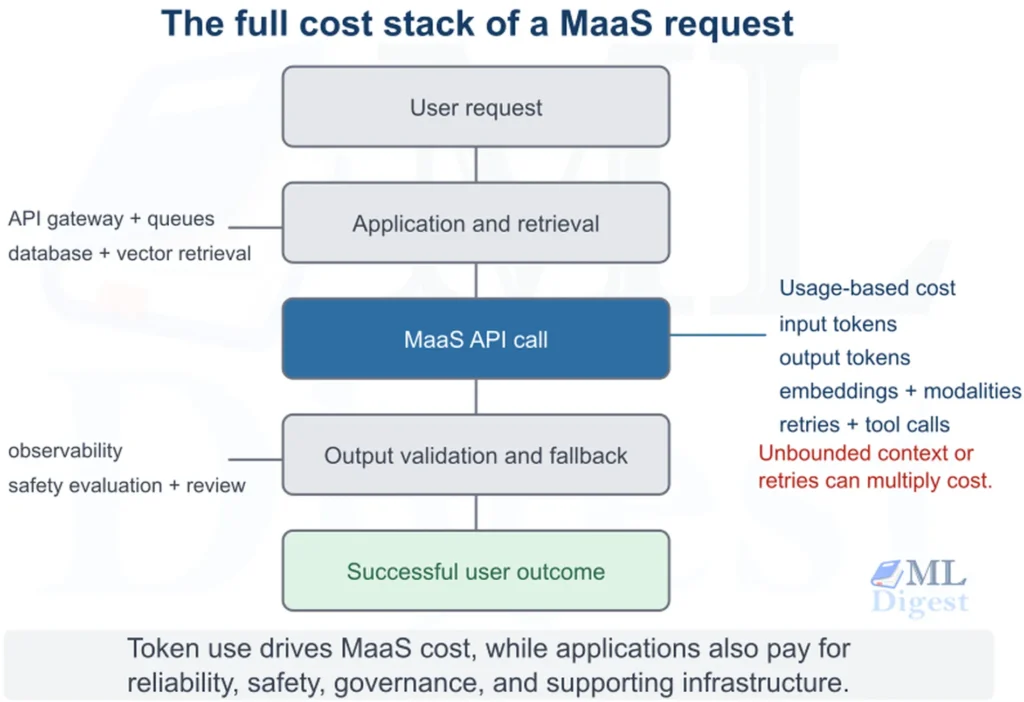
Published prices, such as the provider’s API pricing page, are useful inputs but not a total cost of ownership. Include:
- Variable usage: Input tokens, output tokens, images, audio, embeddings, tool calls, batch versus real-time pricing, and retries.
- Prompt overhead: System instructions, conversation history, tool schemas, retrieved context, and verbose output all consume tokens.
- Application infrastructure: API gateways, queues, caches, databases, retrieval, observability, and regional networking.
- Reliability design: Fallback model calls, retries with backoff, rate-limit handling, circuit breakers, and degraded-mode behavior.
- Evaluation and safety: Gold datasets, human review, red teaming, output validation, content filtering, and issue investigation.
- Procurement and governance: Enterprise agreements, data-processing terms, audit evidence, access control, and regional or private-connectivity options.
The most common cost surprise is token growth rather than a headline price change. A chat product may carry an expanding conversation history, pass large retrieval contexts, retry failed tool calls, and produce long answers. Measure actual input and output distributions by feature, customer tier, model, and workflow. The guide to LLM cost reduction gives practical techniques for lowering unnecessary usage.
5.3 MaaS expertise and time requirements
MaaS lowers the barrier to a useful prototype, not the bar for a reliable product. A product or backend engineer can often build a basic integration in days to two weeks. An initial production release with authentication, observability, error handling, evaluation, safeguards, and data review commonly takes four to twelve weeks.
Time to market is an economic input, not merely a delivery metric. A fast MaaS baseline can reveal whether users value the workflow, produce representative evaluation cases, and expose the actual cost and failure distribution. That learning can be worth more than an early infrastructure saving, especially while product demand and task requirements are still changing.
The required expertise is different from self-hosting:
- Product and domain expertise to define useful outcomes and failure boundaries.
- Backend engineering for API integration, rate limiting, caching, streaming, idempotency, and secure secrets management.
- Prompt, context, and evaluation design for generative tasks.
- Security, privacy, and legal review for the actual provider configuration and contract.
- Operations expertise for usage visibility, incident handling, and vendor contingency planning.
For higher-risk workflows, learn about LLM deployment challenges, including prompt injection and hallucination. A provider model can produce unsafe or incorrect outputs just as a self-hosted model can. The application must constrain actions, validate outputs, and retain human oversight where the consequence of error is high.
5.4 The data and lock-in questions that must be answered explicitly
Do not assume that a provider’s default retention, abuse-monitoring, regional processing, training-use, or support-access policy meets your requirements. Review the current contract, data-processing agreement, security documentation, and exact API configuration with legal and security stakeholders. These policies differ by provider, plan, region, and feature, and they change over time.
Also design a provider abstraction only where it provides real value. A thin internal interface that separates product requests from provider-specific calls can make model routing, failover, and evaluation easier. An elaborate abstraction that hides useful provider features can slow the team down. Preserve the information needed to compare models, including prompt version, model identifier, latency, token usage, output validation result, and user outcome.
6. Compare the Options on the Dimensions That Matter
The table below is a starting point. The ratings are directional, not universal. A tightly optimized edge system can be expensive, and a managed cloud endpoint can be straightforward.
| Dimension | Edge custom model | Managed cloud model | Self-hosted cloud model | MaaS endpoint |
|---|---|---|---|---|
| Time to first prototype | Medium to slow | Medium | Medium | Fast |
| Time to resilient production | Slow for diverse devices | Medium | Medium to slow | Medium |
| Offline behavior | Excellent | None without local fallback | None without local fallback | None without local fallback |
| Raw-data locality | Strong | Depends on region and controls | Depends on deployment and controls | Depends on provider configuration and contract |
| Model-size flexibility | Limited by device | High | High | Determined by provider catalog |
| Update speed | Slower, rollout across clients | Fast, centrally controlled | Fast, centrally controlled | Fast, provider and application controlled |
| Marginal cost at high stable volume | Often low | Depends on platform pricing and utilization | Can become low with high utilization | Often higher, usage-based |
| Upfront engineering cost | High | Medium | High | Low to medium |
| Operational burden | Device fleet and release burden | Platform configuration and model lifecycle | Serving, platform, and capacity burden | Vendor, integration, and application burden |
| Core expertise | ML, client or embedded systems, device lifecycle | ML, data, backend, and MLOps | ML, data, backend, platform or SRE | Backend, evaluation, safety, and vendor management |
| Control over weights and runtime | High | High | High | Low to medium |
| Best fit | Offline, privacy, or very tight latency | Custom model with limited platform capacity | Centralized data, runtime control, steady demand | Fast validation and broad frontier capability |
6.1 Illustrative application patterns
The real-world application determines the path more than a model trend does. These examples are starting hypotheses that still require a measured evaluation and a review of the data boundary.
| Application | Sensible starting approach | Why |
|---|---|---|
| Startup chatbot or writing assistant | MaaS | Fast product validation and broad language capability outweigh ownership early on |
| Enterprise document search | MaaS plus retrieval-augmented generation | Retrieval can ground a provider model in private documents before fine-tuning is justified |
| Medical-imaging workflow | Custom model in a controlled cloud, private, or on-premises environment | Validation, data handling, and integration requirements usually dominate generic model access |
| Autonomous drone or safety control | Edge or edge-first hybrid | The core action needs local latency and availability |
| Factory defect detection | Edge or local-site model | Cameras can generate high-volume data, and local action reduces bandwidth and delay |
| Internal coding assistant | MaaS initially, then evaluate controlled self-hosting | Provider capability is useful early, while privacy, customization, and scale may later justify another path |
7. Make Cost Decisions With Unit Economics, Not Intuition
A cost comparison should include fixed costs, variable costs, and the cost of risk. A simple planning model over $H$ months is:
$$
C_{path}(H)=C_{build}+H(C_{fixed}+C_{operations}+C_{governance})+N(H)C_{variable}+C_{risk}
$$
Where:
- $C_{build}$ is one-time engineering, integration, data preparation, and migration cost.
- $C_{fixed}$ is recurring reserved compute, devices, licenses, or platform capacity.
- $C_{operations}$ covers people, monitoring, incident response, and support.
- $C_{governance}$ covers compliance, security review, audit, and vendor management.
- $N(H)$ is the number of requests, inferences, tokens, images, or device-months during the horizon.
- $C_{variable}$ is cost per unit of work, including provider usage, autoscaled compute, transfer, and storage.
- $C_{risk}$ is the expected cost of failures, such as outages, quality regressions, policy breaches, or vendor disruption.
The formula does not produce truth by itself. It forces assumptions into the open, which is usually the important part.
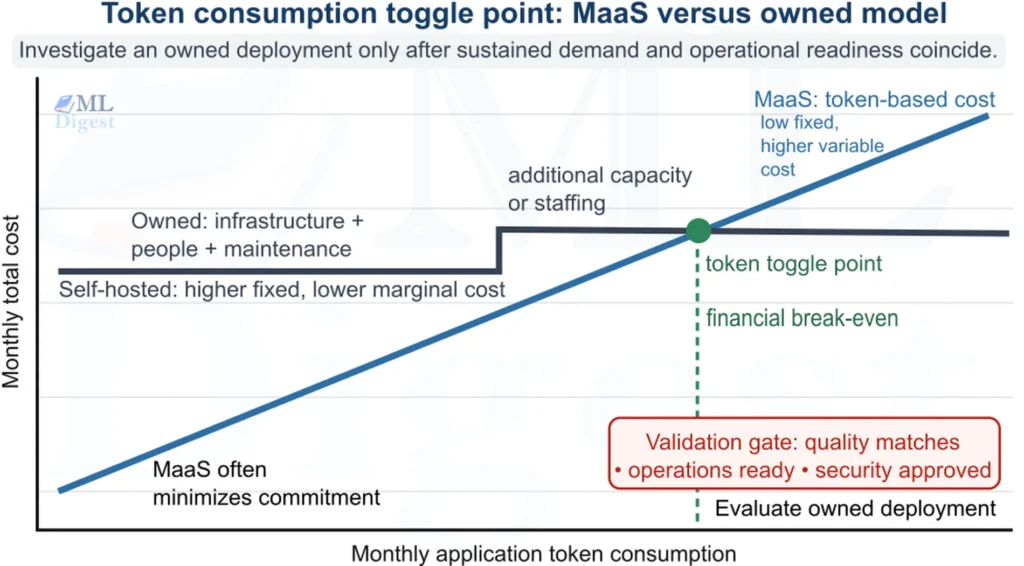
7.1 A break-even calculation for MaaS versus self-hosting
MaaS cost generally rises with use. For language-model features, count all input and output tokens, including system instructions, conversation history, retrieved context, tool calls, and retries. Self-hosting has higher fixed and stepwise costs, such as infrastructure, engineering, on-call coverage, and extra capacity.
Compare the options over 12 to 36 months using sustained demand, not one busy period. Include migration, idle capacity, security, monitoring, and the value of shipping earlier. If self-hosting does not retain a clear cost advantage after these costs, there is no financial case to move.
Treat a favorable estimate as a reason to investigate, not an automatic migration trigger. Switch only if the candidate model also meets quality, reliability, security, and operational-readiness requirements.
7.2 Cost factors by deployment path
| Cost factor | Edge | Managed cloud model | Self-hosted cloud model | MaaS |
|---|---|---|---|---|
| Model development | Compression and device validation | Training or adaptation, evaluation | Training or adaptation, evaluation | Prompt, context, and evaluation design |
| Inference capacity | Customer or site hardware, sometimes new hardware | Endpoint configuration and managed compute | Reserved or autoscaled CPU/GPU capacity | Usage-based requests, tokens, or modalities |
| Data transfer | Often reduced, local telemetry remains | Ingress, egress, cross-region, feature-store traffic | Ingress, egress, cross-region, feature-store traffic | Request payload and application-side transfer |
| Operations | Fleet updates, compatibility, device telemetry | Endpoint configuration, releases, and model monitoring | On-call, autoscaling, patching, and observability | Integration, quotas, provider incidents, and cost monitoring |
| Quality iteration | Slower rollout to clients | Centralized retraining and serving | Centralized retraining and serving | Fast application iteration, model changes depend on provider |
| Security and compliance | Artifact integrity and local data handling | IAM, network, encryption, audit, and region | IAM, network, encryption, audit, and region | Contract, API configuration, access control, and data policy |
8. A Step-by-Step Decision Process
The decision should be a repeatable process, not a one-off architecture debate. It is one part of the broader machine learning project lifecycle.
8.1 Step 1: Write measurable success and failure criteria
Define a small scorecard before comparing solutions. It should include task-quality metrics, user outcome metrics, p95 latency, availability, cost per successful task, data boundary, and unacceptable failure modes.
For classification, ranking, or forecasting, use task-appropriate metrics and calibration. A high accuracy score may be insufficient when decisions depend on probability thresholds, a concern covered in model calibration. For LLM workflows, evaluate representative tasks, factuality requirements, tool-use success, structured-output validity, safety failures, and human satisfaction. Avoid selecting a model from a few memorable demos.
8.2 Step 2: Eliminate options that violate hard constraints
Hard constraints should rule out options before cost comparison.
- If the device must act safely without a network, cloud-only MaaS is not the complete solution.
- If a regulation or contract prohibits data from leaving a site, a public endpoint may be unsuitable without a compliant private deployment arrangement.
- If the task requires a 100 GB model and the target has 2 GB of RAM, edge-only inference is unsuitable unless the design changes.
- If the team has no capacity to operate a GPU service, self-hosting a critical model is a risk even when its spreadsheet cost is lower.
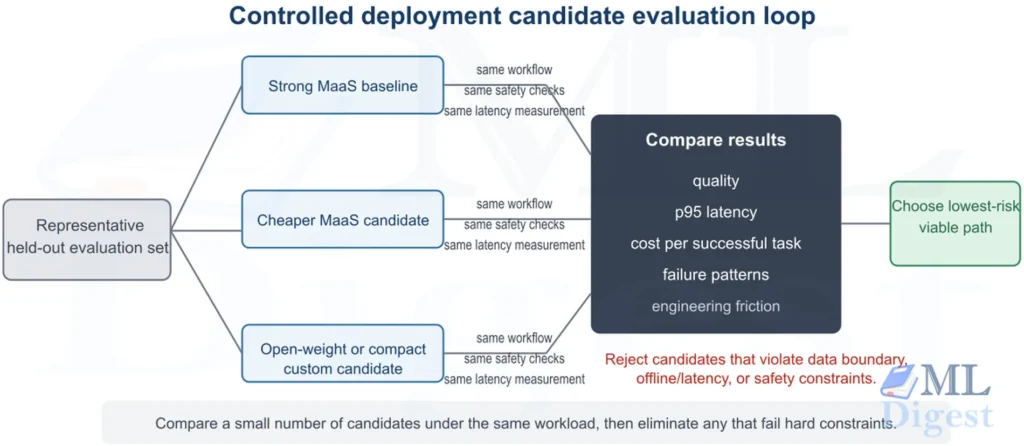
8.3 Step 3: Build the smallest credible comparison
Run a time-boxed proof of value using two or three candidates, not ten. For example:
- A strong MaaS baseline.
- A smaller or cheaper MaaS model.
- If plausible, an open-weight model or compact custom baseline running where you would eventually operate it.
Use the same held-out evaluation set, same product workflow, same safety checks, and comparable latency measurement. Record quality, cost, failure patterns, and engineering friction. This gives you evidence rather than vendor marketing or architecture preference.
8.4 Step 4: Score total risk, not only model quality
Use a simple scorecard to compare quality, latency, privacy and compliance, cost, operational fit, and time to market. Decide which factors matter most for the product. For example, a medical device should prioritize safety and local operation, while an early-stage writing tool may prioritize speed and broad model capability.
Do not let a high score in one area hide a hard constraint. Reject any option that cannot meet a safety, privacy, latency, or availability requirement.
8.5 Step 5: Design for reversibility
Early decisions should be reversible where practical. Store prompts, evaluation records, model versions, inputs or privacy-preserving summaries, outputs, latency, and cost telemetry in a way that lets you compare alternatives. Keep provider-specific code behind a small adapter if you expect to evaluate multiple endpoints. Use versioned model artifacts and staged rollouts for self-hosted or edge models.
This is the real value of an MVP architecture. It does not merely launch faster. It teaches the team what a later migration would need.
8.6 Use a fast decision framework before the detailed scorecard
The following framework is a practical way to select a starting architecture. It deliberately asks the questions in order. Product uncertainty favors MaaS because learning quickly matters more than owning infrastructure. Offline behavior, strict data locality, and hard local-latency requirements override that default and favor edge or hybrid inference. Only after those constraints are cleared should you compare MaaS, a managed endpoint, and self-hosting on quality, compliance, cost, and operational readiness.
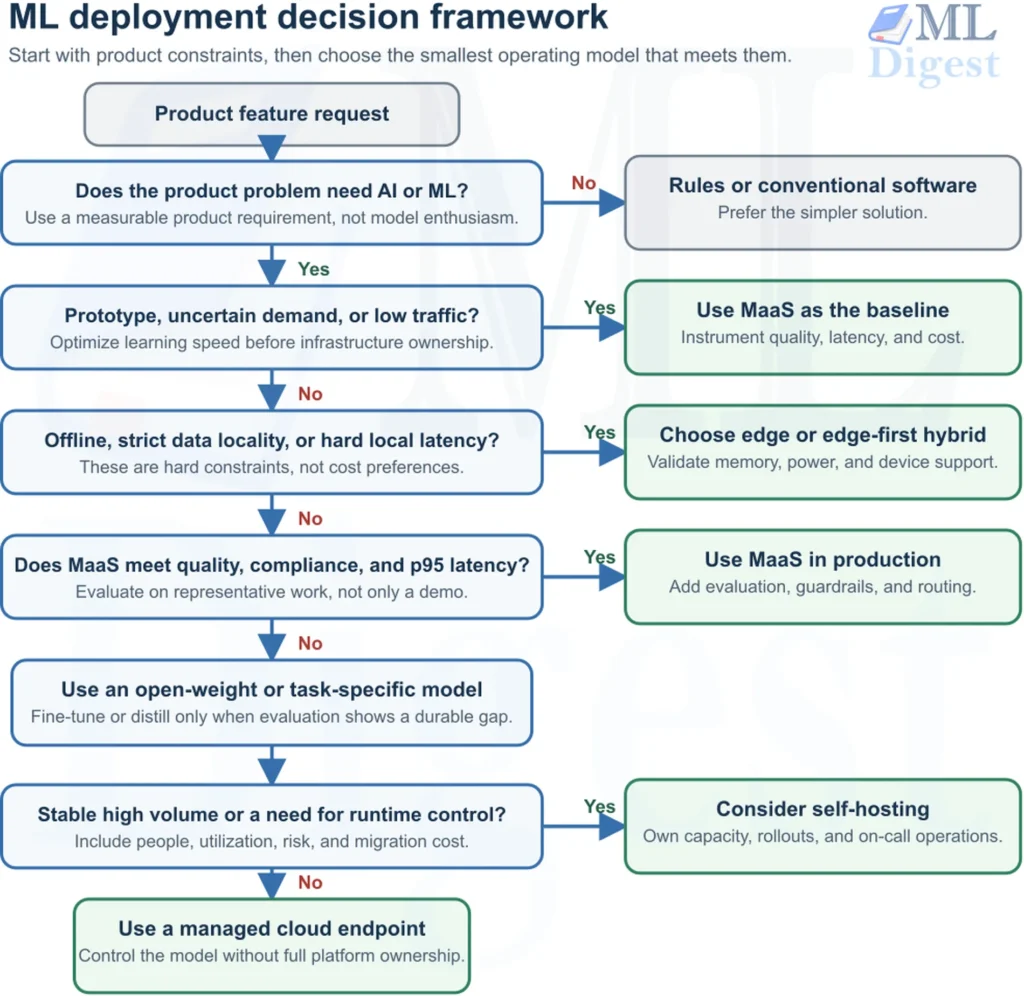
The framework is a triage tool, not a substitute for the evaluation and total-cost analysis in the preceding sections. In particular, high traffic alone does not justify self-hosting, and domain specialization alone does not prove that fine-tuning is necessary. Both decisions need representative evidence and a credible operating plan.
9. When to Stay With MaaS, and When to Move In-House
There is no virtue in moving in-house for its own sake. MaaS can remain the correct long-term choice when it provides differentiated capability, handles uncertainty efficiently, and meets governance requirements. A migration should solve a specific, measured problem.
9.1 Signals that MaaS remains the right choice
Stay primarily with MaaS when:
- Product-market fit is still uncertain or traffic is volatile.
- The provider model remains materially better on your evaluation suite.
- Usage cost is a small portion of the product’s gross margin or operating budget.
- Your team would need to hire or divert scarce people to operate the alternative.
- The endpoint meets privacy, regional, reliability, and contractual requirements.
- New provider capabilities create more value than the control gained by self-hosting.
In this situation, invest in evaluation, caching, routing, prompt efficiency, output validation, and vendor contingency rather than prematurely building an inference platform.
9.2 Signals that an in-house alternative deserves investigation
Start a serious self-hosted or custom-model investigation when several signals persist, not just one month of a large bill:
- Sustained economics: Measured volume is stable, MaaS variable cost is material, and a 12- to 36-month model shows savings after people and migration cost.
- Data or sovereignty: Current provider terms, regional availability, or contractual requirements cannot satisfy the product’s data boundary.
- Latency or availability: Network dependence or provider tail latency harms the product, and a local or closer deployment can fix it.
- Control: You need deterministic version pinning, custom decoding, specialized instrumentation, lower-level safety controls, or a release schedule the provider cannot offer.
- Task specialization: A smaller model trained or fine-tuned for a narrow repeated task meets quality at much lower cost or latency.
- Strategic resilience: A single vendor is a material business risk, and the organization can responsibly support another serving path.
A migration case is strongest when it combines a durable business driver with a validated technical alternative. “We have a lot of requests” is not enough if the task still requires the provider’s capability.
9.3 Do not jump from MaaS directly to training from scratch
The sensible migration ladder is usually:
- Improve the current MaaS system: Reduce unnecessary tokens, cache stable outputs, use smaller models for simple requests, batch asynchronous work, and make retrieval more selective.
- Route by difficulty: Keep MaaS for hard or high-value cases. Use a cheaper endpoint, rules, a small classifier, or a compact model for routine requests.
- Self-host an evaluated open-weight model: Run it in a controlled cloud or private environment, then compare it against the MaaS baseline with shadow traffic.
- Fine-tune, distill, or train a task-specific model: Do this only when labeled data and evaluation show that specialization delivers a durable gain.
- Train a foundation model from scratch: Consider this only if strategic data, scale, capital, research expertise, and a long-term operating commitment justify it.
This sequence turns a risky rewrite into a portfolio of experiments. It also allows a hybrid endpoint strategy, where a self-hosted model handles most traffic and MaaS is retained for long-tail requests, complex escalation, fallback, or periodic evaluation.
10. Build the Operational Foundation Before You Need to Switch
The best time to prepare for an in-house option is while MaaS is still working well. Capture the evidence and abstractions that make a later decision inexpensive.
10.1 Maintain a representative evaluation set
Build an evaluation set from real, permissioned, de-identified, or carefully simulated cases. Include routine examples, difficult edge cases, adversarial inputs, unsafe requests, long inputs, multilingual or domain-specific inputs where relevant, and expected failures. Keep test cases independent from examples used in prompts or fine-tuning.
Treat the evaluation set as a test suite for ML systems, with repeatable checks before changes reach users.
Review the set continuously. Product usage changes, policies change, and models can regress when a provider updates an endpoint. Use both automated checks and human review for subjective, high-stakes, or nuanced tasks. The goal is a reliable comparison harness, not a single benchmark score.
10.2 Instrument the application, not just the model call
For every model path, collect privacy-appropriate telemetry such as:
- Request category and selected route.
- Model and prompt version, without recording unnecessary sensitive content.
- Input and output token counts or model compute units.
- Queue time, time to first token, total latency, timeout, retry, and failure rate.
- Validation outcome, fallback use, and user correction or abandonment where appropriate.
- Cost estimate and actual billed usage at a level that supports reconciliation.
This data lets you identify work that is both expensive and simple enough to route elsewhere. It also helps distinguish a model problem from a retrieval, prompt, data, or user-interface problem.
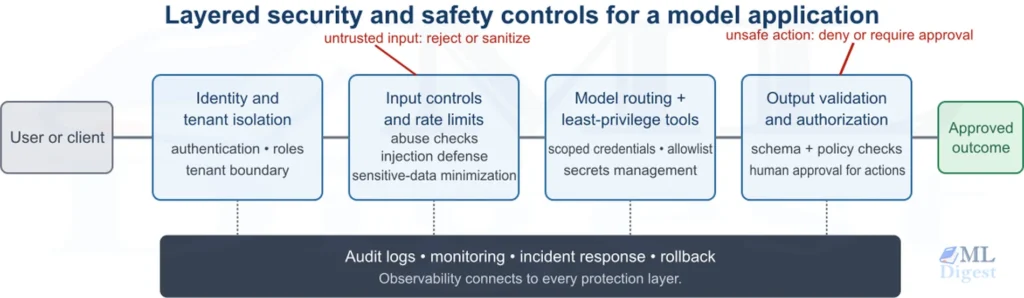
10.3 Treat security and safety as deployment requirements
Model choice cannot compensate for weak application controls. Apply least-privilege credentials, tenant isolation, encryption, audit logs, rate limits, abuse controls, secrets management, and a documented incident process. For systems that can take actions, separate generation from authorization. Validate structured outputs, constrain tools, and require confirmation or human approval for consequential actions.
These controls are a practical part of responsible AI, not a separate concern to address after deployment.
For a governance baseline, the NIST AI Risk Management Framework provides a useful vocabulary for mapping, measuring, managing, and governing AI risk. Adapt its ideas to the product’s actual impact rather than copying a checklist.
11. Common Mistakes and Better Alternatives
11.1 “We need a custom model because the product is important”
Importance is a reason to evaluate carefully, not a reason to own every layer. Start with the smallest solution that can satisfy the requirement. Spend custom-model effort where it yields measurable differentiation, such as proprietary data, a constrained latency target, or an unusually specialized task.
11.2 “MaaS is expensive, so self-hosting must be cheaper”
Compare all costs, including engineering time, idle capacity, on-call coverage, evaluation, security, migration, and provider resilience. Self-hosting is often cheaper only after traffic becomes sustained and predictable enough to keep infrastructure well utilized.
11.3 “Edge is private, so we do not need security work”
Local data processing can reduce exposure, but edge artifacts can be copied, tampered with, or run on compromised devices. Sign model updates, validate integrity, minimize sensitive logs, protect local storage, and plan for rollback.
11.4 “One model should handle everything”
Routing is often more efficient. Use rules, cache, a small custom model, a self-hosted model, and MaaS for different request classes. A heterogeneous system can reduce cost and improve latency without sacrificing the capability needed for hard cases.
11.5 “The model works in a demo, so deployment is finished”
Production quality includes tail latency, availability, cost variance, error handling, data drift, output validation, rollout safety, and user outcomes. Treat the demo as the start of evaluation, not its conclusion.
11.6 “The generic model misses the task, so we need fine-tuning”
Fine-tuning is valuable when a repeated, well-specified behavior remains inadequate after careful prompting and evaluation, and when you have representative examples to train and test it. It is not the automatic answer to every weak output. Missing or changing private knowledge usually calls for retrieval, not new weights. An unreliable output format may call for structured-output validation. A poor workflow may be a product, tool, or context-design problem. Identify the failure source before creating a training-data and model-lifecycle commitment.
Conclusion: Choose the Smallest Responsible System
Edge, cloud, and MaaS solve different problems. Edge is compelling when local latency, offline behavior, or raw-data locality are hard requirements. Cloud is compelling when models need centralized data, large compute, rapid updates, or shared control. MaaS is compelling when speed, broad capability, and low operational burden matter more than ownership of the model runtime.
For most teams, the strongest strategy is to begin with a measured MaaS or managed baseline, instrument it well, and earn the complexity of custom infrastructure only when sustained economics, data constraints, latency, reliability, or specialization justify it. Avoid treating a move in-house as a binary decision. Route simple work to simple systems, keep an escalation path for difficult cases, and use your evaluation data to decide what should change.
As a next step, write a one-page scorecard for one real feature, run a small comparison on representative traffic, and calculate its cost per successful user outcome. That evidence will tell you far more than an abstract debate about whether edge, cloud, or MaaS is “best.”

Happy is a seasoned ML professional with over 15 years of experience. His expertise spans various domains, including Computer Vision, Natural Language Processing (NLP), and Time Series analysis. He holds a PhD in Machine Learning from IIT Kharagpur and has furthered his research with postdoctoral experience at INRIA-Sophia Antipolis, France. Happy has a proven track record of delivering impactful ML solutions to clients. Check more about him here: https://sites.google.com/site/slhappyin/

Silpa brings 5 years of experience in working on diverse ML projects, specializing in designing end-to-end ML systems tailored for real-time applications. Her background in statistics (Bachelor of Technology) provides a strong foundation for her work in the field. Silpa is also the driving force behind the development of the content you find on this site.
Subscribe to our newsletter!