What if building the next GPT costs more than building a skyscraper?
That question is no longer just a thought experiment. A frontier model needs a temporary industrial system behind it: a purpose-built cluster of accelerators, power and cooling, fast networking, data pipelines, and people who can keep the whole thing running. As the cost of a training run climbs, it reshapes the AI industry. The advantage increasingly comes from being able to finance, operate, and get real value from huge amounts of compute.
Most useful AI products do not need a frontier model. Still, understanding frontier economics helps teams make a practical deployment decision: build a model, adapt one, or use an existing one well.
1. Why Frontier Models Are So Expensive
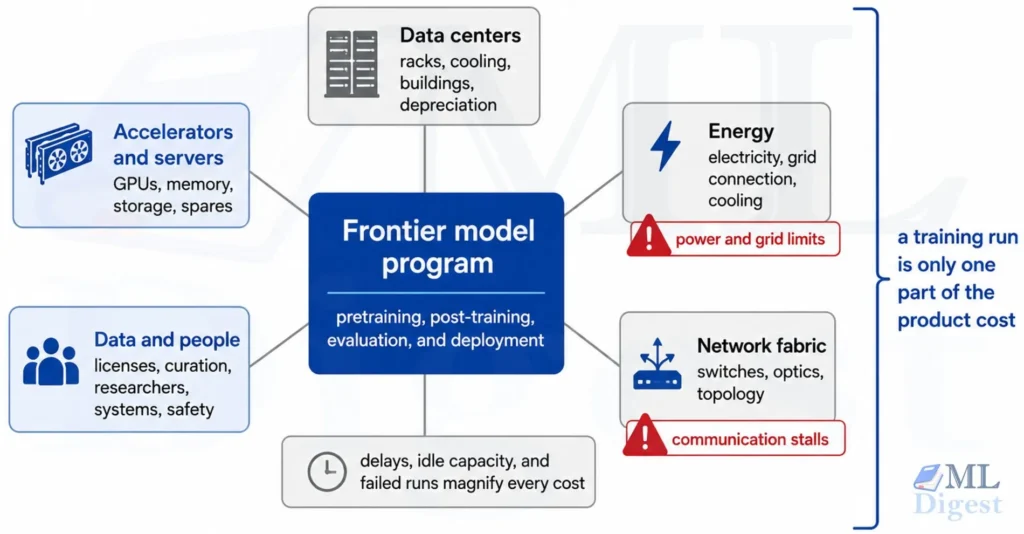
Frontier language models are among the most broadly capable models available at a given time. Their cost is easy to underestimate because a launch announcement can compress years of infrastructure work into a short demo. Training is the visible event, but it is only one line on the bill.
1.1 The model is a factory run, not a single purchase
Imagine a restaurant trying to serve millions of meals at the same moment while rewriting its recipe in the kitchen. The comparison is imperfect, but it captures something important about frontier training. Thousands of accelerators have to process data in lockstep. One slow server, failed cable, or unstable run can leave the rest of the cluster waiting.
Epoch AI research on the rising costs of training frontier models estimates that the amortized cost of the most compute-intensive training runs grew about $2.4\times$ a year from 2016. For major models, accelerator chips and staff each reached tens of millions of dollars, with servers, cluster interconnects, and electricity adding more. These are estimates, not audited invoices, but they show why raw GPU rental is incomplete accounting.
A useful accounting view is:
$$
C_{\mathrm{development}} = C_{\mathrm{hardware}} + C_{\mathrm{facility}} + C_{\mathrm{training}} + \
C_{\mathrm{post}} + C_{\mathrm{data}} + C_{\mathrm{people}} + C_{\mathrm{risk}}.
$$
Here, $C_{\mathrm{post}}$ covers fine-tuning, safety work such as RLHF, evaluations, red-team exercises, and failed runs. $C_{\mathrm{risk}}$ is not a formal accounting category, but it is a real cost. A delayed cluster, unavailable chip allocation, or flawed run can leave expensive capital idle while competitors keep moving.
| Cost layer | What it pays for | Why it is difficult to reduce |
|---|---|---|
| Accelerators and servers | GPUs or AI accelerators, CPUs, memory, storage, spare capacity | Leading chips are scarce at the exact scale and delivery schedule a lab needs. |
| Data centers | Power delivery, cooling, racks, land, buildings, depreciation | Capacity takes years to permit and connect to the grid. |
| Networking | InfiniBand or Ethernet fabrics, switches, optics, topology expertise | Distributed training repeatedly moves gradients and activations between machines. |
| Energy | Electricity for servers and cooling | A lower power price helps, but it does not remove grid and cooling constraints. |
| Data and people | Licenses, filtering, annotation, researchers, systems engineers, security teams | High-quality data and people who can run enormous clusters are difficult to substitute quickly. |
1.2 Compute converts money into experiments
For a dense decoder-only transformer, a common rough estimate for pretraining work is
$$
F \approx 6ND,
$$
where $N$ is the number of model parameters, $D$ is the number of training tokens, and $F$ is total floating-point operations. The constant is an approximation, not a universal law. It hides architecture choices, sequence length, optimizer overhead, recomputation, and utilization losses.
If a cluster sustains $P$ useful FLOPs per second at utilization $\eta$, then training time is roughly
$$
t \approx \frac{F}{P\eta}.
$$
The practical point is simple: a lab is not buying FLOPs in the abstract. It is buying calendar time. Better software, fewer failures, and higher utilization raise $\eta$, so the same hardware completes more experiments before the market moves on. A half-idle cluster is an expensive decoration.
A mixture-of-experts model changes the calculation because only a fraction of its parameters is active for each token. Sparse activation can deliver more capability for a given amount of compute, but it does not make the engineering disappear. Routing, communication, and load balancing can become much harder.
1.3 Power, networking, and data are first-class constraints
Electricity can look minor next to hardware depreciation on a single run, but that misses the system constraint. A data center needs enough power, cooling, and grid connection to run the hardware at all. The International Energy Agency’s report on Energy and AI describes data centers as a growing source of electricity demand and highlights local grid constraints.
Networking is easy to overlook too. During distributed training, machines constantly exchange information. If that exchange is slow or unreliable, expensive accelerators sit waiting. What matters is delivered training throughput, not the sticker price of one GPU.
Data brings a different set of costs. Public web-scale text is not automatically useful training data. Legal rights, provenance, deduplication, multilingual coverage, domain expertise, synthetic-data generation, and quality filtering all take money and time. At the frontier, better data can matter as much as another increment of compute because it changes what the model learns from every token.
2. The Frontier Model Arms Race
OpenAI, Anthropic, Google, Meta, and xAI are all competing to train and deploy general-purpose frontier models, but they are taking different routes. Google and Meta can lean on existing infrastructure. OpenAI and Anthropic have relied heavily on partnerships and external financing. xAI has pursued rapid infrastructure build-out. All of them face the same basic challenge: assembling massive compute, talent, and distribution at once.
The arms-race metaphor is imperfect, but the pressure is real. A lab that postpones a training run may save money but lose product momentum, developer attention, and learning from deployment. Spending aggressively can create a capability lead, but it also locks in high fixed costs before demand is proven.
2.1 Who can afford to compete?
Frontier competitors usually need most of the following:
- Reliable access to a very large accelerator fleet, whether owned or contractually reserved.
- Power, networking, and data-center capacity that can support that fleet.
- Financing that survives several expensive training and post-training cycles.
- Engineers who can operate distributed training safely and efficiently.
- A distribution channel, such as cloud customers, consumer products, enterprise sales, or a developer platform, that can turn capability into usage.
Most organizations do not need all five. A startup with a compelling research direction may partner with a cloud provider, while a cloud provider may acquire a research team. That is one reason the industry is concentrating around a small network of labs, chip suppliers, and infrastructure providers instead of completely self-contained companies.
2.2 What the arms race does not prove
More spending does not guarantee the best model or business. Returns depend on the training recipe, data, evaluation discipline, inference efficiency, and whether users need the added capability.
The question is not “Who has the largest cluster?” It is “Who can turn a costly training run into durable value before the next generation arrives?”
3. The New Moat Is Capital, but It Is Not Only Capital
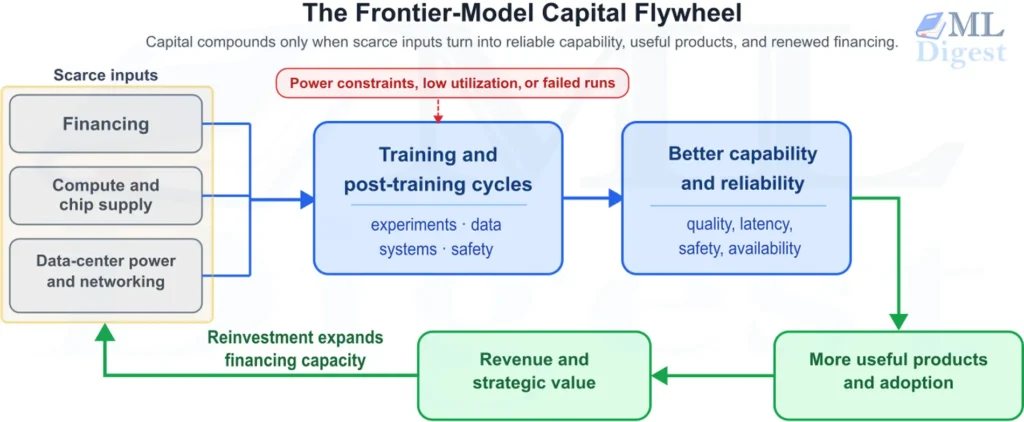
Earlier breakthroughs in machine learning often came from a new architecture, benchmark result, or open-source implementation. Algorithms still matter, including efficient LLM methods. At the frontier, though, advantage also depends on a balance sheet and the ability to put it to work.
The new capital moat has three linked parts:
- Compute access. Owning chips is useful, but a long-term allocation from a cloud partner can be nearly as strategic.
- Physical infrastructure. A data center with power, cooling, networking, and operations staff cannot be created overnight.
- Financing capacity. Large upfront commitments are easier to make when backed by cloud cash flows, public-market access, or patient strategic investors.
Major cloud providers have publicly signaled huge AI infrastructure programs. Alphabet’s SEC filings, for example, list technical infrastructure, including servers and data centers, as a major capital-expenditure category and explain the risks of investing heavily. When several companies commit at this scale, newer entrants face a tougher market for accelerators, construction, power contracts, and experienced engineers.
Capital is necessary, not sufficient. A well-funded lab without a differentiated training process can still produce an expensive imitation. On the other hand, an algorithmic improvement that raises utilization, cuts memory traffic, or improves data efficiency can weaken the moat by delivering more capability per dollar.
4. The Two-Tier AI Economy
The near-term outcome may look like a two-tier economy, although the boundary between the tiers will keep moving.
4.1 Tier 1: frontier labs
Tier 1 organizations train the most expensive general-purpose models. They are not just serving one application. They are placing bets on future products, scientific capabilities, developer ecosystems, and control of a general platform. They carry both the research risk and the capital burden.
4.2 Tier 2: builders who compose capability
Tier 2 includes almost everyone else: startups, enterprise teams, public-interest groups, researchers, and regional providers. This is not a lesser category. It is where much of the long-term product value will be created. These teams have several cheaper paths:
- Use a hosted model for the small share of tasks that genuinely need frontier reasoning.
- Fine-tune efficiently with parameter-efficient fine-tuning, including techniques such as LoRA, when a model needs domain style or behavior rather than a complete new world model.
- Distill a teacher model into a smaller student. Knowledge distillation transfers useful behavior from a larger model without reproducing its full training process.
- Quantize and optimize inference with approaches such as post-training quantization so that a capable model is affordable at production volume.
- Give a model the right context through retrieval-augmented generation instead of trying to encode every changing fact in its weights.
The economic point is simple: a smaller model may preserve enough useful behavior at a much lower inference cost. Teams still need to respect model licenses, data rights, privacy obligations, and provider terms.
The two-tier framing helps separate model creation from value creation. A hospital scheduling assistant, internal research tool, or specialized document workflow can win through trusted data, careful evaluation, and a great user experience, not by owning the biggest pretraining run.
5. Why Investors Keep Funding It
Investors are betting on a particular market structure: that frontier models can become durable platforms with significant strategic value.
5.1 The platform thesis
A successful frontier model can become a platform. One model may support search, coding, customer service, scientific analysis, creative tools, agents, APIs, and enterprise workflows. In principle, its large upfront training cost can be spread across many products and customers.
The attractive case has familiar platform features: developers build on the API, users stick with the product, feedback improves the service, and distribution lowers customer-acquisition costs. That is why valuation discussions focus as much on future revenue and strategic position as on present profit. The Stanford AI Index Report documents rapid growth in private investment and the concentration of notable models among industry organizations, both of which fit this capital-intensive thesis.
5.2 The hard unit-economics test
A large model is a business only if it brings in more money than it costs to run. Start with revenue, then subtract the everyday costs of serving requests, keeping latency low, supporting customers, and reaching new users.
Then look at the bigger picture: can those profits over time repay the upfront spending on training, infrastructure, and the next model release? A project can have strong demand and still struggle if serving that demand costs too much.
The difficult part is that every assumption can change. Demand could be enormous, but inference costs might grow faster than revenue. Competitors may cut prices, and frequent model refreshes can turn a one-time investment into a recurring capital cycle. A headline valuation is not proof that the business works. It is a bet on those assumptions.
5.3 Inference can matter more than training
Training creates the asset, but inference is what serves customers every day. In a widely used service, generating tokens, keeping latency low, using key-value caching, running safety systems and guardrails, and supporting customers can cost more over the model’s life than training it. For reasoning workloads, inference-time scaling can add even more compute to each request. The practical answer may be a portfolio: a frontier model for difficult requests, smaller models for routine work, and retrieval or rules where they are enough.
This is the operational side of LLM deployment strategy. Product teams should measure quality per dollar and quality per watt instead of treating benchmark quality as the only goal.
6. Can Anyone Catch Up?
Yes, but “catch up” needs a clear target. Matching the largest general-purpose training run is very different from matching a benchmark, building a profitable product, or becoming the best model for a regulated domain.
6.1 Open models and efficient research can reset the line
Open-weight models lower the cost of experimentation across the ecosystem. Teams can inspect architectures, fine-tune locally, and deploy without paying an API toll on every request. That lets frontier research feed thousands of specialized products.
DeepSeek is a useful reminder that the cost curve is neither fixed nor smooth. The DeepSeek-V3 technical report describes a 671-billion-parameter mixture-of-experts model with 37 billion activated parameters per token, trained on 14.8 trillion tokens. It reports 2.788 million H800 GPU-hours for full training. That number is not a complete company cost or a universal recipe, but it shows how sparse architectures, systems work, and training choices can change the capability-per-compute equation.
6.2 Commoditization is both threat and opportunity
If capable models become cheaper and more interchangeable, frontier providers may lose pricing power. That is the commoditization risk. For builders, though, cheaper intelligence makes more products viable.
Long-lasting moats may shift downstream to proprietary workflow data, trust, distribution, integration, regulatory expertise, and product design. In that world, the company with the biggest training cluster may supply an important utility, while the company that understands a specific customer problem captures much of the value.
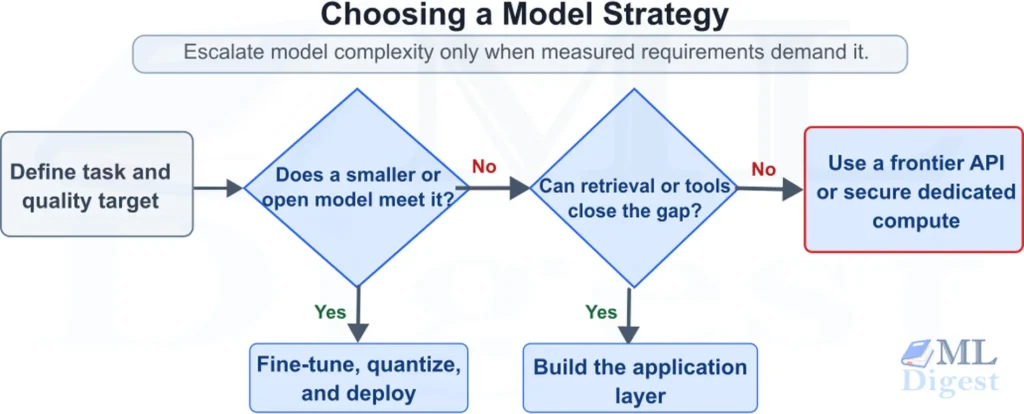
6.3 A practical decision framework
Before committing to a model strategy, ask these questions:
- What capability is actually scarce for this product? Measure task quality with appropriate evaluation metrics, alongside reliability, latency, privacy, and cost. Do not infer need from parameter count.
- Can retrieval, prompting, tools, a smaller model, or even a rules-based or conventional ML system solve it? A practical LLM cost-reduction strategy usually starts with routing and workload design, not a larger model.
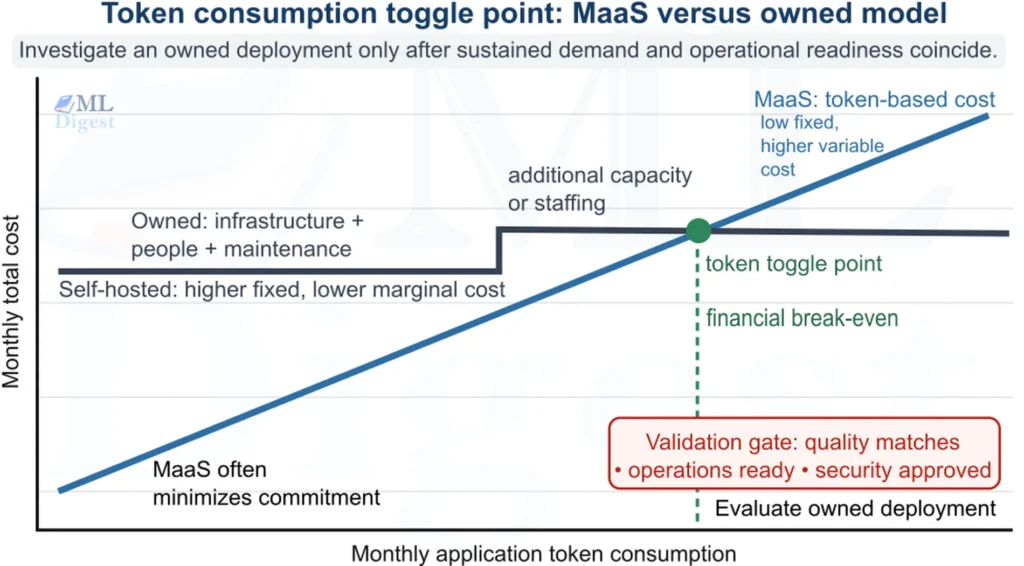
- Will demand be frequent enough to justify owning infrastructure? Sporadic or uncertain demand usually favors an API or cloud deployment.
- Is domain data the real advantage? If it is, invest first in data quality, evaluation sets, and feedback loops.
- What happens if model prices fall by ten times? Prefer designs whose value persists when the base model becomes cheaper.
7. Will Frontier AI Become a Winner-Take-All Market?
The short answer is probably not across the entire AI stack. Training the most capable general-purpose models has strong reasons to concentrate, while product and application markets have equally strong reasons to fragment. The useful question is therefore not whether there will be one winner. It is which layer of the stack rewards scale, and which layer rewards specialization.
7.1 Why the frontier tends to concentrate
Several advantages reinforce one another at the frontier:
- Scale advantages. Larger and better-run training systems can run more experiments, amortize shared tooling across model generations, and improve training efficiency. Scale does not guarantee a breakthrough, but it makes repeated attempts affordable.
- Compute access. Long-term allocations of leading accelerators, networking equipment, and data-center capacity are scarce strategic assets. A lab that can reserve them has more certainty than one buying capacity only when it becomes available.
- Talent. Researchers, distributed-systems engineers, hardware specialists, and safety teams are unusually complementary. A strong team becomes more productive when it has access to the cluster and data needed to test its ideas.
- Data. Public data is broadly available, but licensed, curated, multimodal, domain-specific, and product-interaction data can improve the training recipe and evaluation loop.
- Distribution. A consumer product, cloud platform, enterprise sales organization, or developer ecosystem can turn a better model into immediate usage. This is crucial because a capability lead matters commercially only when customers can reach it.
- Capital and feedback loops. Revenue, strategic partnerships, and investor confidence finance more compute. More compute and deployment data can improve the next model, which can attract more users and capital. This loop can be powerful, but it breaks if costs rise faster than customer value.
7.2 Why concentration has limits
Countervailing forces can reduce the value of an exclusive frontier lead:
- Open-weight models spread strong capabilities to teams that cannot fund pretraining, increasing competition in deployment and customization.
- Falling inference costs make sophisticated features affordable to more products, but they can also compress API prices and reduce the frontier provider’s margins.
- Distillation transfers some useful behavior from expensive teachers to smaller students. It gives applications a path to lower latency and cost without reproducing the original training run.
- Specialized models can outperform a general model on a constrained task when they use domain data, a narrow evaluation target, or an optimized serving stack.
- New architectures and algorithms can change the capability-per-dollar frontier. Sparse models, improved attention mechanisms, data-efficient training, and better systems software are examples of innovations that can weaken a hardware advantage.
- Hardware competition matters because a single accelerator supplier with limited supply strengthens the capital moat. Viable alternatives in accelerators, networking, compilers, and cloud capacity give more organizations bargaining power and design choices.
- Regulatory intervention can limit anticompetitive conduct, require interoperability or transparency in some settings, and impose responsible-AI obligations. The EU AI Act illustrates that regulation can raise compliance costs while also shaping how general-purpose AI providers compete.
7.3 The likely structure is layered, not singular
A more plausible outcome is a layered market:
$$
\mathrm{infrastructure\ oligopoly} \,\rightarrow\, \mathrm{frontier\ model\ competition} \,\rightarrow\, \mathrm{application\ fragmentation}.
$$
At the bottom, chips, power, cloud capacity, and network fabric are likely to remain concentrated because they require large fixed investments. In the middle, a small group of frontier labs may compete intensely, with partnerships and technical improvements causing the membership to change over time. At the top, applications should remain fragmented because customers buy complete workflows, trusted integrations, local knowledge, and accountability rather than raw model capability alone.
8. The Frontier Model Profitability Equation
The economics can be summarized with a deliberately simple conceptual equation:
$$
\begin{equation}
\begin{split}
\mathrm{economic\ value} &= \mathrm{revenue\ generated} \,-\, \mathrm{training\ costs} \,-\, \mathrm{inference\ costs} \\
&-\, \mathrm{infrastructure} \,-\, \mathrm{talent} \,-\, \mathrm{distribution} \,-\, \mathrm{other\ operating\ costs}.
\end{split}
\end{equation}
$$
This is not a valuation model. It omits financing costs, taxes, depreciation conventions, risk, and the uncertain value of future research. Its purpose is to prevent a common mistake: treating training expense as the whole business. A model can be technically excellent and still destroy value if serving, selling, supporting, and continually refreshing it cost more than the revenue it creates.
Frontier economics are difficult for five related reasons:
- Costs arrive early. Capacity commitments, cluster construction, training, data work, and talent are paid for before revenue is proven.
- Revenue may arrive later. Enterprise procurement, integration, security review, and customer behavior change can delay monetization even when a model is impressive.
- Model prices can decline rapidly. Lower inference costs benefit customers, but competitors can pass those savings through as lower API prices.
- Competitors continuously improve. A capability lead can be shortened by the next model release, an open model, or a better product experience.
- Capital requirements remain enormous. Each model generation can require new hardware, more power, and more working capital before the previous generation has fully paid back.
The winners therefore need technical leadership and financial discipline. They must improve capability while deciding where a premium model changes customer outcomes, where a smaller model is sufficient, and when new capacity is justified by credible demand.
9. Three Possible Futures
Nobody knows exactly where this market lands. Still, it is useful to picture three different paths, because each one changes who makes money, who bears the costs, and where a new team should compete.
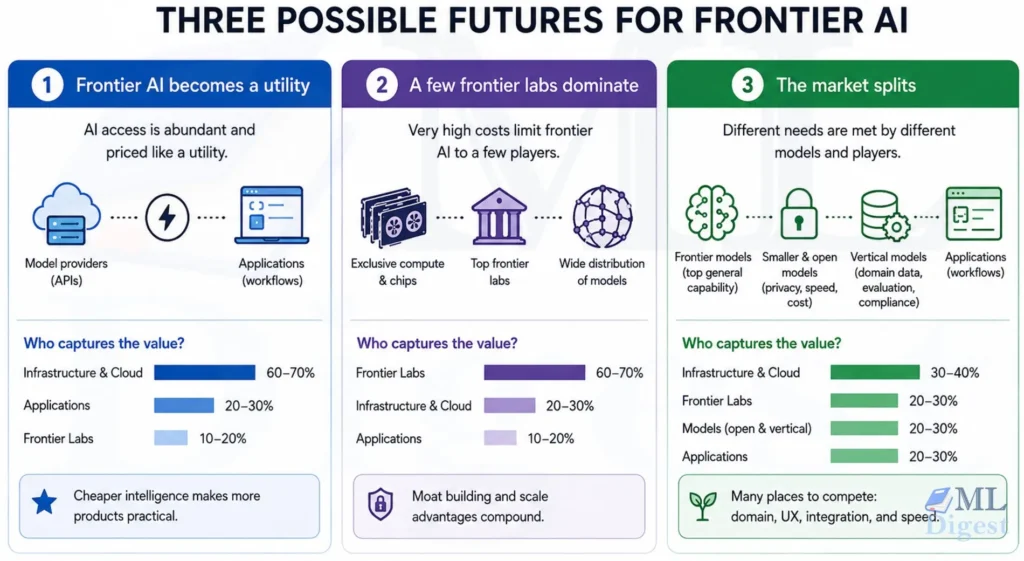
9.1 Scenario 1: Frontier AI becomes a utility
In this future, using a strong model feels a bit like buying cloud storage or electricity. For most everyday jobs, several providers are good enough, so customers pick on price, reliability, privacy, and ease of integration. API prices keep falling toward the cost of efficient serving. Cloud and infrastructure providers take a large share of the value, while applications stand out through their workflows, distribution, customer data, and integrations.
This is great news for builders because cheaper intelligence makes more products practical. It is a tougher world for frontier labs. They may still need enormous up-front investment in chips and data centers, but have less room to charge a premium. This path becomes more likely if open and proprietary models quickly become similar in the ways customers actually care about, and switching providers does not require much rework.
9.2 Scenario 2: A few frontier labs dominate
Here, frontier development starts to look like an industry with a very high admission price. Training costs keep rising, access to leading chips stays scarce, and only a handful of organizations can afford repeated frontier runs. Their models become strategic infrastructure, and their advantages compound through exclusive compute deals, strong distribution, and the ability to spread a model across many products.
There is a real case for this at the very top of general capability. The biggest models need unusually large clusters and complex post-training programs, and not many organizations can operate them well. But this story only goes so far. Even a very strong general model does not automatically own a customer’s workflow, customer relationship, or domain expertise.
9.3 Scenario 3: The market splits
In a split market, a small number of frontier models handle the hardest general-purpose jobs. Smaller language models and open models win where privacy, speed, cost, or customization matters more. Vertical models compete on domain data, careful evaluation, and compliance. Meanwhile, applications keep most of the customer relationship because they package models into useful workflows and reach the people who need them.
This looks like the most plausible medium-term outcome. Training the leading general model has real scale economies, so it is unlikely that thousands of companies will do it. But a model is usually only one part of a finished product. Distillation, cheaper serving, open-weight releases, and domain specialization all give other teams room to compete. The result is a market that is concentrated in infrastructure and frontier research, but still busy and diverse in models, tools, and applications.
Conclusion
Frontier AI is becoming as much an infrastructure business as a research business. Compute, data centers, energy, networks, specialized talent, and financing all raise the bar for training leading general-purpose models. That pressure may concentrate the frontier in a small number of labs, even as cheaper open models, distillation, and better systems techniques spread useful capability more widely.
The future of frontier AI may depend as much on capital allocation as on model intelligence. Track cost per successful task, margin, utilization, and revenue per unit of compute alongside model capability. For most teams, the lesson is encouraging: do not compete to own the largest model. Focus on delivering reliable value per dollar with the smallest, simplest mix of models, data, and tools that meets the real need.

Silpa brings 5 years of experience in working on diverse ML projects, specializing in designing end-to-end ML systems tailored for real-time applications. Her background in statistics (Bachelor of Technology) provides a strong foundation for her work in the field. Silpa is also the driving force behind the development of the content you find on this site.

Happy is a seasoned ML professional with over 15 years of experience. His expertise spans various domains, including Computer Vision, Natural Language Processing (NLP), and Time Series analysis. He holds a PhD in Machine Learning from IIT Kharagpur and has furthered his research with postdoctoral experience at INRIA-Sophia Antipolis, France. Happy has a proven track record of delivering impactful ML solutions to clients. Check more about him here: https://sites.google.com/site/slhappyin/
Subscribe to our newsletter!