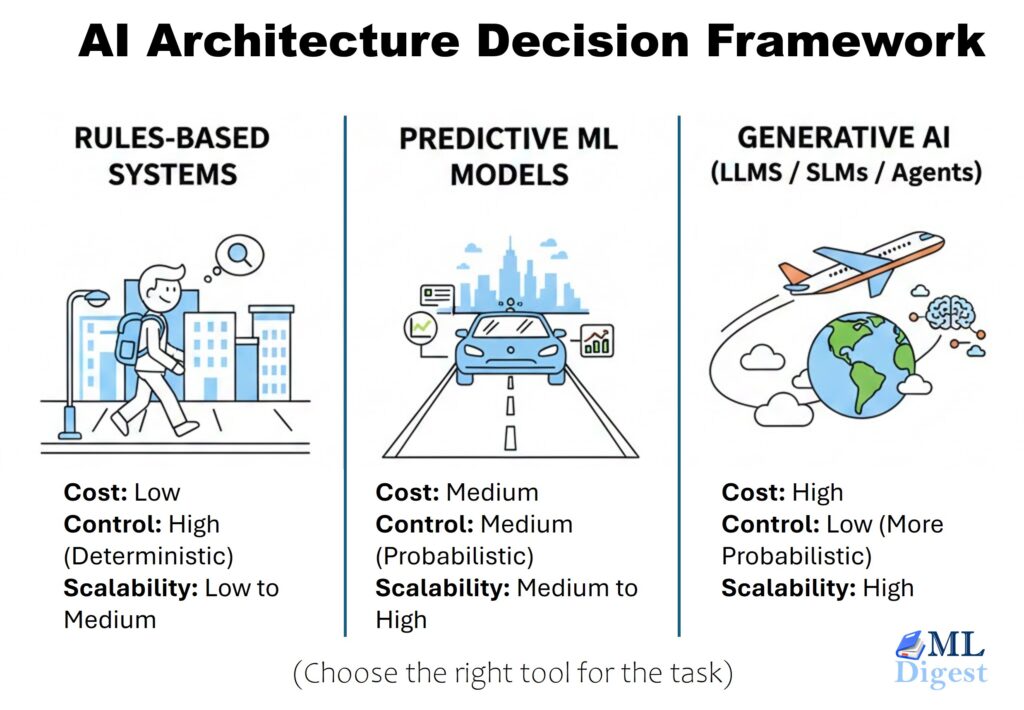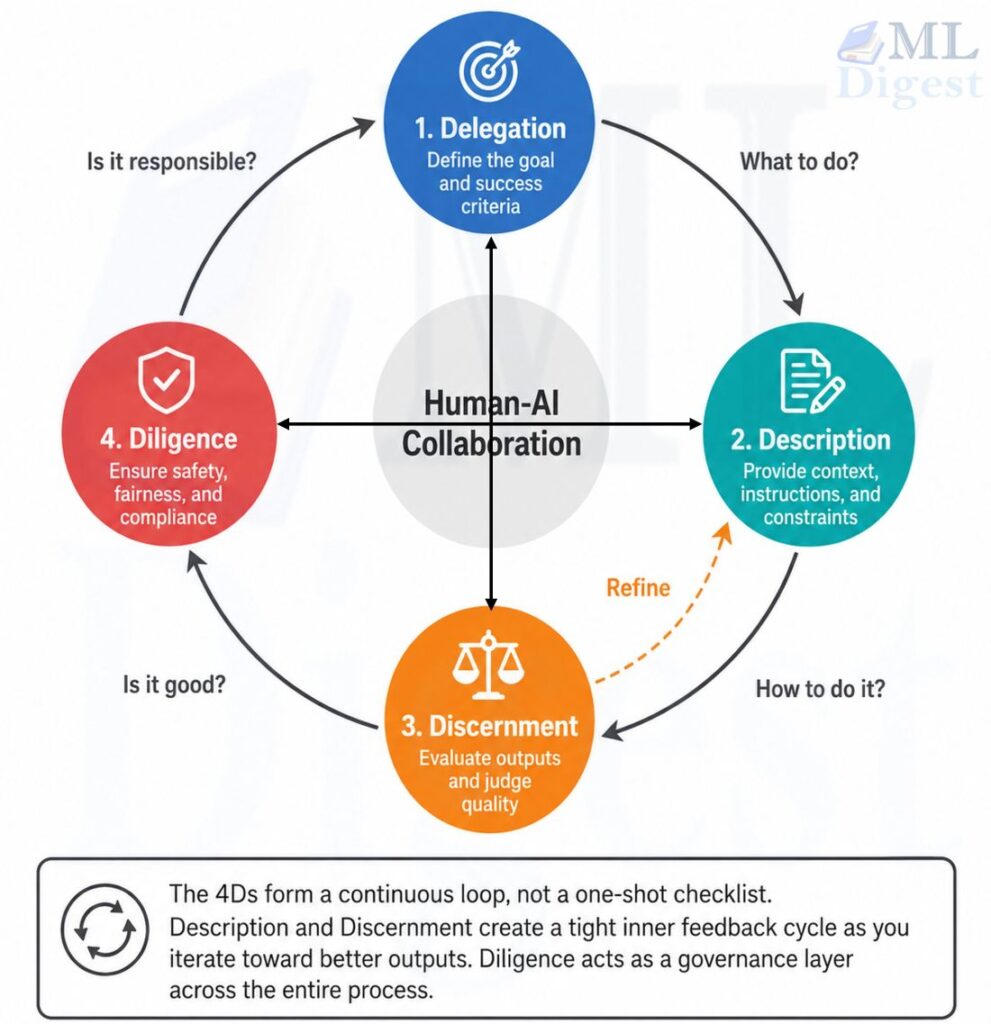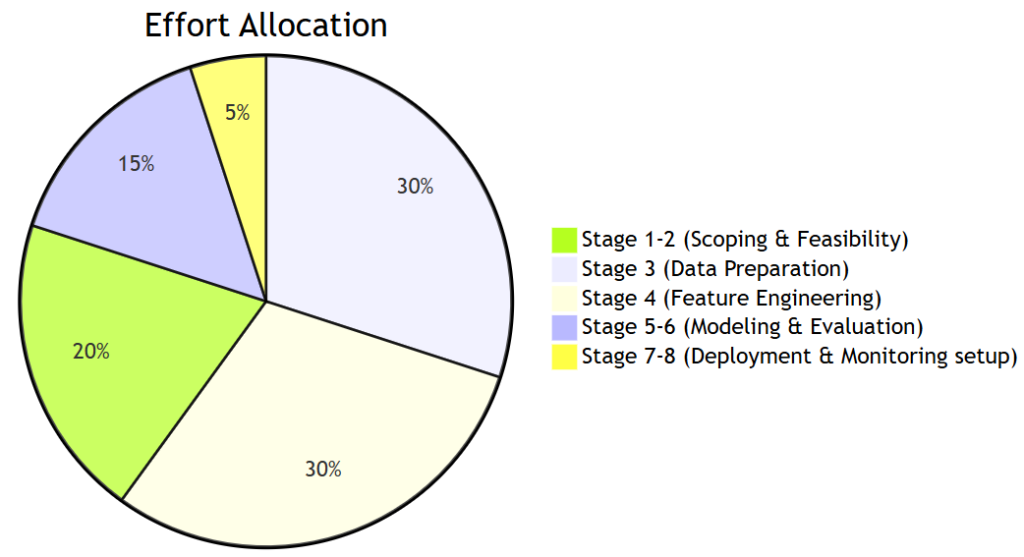
AI is getting cheaper, but not in the simple way headlines suggest. Everyday capabilities are spreading into products, laptops, and factory cameras at lower cost, even as the race to build the next frontier model demands larger clusters, more energy, and scarce chips. This apparent contradiction reveals two different AI economies.
This is not a reason to wait for a single verdict on AI. It is an opportunity to ask a more useful question: what does it cost to obtain a reliable unit of capability for a particular job, at the required latency, scale, and level of risk? Following that question reveals why some applications are becoming remarkably accessible while frontier development remains capital-intensive. The details offer a practical way to see where lower costs can unlock new ideas, better products, and more ambitious work.
1. The apparent contradiction is real
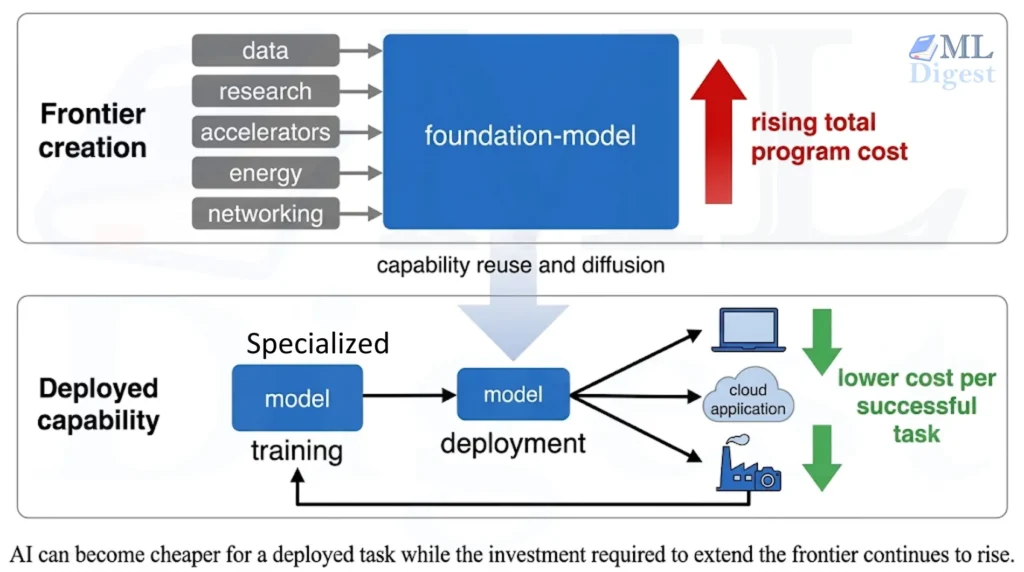
Imagine intelligence as a transportation system. Building the newest aircraft carrier is extraordinarily expensive. Taking a passenger across town, however, becomes cheaper when better engines, mass production, and software make an older capability widely available. AI has a similar two-level economy:
- Frontier creation: training or post-training the best available general-purpose models.
- Capability diffusion: making a useful level of intelligence available to more people and workflows through model reuse, smaller models, better hardware, and better serving systems.
Confusion begins when one number is asked to describe both. A headline about a multibillion-dollar data center says little about the cost of classifying an invoice, drafting a support reply, or extracting data from a form.
1.1 What is getting more expensive?
The compute budget for large frontier models has grown dramatically. The Stanford AI Index tracks the sharp rise in reported training-compute estimates for notable models, while Epoch AI maintains a dataset of public model and compute information. Public estimates are incomplete, but they agree on the direction: leading training programs consume more specialized compute and are now system-building projects rather than simply large experiments.
The bill is also larger than one training run. A serious frontier program includes data acquisition and filtering, distributed-systems engineering, pretraining retries, evaluations, safety work, post-training, and capacity reserved for inference. The latest model can therefore remain scarce even when an earlier generation becomes inexpensive.
1.2 What is getting cheaper?
For a fixed task and an acceptable quality bar, the cost of using a model can fall through several independent channels:
- Algorithms: better data mixtures, architectures, training recipes, and post-training can reach a target capability with less compute.
- Hardware and systems: newer accelerators, faster memory, improved networking, batching, and compilers deliver more useful tokens per dollar.
- Model transfer: knowledge distillation lets an expensive teacher produce data, labels, or supervision that helps a smaller student learn a narrower job.
- Compression: quantization, pruning, and caching reduce the work and memory needed per request.
- Competition and reuse: open weights, cloud capacity, and mature software distribute capabilities that once required a frontier lab.
This is why a model can be expensive to create but cheap to use. The one-time research-and-training cost is spread across a large number of future tasks, and many users do not need the newest capability.
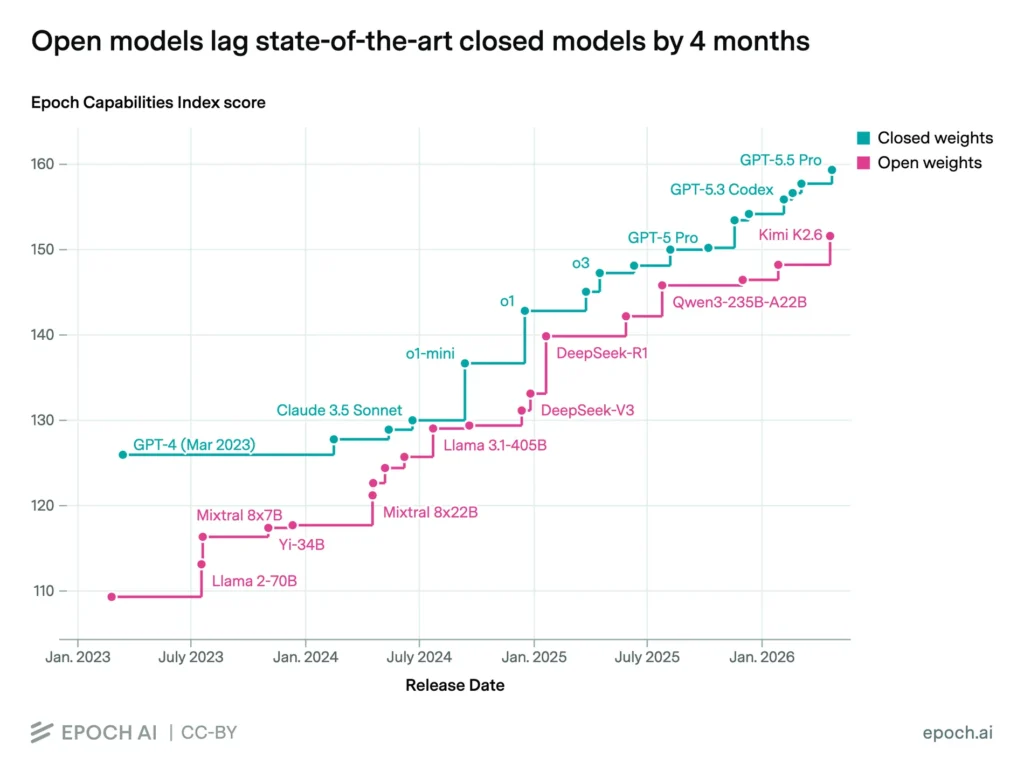
1.3 Open-weight models are turning yesterday’s frontier into a deployable option
The figure captures an important part of capability diffusion. Leading open-weight models increasingly follow closed-weight models with a short delay. At the chart’s endpoint, Epoch AI estimates a gap of roughly four months, meaning that a capability near the frontier can soon become available for self-hosting, fine-tuning, and lower-cost serving.
“Open source model” is common shorthand, but open-weight model is more precise. A release may provide weights without the training data or code, and its licence may restrict some uses. Still, downloadable weights support self-hosting, customization, quantization, data residency, and independence from a single inference provider.
Likely contributors to this catch-up include shared research, released architectures, evaluation methods, training recipes, and distillation. Expensive models can generate explanations or task-specific examples that help teach smaller models, while competition can help turn these advances into deployable releases.
1.4 Smaller models are catching up to the intelligence of earlier large models
Parameter count is a budget, not a direct intelligence score. A recent compact model can outperform a much larger model from an earlier generation because it benefits from better data, architectures, training, post-training, and inference-time scaling.
The useful comparison is new small versus old large, not “every small model beats the latest large model.” For bounded jobs, prompts, retrieval, tools, validation, and output constraints also matter. A newer 8B model with retrieval and a validator can outperform an older 70B model on an invoice workflow.
Mixture-of-experts models make parameter comparisons even less straightforward. They may contain many parameters in total but activate only a subset for each token. Report both total parameters and active parameters, together with memory use and measured throughput, before treating a model as “small” or “cheap.”
2. Start with the right unit: useful intelligence, not tokens or parameters
Token price is observable and convenient, but it is not the economic output. A cheap model that causes costly human rework is not cheap. A slower, more capable model can be cheaper if it resolves a case correctly on the first attempt.
Define an application-level cost per successful task as
$$
C_{\mathrm{success}} = \frac{C_{\mathrm{model}} + C_{\mathrm{retrieval}} + C_{\mathrm{tools}} + C_{\mathrm{human}} + C_{\mathrm{platform}}}{p_{\mathrm{success}}}.
$$
Here, $p_{\mathrm{success}}$ is the probability that the workflow meets its quality, safety, and latency requirements. The numerator includes more than inference: retrieval, tool calls, guardrails, human review, observability, and engineering all matter. The formula is deliberately simple, but it changes the conversation. Optimizing a token rate without measuring task success is like judging a delivery company by fuel cost while ignoring whether parcels arrive.
This ratio should not hide the cost of unrecoverable failures. If failures can cause refunds, remediation, safety incidents, or other material losses, include their expected cost in the numerator or evaluate them as a separate constraint.
Track this metric against a fixed, versioned evaluation set. Otherwise a lower price can be mistaken for progress after a silent drop in answer quality or a change in the mix of requests. For a broader treatment of evaluation design, see how to measure LLM performance.
A capability-price frontier
There is no single “cost of intelligence.” A more honest picture is a frontier with several axes:
| Dimension | Question to measure | Why it changes the decision |
|---|---|---|
| Quality | Does it complete the task correctly? | A weak model creates review and failure costs. |
| Cost | What is the fully loaded cost per successful task? | API price alone omits operations and rework. |
| Latency | Does it respond within the product’s deadline? | A long chain of reasoning may be unusable in real time. |
| Capacity | How many requests can it serve at peak load? | A cheap model is not cheap if it needs excess idle capacity. |
| Risk | Can it meet privacy, audit, and safety requirements? | Some workloads need local execution or review regardless of price. |
The best deployment is usually the cheapest point that clears all five constraints, not the model with the lowest price per million tokens. This is closely related to the deployment choice between edge, cloud, custom models, and model-as-a-service.
3. Why frontier training costs can keep rising
The frontier is a moving target. A lab that is trying to create a new capability is buying an uncertain research outcome, not a fixed amount of existing intelligence. Better algorithms and hardware can lower the cost of yesterday’s target while making a larger experiment feasible tomorrow. The lab may reinvest the saving in more data, context, evaluation, post-training, and capacity rather than spend less.
That is why lower unit costs do not automatically lower frontier budgets. Large-scale training also depends on scarce, interconnected infrastructure, including accelerators, data centers, energy, networking, data, and specialized people. Read The Economics of Frontier Models for the full explanation of this cost stack, the capital cycle, and the two-tier AI economy.
4. Why established capability gets cheaper to use
The opposite trend happens after a capability exists. Training happens periodically, but serving happens for every request. Incremental gains in serving efficiency, model choice, and workload design can therefore reduce the cost of a successful task at enormous scale.
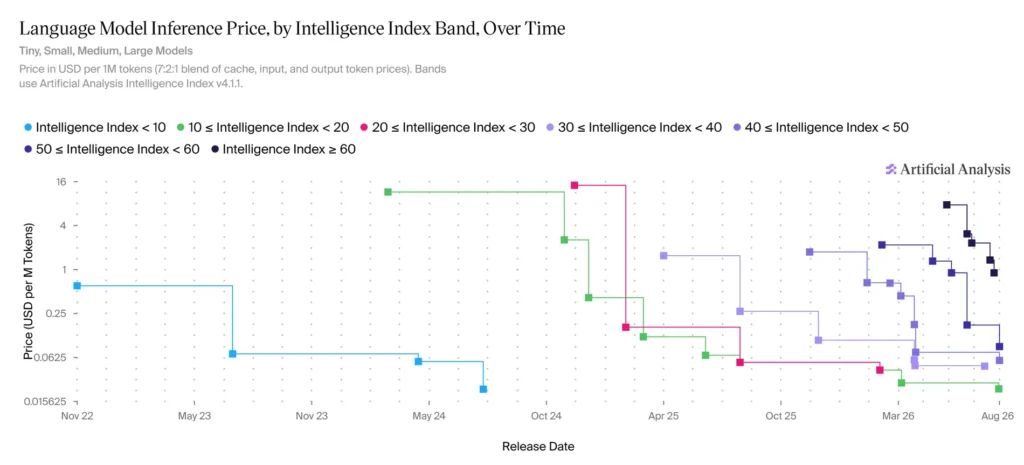
4.1 More work from the same hardware
New accelerators, faster memory, low-precision kernels, compilers, continuous batching, prefix caching, and paged attention can turn idle time and memory overhead into useful capacity. Speculative decoding can accelerate generation when a small draft model has a high acceptance rate. These are workload-dependent gains, not free performance: long prompts, long outputs, concurrency, and tail-latency targets change the result.
Serving also has two distinct phases: prefill, which processes the prompt and builds the KV cache, and decode, which generates output one token at a time. Measure them separately. A cheap model can still be an expensive service if it needs too much memory, misses latency targets, or produces output that requires human rework.
4.2 A smaller model can be the cheaper intelligence
The best model is often not the newest or largest one. A small, well-trained model can clear a narrow task’s quality bar with lower latency, less power, and simpler deployment. Knowledge distillation makes this trade explicit: pay for a strong teacher during data creation or post-training, then serve a compact student repeatedly. A frontier model can remain valuable for difficult cases, evaluation, and escalation without handling every request.
This supports a portfolio rather than a winner-take-all architecture: use rules and caches for deterministic work, compact models for common cases, and stronger models or people for exceptions. See the small-language-model overview for where this approach is most useful.
4.3 Compression lowers the cost of a deployment, not automatically its latency
Quantization stores and computes with lower-precision weights, which can reduce memory use and increase concurrency. Pruning and sparse or mixture-of-experts designs can reduce active compute. These techniques are valuable because they can make a capable model deployable on fewer or smaller accelerators.
They are not automatic speedups. A 4-bit model may not be faster when the serving runtime lacks efficient kernels or when the KV cache is the actual bottleneck. Treat compression as an experiment: compare quality, task success, throughput, time to first token, and tail latency on representative traffic. Use quantization-aware training only when simpler post-training approaches lose unacceptable quality.
5. The key question: does cost fall faster than demand rises?
Total expenditure depends on two things: the cost of completing one task successfully and the number of tasks people want completed. Multiply the cost of one task by the number of tasks to estimate the total spend.
Total spending falls only when the cost of each task drops faster than demand grows. If demand grows faster, spending and infrastructure needs can rise even though every individual task is cheaper.
This is a modern form of the rebound effect, often associated with Jevons’s The Coal Question: efficiency can increase total resource use by making a service affordable in many more situations. Cheaper AI can be used more frequently, embedded in more software, applied to new modalities, and given longer contexts or more tool calls. A company that used a model for support drafts might expand it to every internal document, product surface, test, and workflow.
A numerical thought experiment
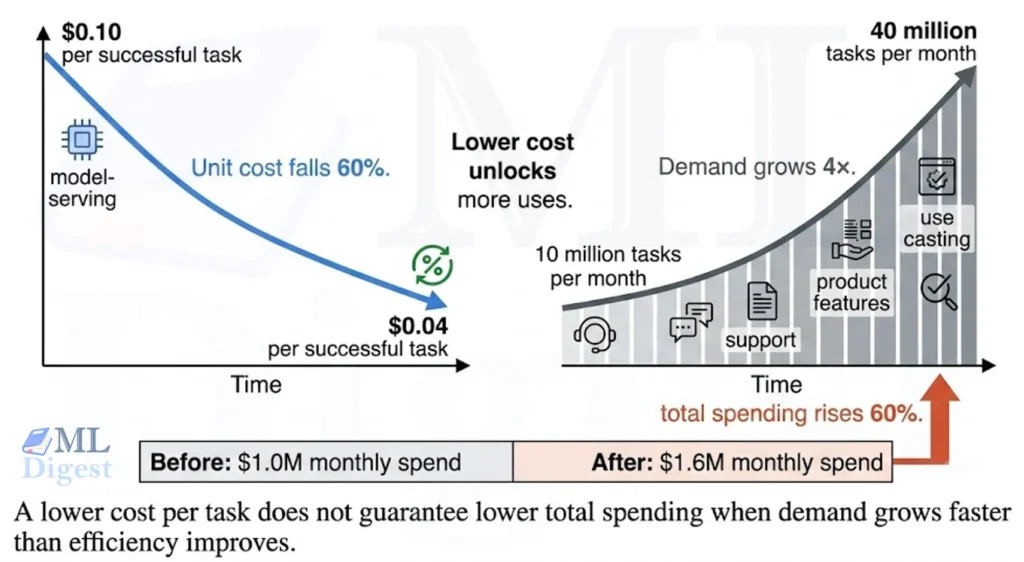
Suppose the cost of a successful task falls from 10 cents to 4 cents, a 60% reduction. At the same time, demand expands from 10 million to 40 million tasks per month, four times as many tasks. Monthly spending starts at $1 million and rises to $1.6 million.
Each task is cheaper, but the total market spend rises by 60%. Neither figure contradicts the other. The organization should plan for lower unit economics and potentially higher aggregate capacity needs.
Two futures can happen at once
The binary framing is useful, but reality can split by capability tier.
| Capability tier | Likely economics | What becomes scarce? |
|---|---|---|
| Established, bounded tasks | Strong pressure toward lower cost through reuse, compression, and competition | High-quality data, integration work, and domain evaluation |
| Production workflows with high stakes | Lower model cost, but non-model costs stay meaningful | Trusted data, auditability, human review, and liability management |
| Latest broad frontier capability | Expensive and capacity-constrained while the frontier keeps moving | Compute clusters, energy, networking, research talent, and proprietary data |
So the likely outcome is not simply “AI is cheap” or “AI is scarce.” Commodity capability can become ubiquitous while the newest, most general, or most trusted capability remains costly. Electricity became broadly available without making every power plant or semiconductor fab cheap to build.
6. A practical method for deciding whether AI is getting cheaper for your product
Do not use industry-wide averages as the basis for a deployment decision. Build a small economic evaluation around the actual work.
6.1 Step 1: define the job and its constraints
Write a testable task contract:
- What input does the system receive and what output is acceptable?
- What error types are unacceptable, expensive, or recoverable?
- What are the latency, throughput, privacy, and availability requirements?
- Can a tool, database, deterministic rule, or retrieval step solve part of the problem more cheaply?
- Who reviews failures, and what does that review cost?
This prevents a common mistake: asking a general model to perform work that a simple rule or a well-designed retrieval step could do. If the product needs external knowledge, retrieval-augmented generation can shift some burden from the model’s parameters to a maintained evidence source, but it introduces retrieval, evaluation, and operational costs of its own.
6.2 Step 2: compare a model portfolio, not one model
Create a fixed evaluation set with common, difficult, adversarial, long-context, and privacy-sensitive examples. Then test at least:
- a small local or low-cost model;
- a medium model that is likely to be the general workhorse;
- a strong frontier model for escalation or quality reference;
- a non-LLM baseline, such as a rule, template, classifier, or search workflow.
Measure quality, latency, reliability, and cost for the complete workflow, including retries and humans. A low-cost model with a 20% escalation rate may be excellent. A low-cost model that creates 20% silent errors may be unacceptable.
6.3 Step 3: route by difficulty and confidence
Many products achieve their best economics with a cascade:
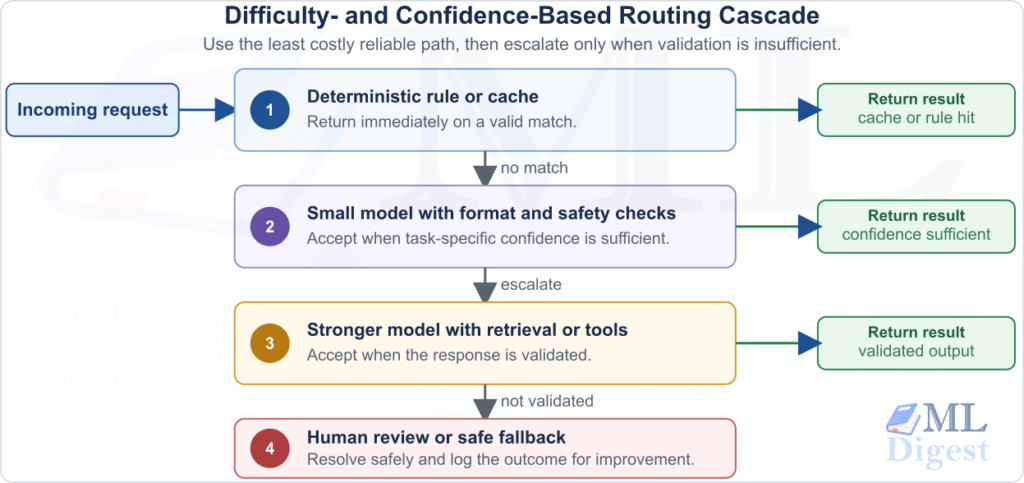
Confidence should not be a raw next-token probability alone. Use task-specific signals such as structured-output validation, retrieval support, calibrated classifiers, and observed performance on similar cases. Agreement among independently prompted runs can be an additional signal, but shared model errors can make correlated answers look confident, so calibrate and validate it on held-out tasks. For background on reliable system design, see guardrails for LLMs.
6.4 Step 4: monitor the economic metric after launch
Track distributions, not only averages. At minimum, watch:
- cost per successful task and cost per request;
- success, escalation, retry, and human-override rates;
- input and output token distributions;
- p50, p95, and p99 latency;
- cache-hit rate, batch utilization, and GPU or API capacity use;
- quality by user segment, language, task type, and input length;
- changes after a model, prompt, retrieval index, or serving-stack update.
An application can become more expensive even after its model price falls, for example when new features create longer prompts or more agentic tool loops. Observability turns that surprise into a measurable engineering trade-off. OpenTelemetry is a useful starting point for tracing the multi-step path that produced a response.
7. The answer: yes for deployed capability, not necessarily for frontier creation
AI is getting cheaper for established, bounded capabilities because better models, hardware, serving systems, compression, and reuse reduce the cost of useful work. This allows AI to spread into ordinary software, devices, and workflows even while frontier models remain expensive to create.
The total bill may still grow if demand for tokens, agents, data-center capacity, and electricity grows faster than unit costs fall. The practical choice is to define a successful task, measure fully loaded cost and quality, use the smallest reliable workflow, and reserve stronger models for cases that need them.

Silpa brings 5 years of experience in working on diverse ML projects, specializing in designing end-to-end ML systems tailored for real-time applications. Her background in statistics (Bachelor of Technology) provides a strong foundation for her work in the field. Silpa is also the driving force behind the development of the content you find on this site.

Happy is a seasoned ML professional with over 15 years of experience. His expertise spans various domains, including Computer Vision, Natural Language Processing (NLP), and Time Series analysis. He holds a PhD in Machine Learning from IIT Kharagpur and has furthered his research with postdoctoral experience at INRIA-Sophia Antipolis, France. Happy has a proven track record of delivering impactful ML solutions to clients. Check more about him here: https://sites.google.com/site/slhappyin/
Subscribe to our newsletter!