
The question “Which frontier LLM is best?” has become less useful than it sounds. A model can lead a broad intelligence index yet be the wrong choice for an interactive product. Another can be cheap and fast enough for millions of calls, yet unsuitable for a high-stakes code migration. A third may have downloadable weights, but still require a restrictive commercial license or infrastructure that costs more than its API alternative.
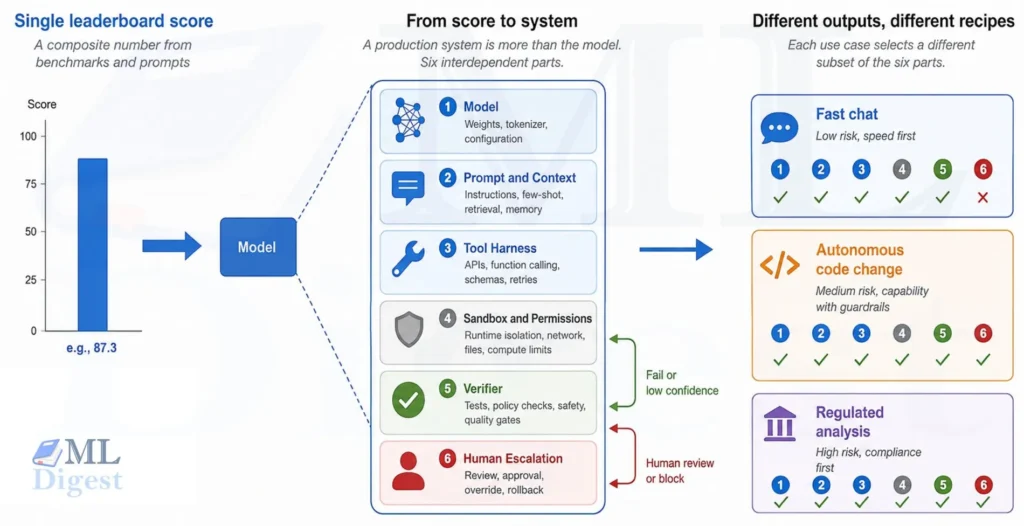
The practical unit of comparison is therefore not a model in isolation. It is a production decision system: a model, a reasoning configuration, a tool harness, a verifier, a latency budget, and a fallback policy.
This article converts the August 2026 frontier landscape into that decision system. Its conclusion is deliberately not a universal 1-to-8 ranking. Instead, it identifies the operational frontier: the choices that remain attractive after capability, cost, latency, modality, governance, and deployment constraints are considered together.
For background on selecting evaluation signals rather than trusting one score, see how to measure LLM performance and agentic-system evaluation.
August 2026 Frontier Model Capability Snapshot
The following table combines independently measured model-page data with official launch information. Intelligence Index scores are useful as a common reference point, but their displayed configuration matters: the values here are for high or maximum reasoning variants, not every endpoint a provider sells.
| Model and evaluated configuration | AA Intelligence Index | API price per 1M input/output tokens | Measured output speed | Context and modality | Overall take | Best at |
|---|---|---|---|---|---|---|
| Claude Opus 5, max | 63 | $5 / $25 | 61.9 tok/s | 1M, text and image input | Best overall / most balanced; premium quality baseline when latency is secondary. | Reasoning, software engineering, agents, and knowledge work. |
| GPT-5.6 Sol, max | 61 | $5 / $30 | 67.0 tok/s | 1M, text and image input | Best coding/agentic contender for controlled, security-aware workflows, subject to entitlement and policy checks. | Coding agents, tool use, terminal coordination, and deep planning. |
| Grok 4.6, high | 61 | $2 / $6 | 69.3 tok/s | 500K, text and image input | Best price/performance among closed models for cost-conscious frontier reasoning and interactive product work. | Agents, general tasks, real-time information, and interactive product-building experiments. |
| Kimi K3, max | 60 | $3 / $15 | 39.5 tok/s | 1M, text and image input | Best open-weight frontier model for customization, if its slower output and commercial-license constraints are acceptable. | Coding, agents, long-context work, and customizable deployments. |
| Gemini 3.7 Flash, high | 56 | $0.75 / $3.75 introductory | 340.1 tok/s | 1M, text, image, speech, and video input | Best fast/cheap workhorse and first-pass router for high-throughput multimodal workloads. | Coding, multimodal workflow tasks, triage, and latency-sensitive experiences. |
| DeepSeek V4 Pro 0813, max | 53 | $1.32 / $3.96 | 89.7 tok/s | 1M, text input | Strong open-weight alternative with an MIT license when text-only deployment is acceptable. | Reasoning/value, private text reasoning, and self-hosted deployment. |
| GLM-5.2, max | 53 | $1.40 / $4.40 | 110.8 tok/s | 1M, text input | Fast open-weight text option for self-hosted or multi-provider deployments. | Fast text reasoning, self-hosting, and multi-provider deployments. |
These figures reflect the pages available at the snapshot date. They should not be used to infer that a one-point score difference is significant for a specific business workflow. The index itself estimates a confidence interval below $\pm 1\%$ for its composite under its methodology, while individual evaluation confidence intervals can be wider.
Three corrections that change the shortlist
1. GLM-5.3 is a documented product endpoint, not yet a comparable public benchmark entry. Z.AI’s GLM Coding Plan documentation lists GLM-5.3 and routes GLM-5.1 and GLM-5.2 requests to it in that plan. However, the public comparison data retrieved for this snapshot was for GLM-5.2, not a separately evaluated GLM-5.3 model card. It would be inaccurate to copy GLM-5.2 scores, parameters, MIT license, or weight availability onto GLM-5.3. Evaluate the exact endpoint before production adoption.
2. Open weights is not equivalent to open source or operationally cheap. Kimi K3 exposes weights, but its Kimi K3 license requires a separate commercial agreement. DeepSeek V4 Pro and GLM-5.2 are listed under MIT. Neither fact alone proves that self-hosting is the lower-cost choice. The Openness Index separates model availability from training-data, methodology, and pipeline transparency for precisely this reason.
3. The low-cost multimodal choice is not the low-risk choice. Google describes Gemini 3.7 Flash as a 1M-context model accepting text, images, audio, and video with configurable thinking. Its model card also states that hallucinations, occasional slowness, timeouts, and uneven knowledge freshness remain known limitations. High throughput reduces queueing cost, but it does not remove the need for task-specific validation.
The important correction: a leaderboard is a projection, not reality
A leaderboard maps a high-dimensional design problem onto one axis. The Artificial Analysis Intelligence Index methodology is unusually useful because its current version combines nine evaluations across agents, coding, scientific reasoning, and general knowledge. Its weights are 34%, 24%, 24%, and 18% respectively. Yet the index is still a text-only, English-language, pass-at-one suite run with a specified harness and set of parameters. It is evidence, not a deployment guarantee.
This distinction matters even more for coding agents. The Artificial Analysis Coding Agent Index evaluates agent variants, not naked models, using DeepSWE, Terminal-Bench v2, and SWE-Atlas-QnA. It explicitly shows that harness choice, token use, wall-clock time, cache behavior, and model settings change outcomes. Holding a model constant while changing the harness can move its score materially.
Think of an agent’s useful output as
$$
\mathrm{useful\ work} = f(\mathrm{model}, \mathrm{prompt}, \mathrm{tools}, \mathrm{state}, \mathrm{budget}, \mathrm{verifier}, \mathrm{operator})
$$
The model is necessary, but it is only one argument of $f$.
Read the frontier as four operating profiles
1. The quality ceiling: Claude Opus 5 and Claude Fable 5
Claude Opus 5 is the current quality-first default in this snapshot. Its 63 Intelligence Index score is accompanied by a $5/$25 input/output price and 1M context in the evaluated maximum-effort configuration. Anthropic reports that Opus 5 approaches Fable 5 on CursorBench at roughly half the cost per task, and that it supports automatic model fallbacks for safety-classifier interventions.
That creates a less obvious recommendation: start with Opus 5 as the premium baseline, then promote only locally demonstrated cases to Fable 5. Fable’s 62 score is close, but it costs $10/$50 per million input/output tokens in its evaluated configuration and had a much higher observed time to first token on the comparison page. A premium model is justified when a correct outcome has much greater value than a slow or expensive one: difficult code review, complex analysis, legal work product under human review, or a sparse set of long-horizon agent tasks.
The caution is important for cybersecurity use. Anthropic states that Opus 5 remains behind Mythos 5 on offensive cyber tasks and applies stronger safeguards to a narrow range of cyber requests. Treat a safety fallback as a normal branch in the product architecture, not an exceptional error.
2. The controlled frontier agent: GPT-5.6 Sol
GPT-5.6 Sol is positioned as OpenAI’s flagship reasoning tier, with max reasoning and an ultra mode that uses subagents for complex work. OpenAI reports a Terminal-Bench 2.1 result at the frontier and emphasizes cybersecurity and biology safeguards. At launch, access was a limited preview for selected trusted organizations through the API and Codex, priced at $5/$30 per million input/output tokens.
The selection rule is not “choose Sol for all coding.” Choose it when the task needs deep planning, strong terminal coordination, or careful security-adjacent defensive work, and when the organization has the required access and governance controls. Its quality can be attractive, but access state and safety intervention are part of its real interface contract.
3. The high-throughput multimodal system: Gemini 3.7 Flash
The term Flash can mislead readers into treating this model as merely a lightweight assistant. The Gemini 3.7 Flash model card reports a 56 Intelligence Index score, 340.1 measured output tokens per second, a 1M context window, and text, image, audio, and video input. This makes it a strong router default for multimodal triage, document processing, first-pass code generation, and latency-sensitive product experiences.
Its role is especially valuable in a cascade. Let Flash handle the high-volume majority, then route low-confidence, high-value, or verifier-failed items upward. A 340-token-per-second worker can make an application feel responsive even when a more deliberate model is reserved for the difficult tail.
4. The open-weight deployment pair: Kimi K3, DeepSeek V4 Pro, and GLM-5.2
Kimi K3 is the capability-oriented open-weight option in this comparison. It reports 2.8T total parameters with 104B active in a mixture-of-experts architecture, 1M context, image input, and a 60 Intelligence Index score. Its trade-off is explicit: 39.5 tokens per second and a license that restricts commercial use without a separate agreement.
DeepSeek V4 Pro and GLM-5.2 shift the trade-off. Both report an Intelligence Index score of 53, 1M text context, MIT licenses, and faster observed output than Kimi K3. DeepSeek reports 1.6T total and 49B active parameters; GLM reports 753B total and 40B active parameters. These details matter for capacity planning because active parameters influence per-token compute, but they do not determine a whole deployment bill. Quantization, batch size, context length, cache behavior, replicas, utilization, observability, and engineering support do as well.
For an explanation of the architectural trade-off, see mixture-of-experts models. For the larger cloud-versus-self-host decision, see LLM deployment from cloud to edge.
The selection function: optimize expected value, not score
A useful model decision begins by excluding infeasible candidates. If a workload requires video input, a text-only open-weight model is not a candidate. If data cannot leave a region, an external API without the required controls is not a candidate. If a task must return inside two seconds, a long-thinking maximum-effort configuration is not a candidate.
For the remaining models, calculate a workload-specific utility:
$$
U(m \mid w) = w_qQ_m + w_rR_m + w_sS_m + w_oO_m – w_cC_m – w_lL_m – w_gG_m
$$
where:
- $Q_m$ is task quality on a held-out local evaluation;
- $R_m$ is reliability, including verifier pass rate and failure variance;
- $S_m$ is throughput or latency fitness;
- $O_m$ is modality and deployment fit;
- $C_m$ is expected total cost per successful task;
- $L_m$ is latency penalty relative to the service-level objective; and
- $G_m$ is governance or operational risk.
The weights belong to the workload, not to the model vendor. A consumer visual assistant might make $w_s$ and $w_o$ dominant. A production database migration should make $w_q$, $w_r$, and $w_g$ dominant. A back-office summarizer may make $w_c$ dominant.
Cost per token is not cost per successful task
For an agent, a more realistic cost estimate is
$$
C_{\mathrm{success}} = \frac{C_{\mathrm{model}} + C_{\mathrm{tools}} + C_{\mathrm{compute}} + C_{\mathrm{review}}}{P(\mathrm{verified\ success})}
$$
This equation explains why a more expensive model can be cheaper. Suppose Model A costs $3 per attempt and passes a verifier 95% of the time, while Model B costs $0.75 and passes 40% of the time. Ignoring retry limits and side effects, their cost per verified success is approximately $3.16 and $1.88 respectively. Model B is cheaper in this example, but only while review, retries, and failure consequences stay small. If B triggers a human review or a long repair loop, its apparent bargain can disappear.
This is the same reason prompt caching and context design deserve engineering attention. Caches, retrieved context, and state summaries change both the numerator and the probability in the equation. See a practical guide to LLM cost reduction and memory in agentic systems.
Build a cascade, not a single-model dependency
The strongest deployment pattern for most teams is a cascade with explicit escalation gates:
- Classify the request. Determine modality, sensitivity, expected complexity, maximum latency, data residency, and whether tools are required.
- Choose the lowest-cost feasible first model. For example, Gemini 3.7 Flash may handle multimodal intake; a self-hosted text model may handle privacy-constrained classification.
- Execute inside bounded permissions. Place file writes, shell commands, network calls, and database operations behind allowlists, scoped credentials, and a sandbox.
- Verify the outcome. Use tests for code, schema checks for structured outputs, retrieval citations for research, reconciliation checks for data work, and policy checks for actions.
- Escalate only when evidence warrants it. Escalate on low confidence, failed verification, high value, ambiguous requirements, or a high-risk action. Do not escalate merely because an answer is verbose.
- Record the outcome. Log model version, reasoning setting, route, token mix, tool calls, verifier result, latency, and human override. This data becomes the next evaluation set.
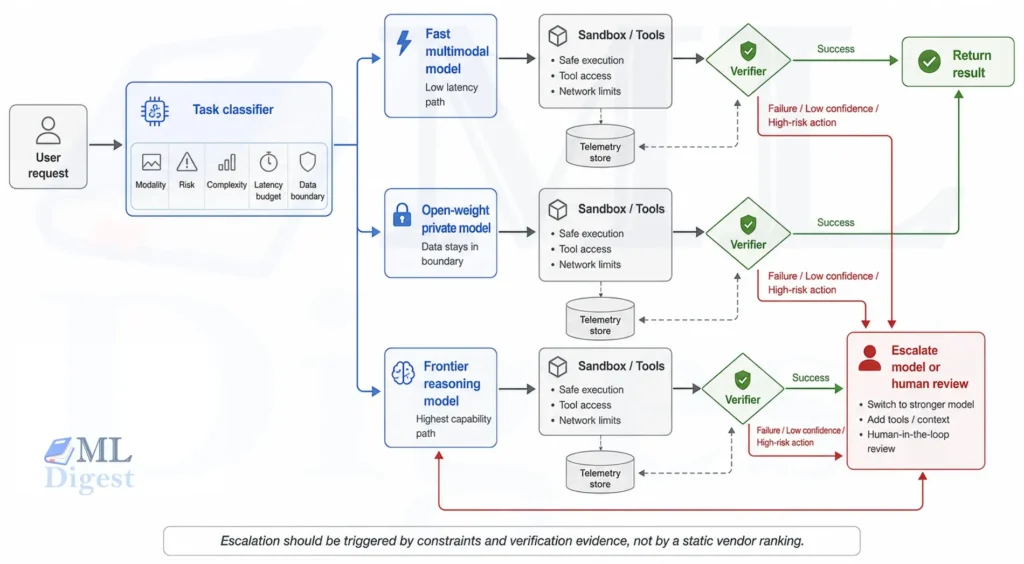
This design makes the system resilient to a provider outage, a temporary safety refusal, model drift, and a benchmark regression. It also aligns with the design principles in agent harnesses, single-agent architecture patterns, and guardrails for LLMs.
Why verification changes the model choice
An unverified agent must be accurate before it acts. A verified agent can be useful even when its first proposal is imperfect, provided it can test, repair, or safely escalate. This shifts investment from an endless search for the highest benchmark score toward better test fixtures, sandboxes, typed tool interfaces, idempotent actions, and rollback plans.
For code, a minimum loop is: inspect repository state, propose a minimal change, run focused tests, inspect the diff, run a broader test suite if the risk warrants it, and request review for irreversible changes. For enterprise workflows, check the final state of the system, not whether the assistant sounded confident. For grounded research, require a claim-to-source trace and distinguish retrieved evidence from inference.
These controls are especially important for prompt injection and external tool use. See the prompt-injection section of the LLM deployment guide and MCP, the Model Context Protocol.
Recommended starting points by workload
| Workload | Starting configuration | Why it is a starting point | Required safeguard |
|---|---|---|---|
| Difficult code changes and code review | Claude Opus 5 or GPT-5.6 Sol, with an established coding harness | Capability ceiling and careful multi-step reasoning are valuable when tests can verify changes. | Ephemeral sandbox, tests, diff review, protected branches, human approval for deployment. |
| High-volume multimodal intake | Gemini 3.7 Flash as default, premium escalation path | Its measured throughput, low introductory price, and audio/video input fit this service shape. | Schema validation, sample-based quality review, escalation for uncertain extraction. |
| Interactive prototype or visual application | Grok 4.6 with explicit artifact tests | It offers frontier-level index performance at lower API price and emphasizes interactive work. | Browser tests, accessibility checks, dependency scanning, review before publishing. |
| Private text reasoning or self-hosting experiment | DeepSeek V4 Pro or GLM-5.2, then Kimi K3 when quality gain justifies the license and latency | MIT availability and faster text output can be operationally attractive; Kimi K3 supplies a higher measured capability point with a different license trade-off. | Capacity plan, license review, red-team evaluation, model supply-chain controls. |
| Multimodal, long-context analytical work | Gemini 3.7 Flash for first pass; Opus 5 or Sol for verifier-failed cases | One model accepts the full media payload quickly; another handles difficult reasoning escalation. | Source provenance, claim verification, PII controls, human sign-off for consequential conclusions. |
| Security-defensive code review | Vendor endpoint approved for the organization, usually Opus 5 or Sol after testing | Both vendors document security-aware capability and safeguards, but access and refusals are part of the workflow. | Scope authorization, audit logs, no autonomous offensive action, security-team review. |
Conclusion: choose a portfolio, then earn the right to simplify it
The August 2026 field offers no single winner. Claude Opus 5 is the strongest broad capability baseline in the referenced independent snapshot. GPT-5.6 Sol and Grok 4.6 are compelling frontier alternatives with different access, price, and safety trade-offs. Gemini 3.7 Flash changes the economics of fast multimodal routing. Kimi K3, DeepSeek V4 Pro, and GLM-5.2 make open-weight deployment a real engineering option, provided that license and infrastructure realities are treated seriously. GLM-5.3 should be evaluated as its own endpoint rather than inferred from GLM-5.2.
Start with two or three complementary models, a versioned local evaluation set, strict verification, and an escalation policy. Then remove models only after evidence shows that one configuration reliably dominates for your workloads. The objective is not to predict the next leaderboard. It is to build an AI system that still works when it changes.

Silpa brings 5 years of experience in working on diverse ML projects, specializing in designing end-to-end ML systems tailored for real-time applications. Her background in statistics (Bachelor of Technology) provides a strong foundation for her work in the field. Silpa is also the driving force behind the development of the content you find on this site.
Subscribe to our newsletter!