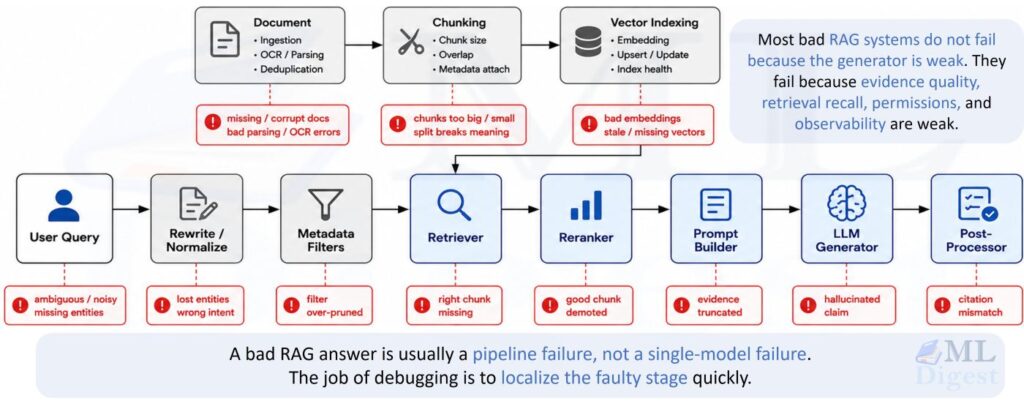
Retrieval-Augmented Generation (RAG) is a technique that acts as an open-book exam for Large Language Models (LLMs). It allows a model to browse external data references at query time, rather than relying solely on its static training memory.
The Intuition: The Open-Book Exam
Imagine you are a student sitting for a final exam in Advanced Quantum Physics.
- Scenario A (Pure LLM): You are taking a closed-book exam. You must rely entirely on what you memorized during your studies months ago. If you forgot a specific constant or a recent formula, you might hallucinate a plausible-sounding but incorrect answer to fill the gap.
- Scenario B (RAG): You are taking an open-book exam. You are allowed to carry a textbook and a notebook into the hall. When a question asks about a specific experiment, you do not just guess; you look up the exact page, read the relevant paragraph, and then synthesize the answer.
RAG transforms the LLM from Scenario A to Scenario B. It gives the model access to a dynamic library of information that it can search, read, and use to generate accurate responses.
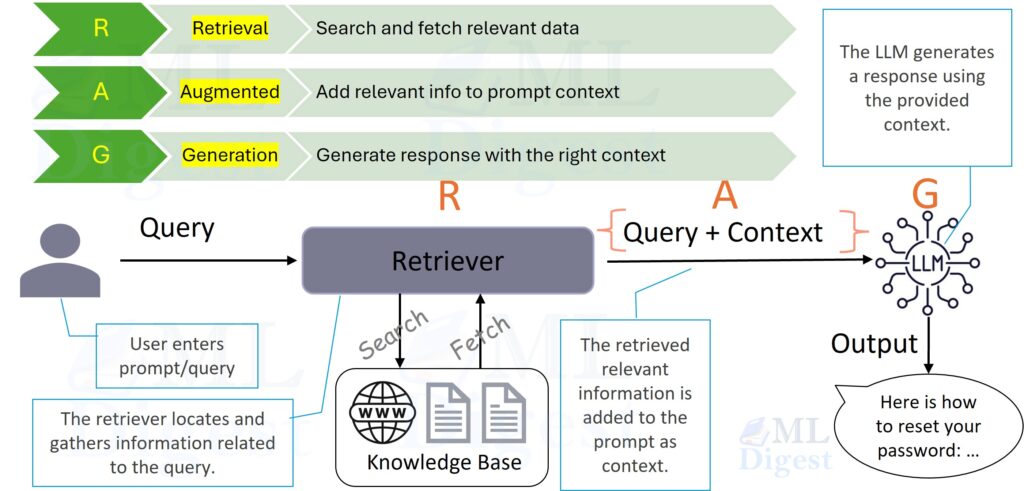
In this guide, we will explore the architecture of RAG, the mathematics behind the retrieval mechanism, and the code required to build it.
1. Why RAG?
1.1 The Limitations of Fixed Weights
Large Language Models are powerful reasoning engines, but when used in isolation, they suffer from significant memory limitations:
- Fixed Knowledge Cutoff: A model only knows what it saw during its training. It is unaware of events or documents created after that date.
- Hallucinations: When a model is unsure, it often prioritizes fluency over factuality, generating confident but wrong assertions.
- High Update Costs: Updating a model’s internal knowledge requires retraining or extensive fine-tuning, which is computationally expensive and slow.
- Opacity: It can be difficult to trace why a model produced a specific answer, or to provide auditable sources.
These limitations become acute in real systems where:
- Content changes frequently (documentation, policies, product catalogs).
- Compliance and traceability matter (finance, healthcare, legal).
- You must reduce hallucinations and provide citations.
1.2 The Strategic Value of RAG
RAG is not merely “adding a vector database.” It is a separation of concerns:
- Knowledge storage lives in your corpus and index.
- Reasoning and writing live in the LLM.
This separation is operationally important: you update the corpus without retraining the model.
1.3 The Core Idea of RAG
RAG addresses these problems by decoupling knowledge storage from reasoning:
- The Retriever acts as the librarian. It finds the relevant pages from a knowledge base (like a vector database).
- The Generator acts as the writer. It takes the user’s question and the retrieved pages, then synthesizes an answer.
High-level data flow:
- Query: The user asks a question $q$.
- Search: The system searches a large corpus $\mathcal{C}$ for the top-$k$ most relevant chunks.
- Augment: The system feeds both the question $q$ and the retrieved chunks into the LLM.
- Generate: The LLM generates a response grounded in the retrieved text.
This architecture makes systems maintainable. If your company updates its vacation policy, you simply update the document in the database. You do not need to retrain the neural network.
2. High-Level RAG Architecture
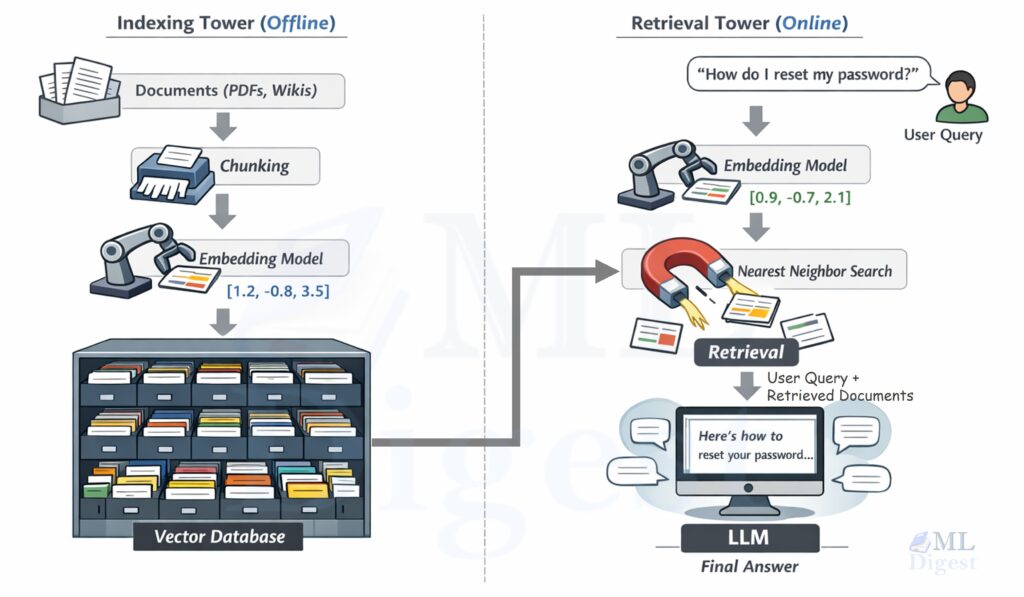
It is useful to separate RAG into two pipelines: an offline indexing pipeline (prepare the corpus) and an online retrieval + generation pipeline (answer user queries).
2.1 RAG Flow
In the above figure, the two vertical “towers” are connected by a shared embedding space.
- The indexing tower turns documents into vectors and stores them.
- The retrieval tower turns the user query into a vector, finds nearby vectors, and hands the matching text to the LLM.
The Indexing Tower (Offline)
- Documents: You start with your knowledge base (PDFs, Wikis, HTML pages).
- Chunking: You slice these documents into small, digestible semantic units—like paragraphs in a textbook.
- Embedding: You pass these chunks through an Embedding Model, which converts text into a vector (a list of numbers).
- Index: You store these vectors in a Vector Database, creating a geometric map of your knowledge.
The Retrieval Tower (Online)
- User Query: A user asks, “How do I reset my password?”
- Query Embedding: The same Embedding Model converts this question into a vector.
- Nearest Neighbor Search: The database calculates the distance between the question-vector and all document-vectors, finding the closest matches.
- Generation: The LLM receives the prompt: “Context: [Retrieved Chunks]. User Question: [Query]. Answer:”
2.2 Key Components
- Orchestrator: Application code (framework or custom) that manages ingestion, retrieval, prompt construction, and citations.
- Retriever: The search component, typically:
- Embedding model: Converts text to vectors (for example, modern
bge/E5/GTEfamilies). - Vector store: Performs nearest-neighbor search (FAISS, Qdrant, Pinecone, pgvector).
- Embedding model: Converts text to vectors (for example, modern
- Generator: The LLM that synthesizes the final answer.
2.3 A Minimal “Prompt Contract” (Grounding Rule)
In practice, much of RAG quality comes from a simple contract you enforce in the prompt:
- Use the retrieved context as the primary evidence.
- If the answer is not supported by the retrieved context, say that the evidence is insufficient.
- When possible, cite or quote the specific passages used.
This contract turns retrieval into a measurable bottleneck: if the retriever fails to surface the relevant passage, the generator should not guess.
3. Mathematical View
Let us formalize the retrieval and generation steps.
3.1 Offline Pipeline: Indexing
RAG is easiest to reason about when you separate what happens before any user question (offline) from what happens at question time (online).
The offline pipeline builds a search structure over your corpus.
- Documents: Let $\mathcal{D} = \{d_1, \ldots, d_M\}$ be the raw documents.
- Chunking: A chunker splits each document into smaller, atomic units (passages) so we can retrieve precise information later:
$$
g(d_i) = (z_{i,1}, \ldots, z_{i,n_i}).
$$
Let the full chunk set be $\mathcal{C} = \bigcup_{i=1}^{M} \{z_{i,1}, \ldots, z_{i,n_i}\}$.
- Embedding: An embedding model $f_\phi$ maps each chunk to a vector:
$$
e(z) = f_\phi(z) \in \mathbb{R}^d.
$$
- Indexing: An index $\mathcal{I}$ stores all chunk embeddings (plus metadata) to support fast nearest-neighbor search:
$$
\mathcal{I} \leftarrow \operatorname{BuildIndex}(\{(e(z), z) : z \in \mathcal{C}\}).
$$
3.2 Online Pipeline: Retrieval + Generation
Given a user query $q$, the system:
- Embeds the query: $e(q) = f_\phi(q)$.
- Retrieves evidence: query the index for top-$k$ chunks.
- Generates an answer: condition the language model on the query plus the retrieved chunks.
The rest of this section makes steps (2) and (3) more explicit.
3.2.1 The Retrieval Space
The relevance score $s(q, z)$ is commonly defined by the dot product or cosine similarity between vectors:
$$
s(q, z) = \frac{f_\phi(q)^\top f_\phi(z)}{|f_\phi(q)| |f_\phi(z)|}
$$
Details for normalization and similarity
Two common similarity functions are used:
- Cosine similarity: compares direction, not magnitude.
- Inner product (dot product): often used with normalization so it behaves like cosine.
If you $L_2$-normalize all vectors (both chunks and queries), then:
$$
\operatorname{cos}(q, z) = \frac{e(q)^\top e(z)}{|e(q)|\,|e(z)|} = e(q)^\top e(z)
$$
That simple trick is why many implementations normalize and then use an inner-product ANN index.
The retriever selects the Top-$k$ chunks ($\mathcal{Z}_k$) that maximize this score:
$$
\mathcal{Z}_k = \operatorname*{Top-k}_{z \in \mathcal{C}} s(q, z)
$$
You can also express retrieval as an (approximate) distribution over chunks, for example by normalizing scores with a softmax:
$$
P(z \mid q) = \frac{\exp(\beta\, s(q, z))}{\sum_{z’ \in \mathcal{C}} \exp(\beta\, s(q, z’))}
$$
where $\beta$ is a temperature parameter. In practice, this distribution is approximated by restricting the denominator to the retrieved set $\mathcal{Z}_k$.
3.2.2 Probabilistic Generation
Standard language modeling estimates the probability of a sequence $y$ given an input $q$:
$$
P(y \mid q)
$$
In RAG, we treat the retrieved document $z$ as a latent variable. In our student analogy, this corresponds to the probability of selecting a specific book $z$ from the shelf to answer the question. The generation probability marginalizes over all possible documents. Ideally, we would sum over all passages in the corpus:
$$
P(y \mid q) = \sum_{z \in \mathcal{C}} P(y \mid q, z) P(z \mid q)
$$
However, summing over the entire corpus $\mathcal{C}$ is computationally intractable. In practice, we approximate this sum using the top-$k$ retrieved documents $\mathcal{Z}_k$:
$$
P(y \mid q) \approx \sum_{z \in \mathcal{Z}_k} P(y \mid q, z) P(z \mid q)
$$
- $P(z \mid q)$ represents retrieval confidence (often a normalized score).
- $P(y \mid q, z)$ represents the generator probability given the query and a specific passage.
In many implementations, the system concatenates the top-$k$ passages into a single context block $c = [z_1; \dots; z_k]$ and conditions generation on that block:
$$
y \sim P(y \mid q, c)
$$
This mathematical view highlights the core improvement RAG offers: we represent the probability of an answer not just as a function of the model’s weights $\theta$, but as a function of the explicitly retrieved context $c$.
4. Building Blocks in Practice
In this section, we connect the concepts to concrete implementation steps.
The components are: Ingest Documents → Clean → Chunk → Annotate → Embed → Index → Retrieve → Prompt Construction → Generate Output.
Ingest Documents
Ingest Documents
First, you must build your knowledge base. The first step is to load documents from various sources such as PDFs, HTML files, Word documents, Markdown files, or database dumps.
Clean
Clean
Once documents are loaded, you need to strip noisy content. This includes removing headers, footers, navigation elements, and repeated banners that do not contribute to the semantic meaning of the text.
Chunk
Chunking
Next, split the long text into smaller semantic units.
Fixed-size, token-based sliding windows are a simple and reliable baseline for chunking. In this approach text is cut into uniform windows (for example, 512-token windows with a 64-token overlap) and each window is treated as an independent retrieval unit. This method is robust, easy to implement, and works well when documents lack clear structure or when a predictable index size and search cost are required. The main drawbacks are that logical units (sentences, paragraphs, or procedures) can be split across chunk boundaries, which can harm citation quality and make it harder for a generator to find a contiguous piece of evidence; using modest overlap reduces this risk at the cost of some redundancy.
Structure-aware or semantic chunking instead leverages the document layout and linguistic cues to produce chunks that align with human-readable units. Text is split by headings, paragraph breaks, lists, code blocks, or other semantic boundaries so that each chunk preserves a complete idea—an API endpoint description, a policy clause, a procedure step, or a self-contained example. This strategy tends to yield higher-quality citations and makes retrieved passages easier for an LLM to use directly, but it requires reliable parsing of input formats and fallback rules for poorly structured content.
In practice, many systems combine both approaches: apply structure-aware chunking where possible and fall back to sliding windows with overlap when semantic boundaries are absent or insufficient.
You usually want chunks that are large enough to contain useful context, but small enough to not waste prompt space.
Chunk for Retrieval, Not for Reading
Chunking is not summarization. The goal is that a single retrieved chunk contains the exact sentence or paragraph that can serve as evidence. If your corpus is written as long narratives, a small overlap can help prevent “facts on the boundary” from being split across chunks.
Annotate
Annotate
Attach metadata for filtering and citations:
- Source URL or file path
- Document title and heading path
- Timestamps, authors, access control tags
Embed
Chunk Embedding
You need to turn each chunk into a vector $e(z) \in \mathbb{R}^d$ that the retriever can search. The intuition is geometric: imagine every chunk becomes a point on a map. Similar ideas live near each other. When a user asks a question, you compute a point for the question and then you go looking for the nearest points.
Choosing an embedding model
Think of an embedding model as a compressor that keeps meaning and discards surface form. The same idea phrased with different wording should land in roughly the same region.
Practical considerations:
- Domain match: a general-purpose embedding model is often enough for documentation and product text; specialized domains (legal, biomedical) usually benefit from domain-trained embeddings.
- Dimensionality and cost: larger $d$ can help but increases memory and search time. In most systems, model choice matters more than squeezing a few dimensions.
Index
Indexing
Store the vectors in a data structure that supports fast nearest-neighbor queries.
What you store per chunk
Embeddings alone are not enough. You also want metadata for filtering and for citations:
doc_idorurlchunk_id(stable and deterministic)- title / heading path
- timestamps (for recency filters)
- access tags (if you do ACL-aware retrieval)
If you want citations, treat chunk_id as a first-class citizen. A good shape looks like doc-id#chunk-0007.
Index choices: brute force vs. ANN
- Exact search (brute force): simplest, good for small corpora. Compute similarity against all vectors. Becomes expensive when you have tens of thousands of chunks or more.
- Approximate nearest neighbor (ANN): trades a tiny amount of recall for large speedups. Common options include FAISS (local), HNSW-based stores (Qdrant), and pgvector for Postgres-backed setups.
The core design idea is the same: store $\{e(z_i)\}$ and find the top-$k$ by similarity.
Retrive
Retrieval
Now we move to the online phase: you have a user question and you want to fetch evidence.
The intuition is the librarian walk:
- Take the question and translate it into the same “map coordinates” as your documents.
- Walk to the nearest shelves (nearest vectors).
- Pick a small stack of pages ($k$ chunks) that are most likely to contain the answer.
This is the step that often determines whether the system is faithful. If retrieval fails, generation becomes guesswork.
The online retrieval loop
At query time, you typically do:
- Preprocess the query: optional spell fix, lowercasing, removal of boilerplate, query rewriting for conversational context.
- Embed the query: $e(q) = f_\phi(q)$.
- Search for top-$k$ chunks: retrieve $\mathcal{Z}_k$ with dense similarity.
- (Optional) Hybrid merge: combine dense retrieval with sparse retrieval (BM25) for better recall.
- (Optional) Rerank: use a cross-encoder reranker to reorder the candidates.
- Select context: choose top-$m$ chunks to send to the generator, possibly with a token budget.
The simplest approach is Step (2) + (3). Most production systems end up adding Step (5).
Dense vs. sparse vs. hybrid
- Dense (embeddings): great at semantic matches: synonyms, paraphrases, and conceptual similarity.
- Sparse (BM25 / keyword): great at exact terms: error codes, IDs, API names, and rare tokens.
- Hybrid: often best in practice because it reduces “misses” caused by either method alone.
You can combine scores with a weighted sum:
$$
\operatorname{score}(z \mid q) = \alpha\, s_{\text{dense}}(q, z) + (1 – \alpha)\, s_{\text{sparse}}(q, z)
$$
where $\alpha \in [0, 1]$.
Why reranking is a big deal
Dense retrieval is fast but imperfect. It can retrieve passages that are on-topic but do not contain the actual answer.
A reranker (often a cross-encoder) reads (query, passage) pairs and assigns a more faithful relevance score. It is slower, so you use it on a small candidate set:
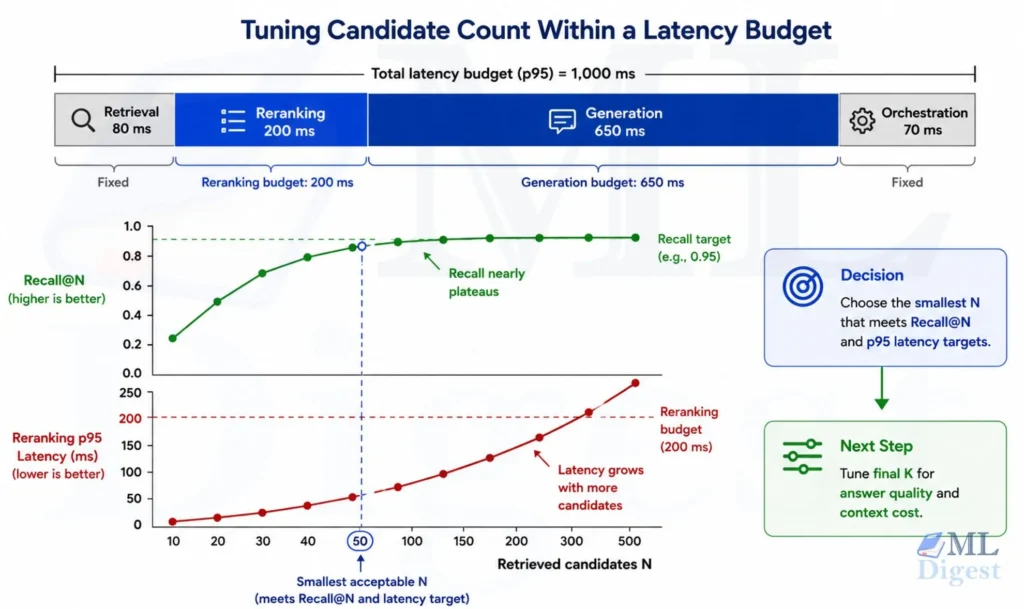
- Retrieve top-50 to top-200 candidates with a fast retriever.
- Rerank those candidates.
- Keep top-3 to top-10 for the LLM prompt.
Practical knobs that matter
- Top-$k$ for retrieval: increase for recall, decrease for speed.
- Overlap and chunk size: impacts whether an answer fits in one chunk.
- Filtering: limit by product/version/date/user permissions; improves precision.
- Deduplication: remove near-duplicate chunks, otherwise the prompt wastes budget.
Retrieval output format
Before you pass retrieved chunks to the generator, treat them as “sources”:
- Assign or reuse stable identifiers:
doc_id#chunk_id. - Keep the chunk text intact (do not paraphrase evidence).
- Include lightweight metadata (title, heading) for readability.
That structure makes it easy to demand citations later.
Prompt Construction
Prompt Construction
A Small Prompt Upgrade: Citations
If each chunk has a stable identifier (URL, doc id + chunk id), you can format the context as numbered sources:
[docA#chunk12] ...[docB#chunk03] ...
Then instruct the model to cite like [docA#chunk12]. This is a simple change that dramatically improves auditability.
The prompt contract
In most RAG systems, reliability comes from a simple contract written into the prompt:
- Use the provided sources as primary evidence.
- If the sources do not support a claim, say that the evidence is insufficient.
- Cite sources at the sentence level.
- Keep citations stable and machine-checkable.
This turns correctness into an engineering problem: you can evaluate retrieval quality and citation accuracy, not just the fluency of the final prose.
A practical prompt template
Below is a prompt template that works well as a baseline. The important part is the structure: sources are listed with stable identifiers, and the answer must cite them.
System:
You are a helpful assistant. Follow the rules strictly.

Rules:
1) Use only the Sources for factual claims.
2) If the Sources do not contain enough evidence, say: "The evidence is insufficient."
3) Cite sources using brackets like [docA#chunk12].
4) Do not invent citations.

Sources:
1. [docA#chunk12] (Title: ..., Section: ...)
    ...chunk text...
2. [docB#chunk03] (Title: ..., Section: ...)
    ...chunk text...

User Question:
...user question...

Answer:
If you want the model to be even more grounded, constrain the format of the answer, for example:
Answer format:
- Short answer (1-2 sentences)
- Evidence bullets (each bullet must include a citation)
Stronger guarantees: Quote next to each citation
The most common failure mode in citation-based RAG is “citation laundering”: the model gives a plausible claim and attaches a real-looking citation that does not actually support it.
One practical mitigation is to require a short quote next to each citation:
When you cite a source, include a short quote (one sentence) from that source.
Format: Claim ... [docA#chunk12: "quoted sentence"]
This makes citations auditable and easier to automatically verify.
Prompt sizing
You usually have two budgets:
- Retrieval budget: how many candidates you fetch (top-50, top-200).
- Prompt budget: how many chunks you actually include (top-3, top-10).
The prompt budget is typically smaller. A clean approach is to keep adding sources until you hit a token limit, while prioritizing:
- reranked relevance
- diversity (avoid duplicates)
- coverage across documents
Generate Output
Generate Output
Then call your LLM (via API or local inference) with this prompt to generate the final answer.
Generation settings: Reduce creative drift
Even with good retrieval, generation can drift. Settings that often improve faithfulness:
- Lower temperature.
- Ask for concise answers.
- Ask for an explicit “insufficient evidence” fallback.
In practice, the best guardrail is still prompt contract + citation checks.
Example Implementation in Python
Example: Simple RAG Pipeline in Python
Below is an end-to-end implementation of a minimal RAG pipeline using sentence-transformers for embeddings and faiss for vector search. This class demonstrates indexing, retrieval, and prompt construction.
To run it locally, you will need the packages:
sentence-transformersfaiss-cpu(orfaiss-gpu)numpy
from __future__ import annotations

from dataclasses import dataclass
from typing import List, Optional

!pip install faiss-cpu
import faiss
import numpy as np
from sentence_transformers import SentenceTransformer


@dataclass(frozen=True)
class Chunk:
    chunk_id: str
    doc_id: str
    heading: str
    text: str


class SimpleRAG:
    """A minimal, runnable RAG skeleton: chunk -> embed -> search -> prompt."""

    def __init__(self, model_name: str = "sentence-transformers/all-MiniLM-L6-v2"):
        self.encoder = SentenceTransformer(model_name)
        self.chunks: List[Chunk] = []
        self.index: Optional[faiss.Index] = None

    def build_index(self, documents: List[tuple[str, str]], chunk_size: int = 120, overlap: int = 20) -> None:
        """Build an in-memory FAISS index over (doc_id, text) documents."""
        self.chunks = self._chunk_documents(documents, chunk_size=chunk_size, overlap=overlap)

        texts = [c.text for c in self.chunks]
        embeddings = self.encoder.encode(texts, convert_to_numpy=True, show_progress_bar=True)

        # Normalize for cosine similarity via inner product.
        faiss.normalize_L2(embeddings)

        d = embeddings.shape[1]
        self.index = faiss.IndexFlatIP(d)
        self.index.add(embeddings)

    def retrieve(self, query: str, top_k: int = 5) -> List[tuple[Chunk, float]]:
        if self.index is None:
            raise ValueError("Index is not built. Call build_index first.")

        q_emb = self.encoder.encode([query], convert_to_numpy=True)
        faiss.normalize_L2(q_emb)

        scores, indices = self.index.search(q_emb, top_k)

        results: List[tuple[Chunk, float]] = []
        for score, idx in zip(scores[0], indices[0]):
            if idx == -1:
                continue
            results.append((self.chunks[int(idx)], float(score)))
        return results

    def generate_prompt(self, query: str, retrieved: List[tuple[Chunk, float]]) -> str:
        sources = []
        for chunk, _score in retrieved:
            sources.append(
                f"[{chunk.chunk_id}] ({chunk.doc_id} · {chunk.heading})\n{chunk.text}"
            )

        sources_block = "\n\n".join(sources)
        return (
            "You are a helpful assistant. Answer the question using only the sources below.\n"
            "If the sources do not contain enough evidence, state that the evidence is insufficient.\n\n"
            "Sources:\n"
            f"{sources_block}\n\n"
            f"Question: {query}\n"
            "Answer with citations like [chunk_id]."
        )

    def _chunk_documents(
        self, documents: List[tuple[str, str]], chunk_size: int, overlap: int
    ) -> List[Chunk]:
        """Simple word-window chunker with stable chunk ids and lightweight metadata."""
        if chunk_size <= overlap:
            raise ValueError("chunk_size must be larger than overlap")

        chunks: List[Chunk] = []
        step = chunk_size - overlap
        for doc_id, heading, text in documents:
            words = text.split()
            for start in range(0, len(words), step):
                window = words[start : start + chunk_size]
                if not window:
                    continue
                chunk_index = len(chunks)
                chunk_id = f"{doc_id}#chunk{chunk_index:04d}"
                chunks.append(
                    Chunk(
                        chunk_id=chunk_id,
                        doc_id=doc_id,
                        heading=heading,
                        text=" ".join(window),
                    )
                )
        return chunks


if __name__ == "__main__":
    # Each document is (doc_id, text). In production, doc_id would map to a URL or file.
    docs = [
        (
            "docA", "titleA",
            "RAG helps LLM applications by retrieving external text at query time and grounding answers on that text.",
        ),
        (
            "docB", "titleB",
            "Fine-tuning updates a model weights using additional training data; it is useful for behavior and style but is costly to keep current.",
        ),
    ]

    rag = SimpleRAG()
    rag.build_index(docs)

    query = "How does RAG help LLM applications?"
    retrieved = rag.retrieve(query, top_k=2)
    prompt = rag.generate_prompt(query, retrieved)

print(prompt)The output prompt will look like this:
You are a helpful assistant. Answer the question using only the sources below.
If the sources do not contain enough evidence, state that the evidence is insufficient.

Sources:
[docA#chunk0000] (docA · titleA)
RAG helps LLM applications by retrieving external text at query time and grounding answers on that text.

[docB#chunk0001] (docB · titleB)
Fine-tuning updates a model weights using additional training data; it is useful for behavior and style but is costly to keep current.

Question: How does RAG help LLM applications?
Answer with citations like [chunk_id].
You would then send this prompt to your chosen LLM (e.g., OpenAI, Anthropic, or a local Llama model) to generate the final response.
5. Variants and Extensions of RAG
The basic RAG pattern (single-step retrieve-then-generate) is powerful, but many real systems use more sophisticated variants.
5.1 Multi-Stage and Hybrid Retrieval
To improve recall and precision, you can:
- Hybrid retrieval
- Combine dense retrieval (embeddings) with sparse retrieval (BM25, keyword search).
- Example: score =
alpha * dense_score + (1 - alpha) * sparse_score.
- Reranking
- First retrieve a larger set (e.g., top-100) with a fast method.
- Then use a cross-encoder or reranker model to rescore the candidates and choose the top-k to feed into the LLM.
- Metadata-aware retrieval
- Filter by structured metadata (date, language, customer id).
Why Reranking Helps (Intuition)
Dense retrieval is fast and good at semantic recall, but it can mis-rank passages that share “topic words” without containing the precise answer. A reranker (often a cross-encoder) reads the query and a candidate passage together and produces a more faithful relevance score.
In practice, a strong baseline is:
- Retrieve top-50 to top-200 candidates with a fast retriever.
- Rerank with a cross-encoder.
- Send top-3 to top-10 to the generator.
5.2 Iterative / Conversational RAG
In conversational settings, you often want to:
- Incorporate chat history alongside retrieved documents.
- Perform follow-up retrieval based on intermediate results.
Example flow:
- Use the latest user message and some history as the query.
- Retrieve context and answer.
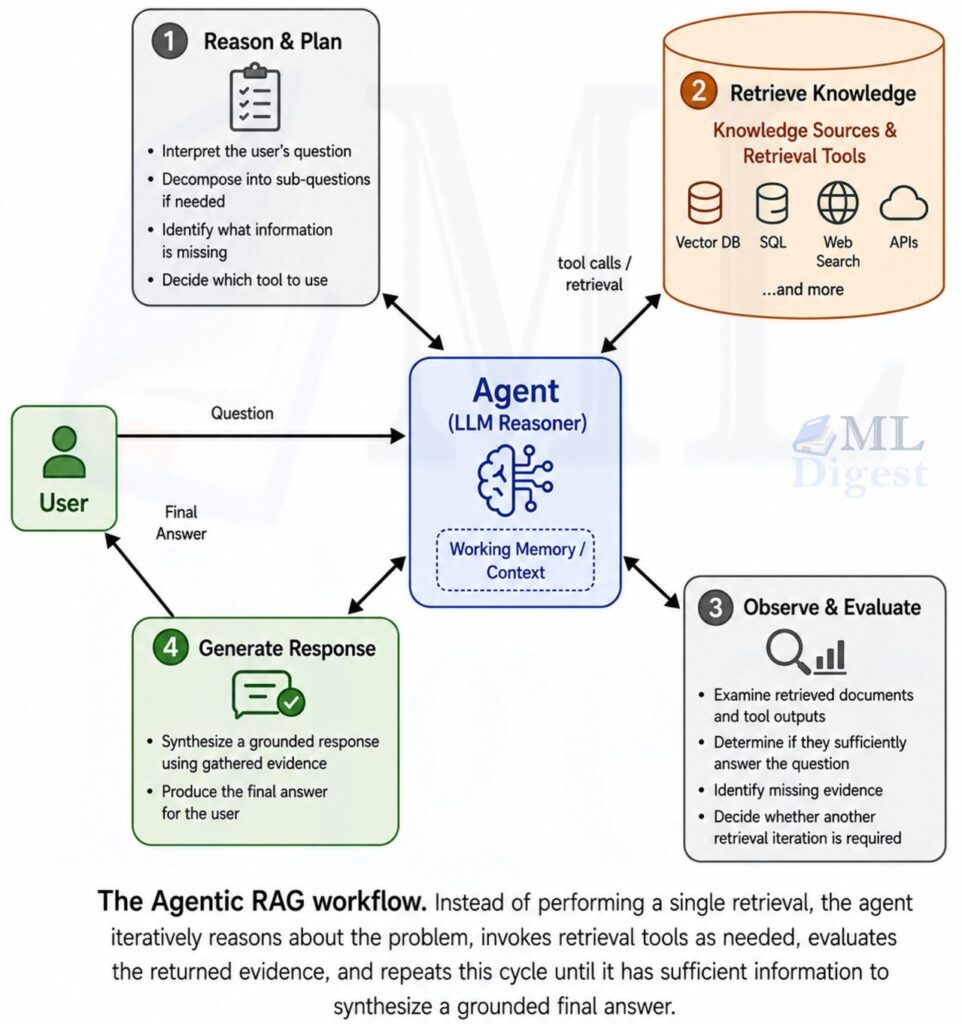
- If the model detects that information is missing, it may issue another retrieval (sometimes guided by tool calls or special prompts).
5.3 Agentic RAG and Tools
In more advanced systems, the LLM acts as an agent that can:
- Decide when to call a retriever tool.
- Decide which collection or index to query.
- Possibly call other domain-specific tools (search APIs, databases, calculators) and combine the results.
The core idea remains the same: ground the model’s reasoning in external, query-time information.
5.4 Knowledge Graph RAG (KG-RAG)
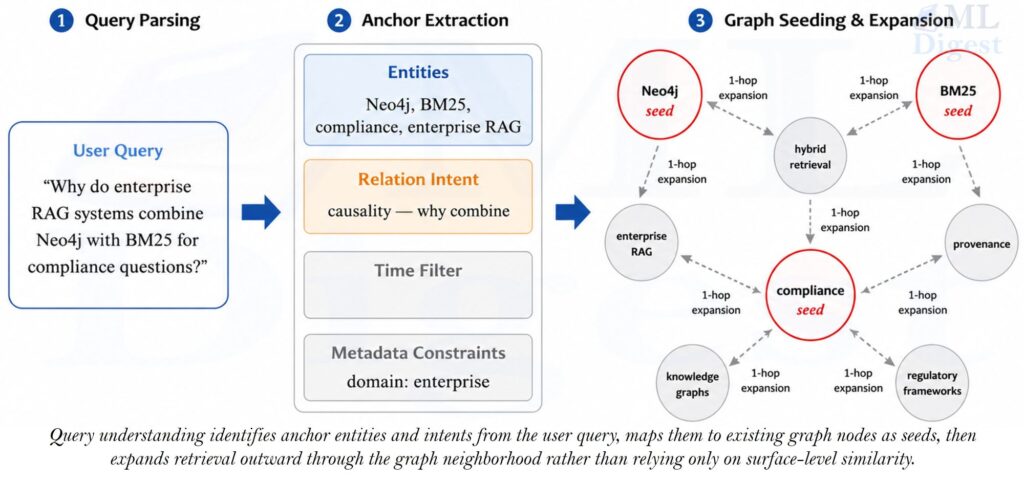
While vector-based RAG excels at finding similar passages, it often struggles with global reasoning (e.g., “What are the main themes in these 100 documents?”) or multi-hop relationship traversal (e.g., “How is Person A connected to Company B through their shared projects?”).
Knowledge Graph RAG addresses this by structured indexing:
- Entity Extraction: Using an LLM to identify key entities (people, places, concepts) and their relationships in the corpus.
- Graph Construction: Building a graph where nodes are entities and edges are relationships.
- Community Detection: Grouping related nodes into communities and generating summaries for these communities.
Key Benefits:
- Multi-hop reasoning: Naturally follows edges to connect disparate facts.
- Global understanding: Can answer “big picture” questions by querying community summaries rather than individual chunks.
- Traceability: Relationships are explicitly defined, reducing the “black box” nature of vector similarity.
In practice, GraphRAG is often used as a complement to vector RAG. A system might query a knowledge graph for high-level structure and a vector database for specific textual evidence.
Grapg-based RAG are not useful; sometimes vanilla RAG wins. Follow this post for additional info.
5.5 Structured Outputs and RAG
RAG is not limited to free-form text answers. You can combine retrieval with:
- JSON schemas or function-calling to get structured output.
- SQL generation where the model consults retrieved table schemas or documentation.
- Code generation where retrieval provides relevant code snippets or API docs.
6. Design Choices and Trade-Offs
Designing a good RAG system involves many practical decisions. Here are key axes to consider.
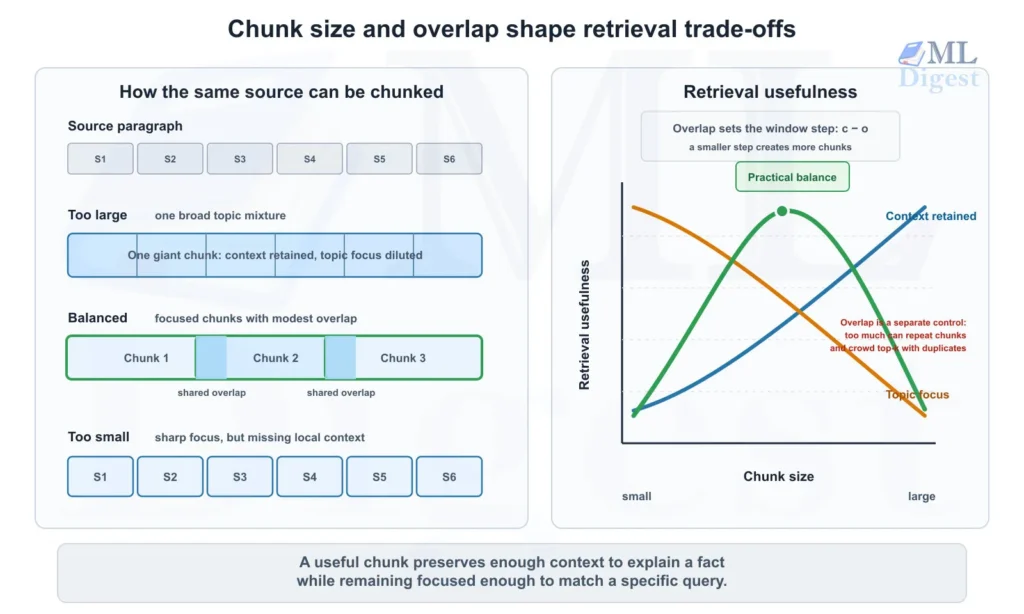
6.1 Chunk Size and Overlap
- Small chunks (e.g., 100–300 tokens):
- Pros: fine-grained retrieval; less irrelevant text.
- Cons: loss of semantic context; may miss context that spans multiple chunks.
- Large chunks (e.g., 800–2000 tokens):
- Pros: more context per retrieval; preserves narrative flow and context; fewer queries to index.
- Cons: higher cost per query (more tokens to LLM); risk of noise; “Lost-in-the-middle” phenomenon (LLMs struggle to find facts in the middle of long contexts).
Common practice: start with 300–800 tokens with 10–20% overlap and tune empirically.
6.2 Number of Retrieved Chunks (k)
- Low k (e.g., 3–5):
- Pros: smaller prompts; cleaner context for the LLM; faster and cheaper.
- Cons: lower recall; may miss some relevant content.
- High k (e.g., 10–40):
- Pros: higher recall; better coverage.
- Cons: more noise; longer prompts; possible confusion/hallucination for the LLM; higher cost.
The optimal k depends on:
- Query complexity
- Domain size and redundancy
- Model context window and cost constraints
6.3 Embedding Model Choice
- Smaller, faster embeddings (e.g., 384–768 dimensions):
- Cheaper to compute, smaller index, faster search.
- Adequate for many enterprise QA use cases.
- Larger, more expressive embeddings (e.g., 1,024–4,096 dimensions):
- Better semantic fidelity and cross-lingual performance.
- More expensive compute and storage.
It is common to start with a good open model (e.g., a modern bge / GTE / E5 model) and only move to heavier models if quality is insufficient.
6.4 Vector Store and Indexing Strategy
Consider:
- Scale: How many chunks (10k vs 10M+) do you need to store?
- Latency: Do you need sub-100ms retrieval?
- Filtering: Do you need complex metadata filters or hybrid search?
- Operational complexity: Self-hosted vs fully managed.
Do not over-engineer the database on Day 1.
- For < 100k chunks: An in-memory index (like FAISS or even a local array) is faster and simpler than managing a dedicated server.
- For > 1M chunks: You need a managed Vector Database (Pinecone, Qdrant, Weaviate, pgvector) to handle persistence, replication, and filtering at scale.
6.5 Evaluation and Quality Measurement
RAG systems must be evaluated at both retrieval and generation stages.
Key metrics:
- Retrieval recall / precision: Does the retriever surface the right chunks?
- Answer correctness: Are generated answers factually correct and complete?
- Groundedness: Are answers supported explicitly by retrieved context?
- Citations quality: Are correct source passages cited or linked?
Two practical retrieval metrics that are especially useful during iteration:
- Recall@k: Over a labeled set (question, relevant chunk), how often does the relevant chunk appear in top-$k$ retrieved results?
- MRR (Mean Reciprocal Rank): How high does the first relevant chunk appear in the ranked results?
These typically move faster than end-to-end “answer correctness”, which is why teams use them to debug chunking, embeddings, and reranking.
Practical evaluation strategies:
- Human-labeled QA sets: Pair questions with ground-truth answers and relevant documents.
- LLM-as-judge: Use another model to rate answers against reference documents (with care).
- A/B tests: Compare different retrieval configurations in production.
6.6 What To Log (To Debug RAG)
If you log only the final answer, debugging is guesswork. Log the intermediate artifacts:
- The rewritten query (if you do query rewriting)
- Retrieved chunk ids, scores, and the final top-$k$
- The exact prompt sent to the generator (or a hashed version if sensitive)
- Citations emitted by the model (and whether they point to retrieved text)
This enables structured evaluation: is the failure in retrieval, prompt construction, or generation?
7. RAG vs Fine-Tuning vs Prompt Engineering
RAG is one of several strategies to adapt a base model to your domain. It is helpful to understand how they compare. The table below preserves the full content from the original subsections for each strategy.
| Strategy | What it is | Pros | Cons |
|---|---|---|---|
| Prompt Engineering Alone | Prompt engineering tries to coax better behavior from the model without changing its knowledge. | – No infrastructure for retrieval needed. – Works well for stylistic changes, reasoning modes, instruction-following. | – Cannot introduce truly new factual knowledge. – Still vulnerable to hallucinations on niche or up-to-date information. |
| Fine-Tuning | Fine-tuning updates model weights using additional training data. | – Can deeply specialize model behavior. – Helps with domain-specific jargon, formats, and patterns. | – Computationally expensive; requires training pipeline. – Harder to keep updated with fast-changing data. – Harder to trace sources and maintain strict factuality. |
| RAG | RAG introduces external retrieval instead of (or in addition to) weight updates. | – Easy to update knowledge by changing documents. – Better control over sources and citations. – Can reduce hallucinations by asking the model to stay within retrieved context. | – Requires additional infrastructure (indexing, vector DB, pipelines). – Retrieval quality can become the bottleneck. – Longer latency compared to pure generation. |
Combined Approaches
In practice, high-performing systems often use all three:
- Prompt engineering to specify behavior and style.
- RAG to provide up-to-date, grounded knowledge.
- Fine-tuning to adapt to domain-specific tasks and improve robustness.
8. Common Pitfalls and How to Mitigate Them
| Pitfall | What it looks like (symptoms) | Practical mitigations |
|---|---|---|
| Irrelevant or weak retrieval | – Answers feel generic or off-topic. – Model hallucinates even with RAG enabled. | – Improve chunking (semantic boundaries, better overlaps). – Use stronger embedding models. – Introduce hybrid retrieval and/or reranking. – Tune k and metadata filters. |
| Context overflow and prompt budget | – Prompts often hit context window limits. – Retrieval returns very large chunks. | – Reduce chunk size or k.– Use summarization or selective extraction before passing text to the LLM. – Use multi-step RAG (retrieve more, then summarize and condense before final answer). |
| Knowledge gaps in the corpus | – LLM frequently responds “I do not know” or hallucinates. – Retrieved chunks are consistently only tangentially related. | – Identify missing or outdated documents; expand coverage. – Improve data quality during ingestion. – Add domain experts to curate critical sections. |
| Evaluation blind spots | – System looks good on a few examples but fails in production edge cases. | – Use realistic queries from logs for evaluation. – Cover diverse query types (lookup, reasoning, multi-hop). – Iterate with human-in-the-loop evaluation. |
9. Summary
RAG decouples memory (database) from reasoning (model), allowing for flexible and updateable AI systems. The architecture consists of an Indexing Pipeline (to prepare data) and a Retrieval Pipeline (to query data). Mathematically, RAG approximates the probability of an answer by conditioning on the top-$k$ retrieved documents. The success of RAG depends heavily on the quality of your embeddings and your chunking strategy.
Final Thought: In our experience, the difference between a fragile demo and a robust production system often lies not in the choice of the largest LLM, but in the unglamorous work of clean data chunking and rigorous evaluation strategies. Start simple, evaluate often, and let the data guide your complexity.

Happy is a seasoned ML professional with over 15 years of experience. His expertise spans various domains, including Computer Vision, Natural Language Processing (NLP), and Time Series analysis. He holds a PhD in Machine Learning from IIT Kharagpur and has furthered his research with postdoctoral experience at INRIA-Sophia Antipolis, France. Happy has a proven track record of delivering impactful ML solutions to clients. Check more about him here: https://sites.google.com/site/slhappyin/
Subscribe to our newsletter!