

WordPiece: A Subword Segmentation Algorithm
WordPiece is a subword tokenization algorithm that breaks down words into smaller units called “wordpieces.” These wordpieces can be common […]
WordPiece: A Subword Segmentation Algorithm Read More »
WordPiece is a subword tokenization algorithm that breaks down words into smaller units called “wordpieces.” These wordpieces can be common […]
WordPiece: A Subword Segmentation Algorithm Read More »
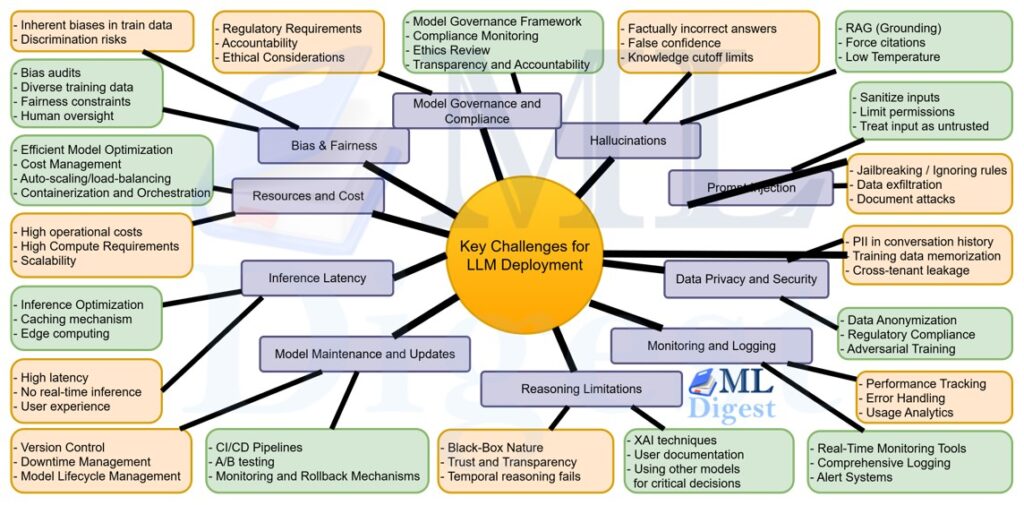
Transitioning LLM models from development to production introduces a range of challenges that organizations must address to ensure successful and
Key Challenges For LLM Deployment Read More »
Large Language Models (LLMs) offer immense potential, but they also come with several challenges: Technical Challenges Accuracy and Factuality: Bias
What are the Challenges of Large Language Models? Read More »
Model degradation refers to the decline in performance of a deployed Large Language Model (LLM) over time. This can manifest
Addressing LLM Performance Degradation: A Practical Guide Read More »
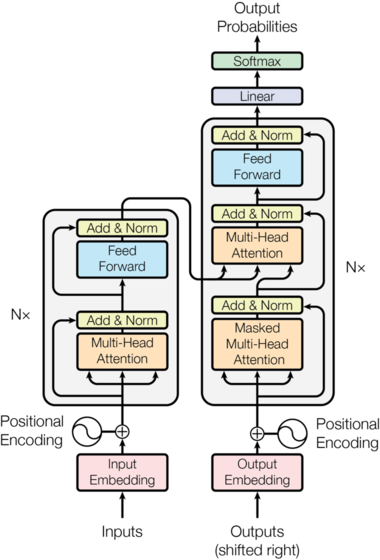
Initially proposed in the seminal paper “Attention is All You Need” by Vaswani et al. in 2017, Transformers have proven
Decoding Transformers: What Makes Them Special In Deep Learning Read More »
Large Language Models (LLMs) are computationally expensive to train and deploy. Here are some approaches to reduce their computational cost:
How To Reduce LLM Computational Cost? Read More »
Controlling the output of a Large Language Model (LLM) is essential for ensuring that the generated content meets specific requirements,
How To Control The Output Of LLM? Read More »
Traditional tokenization techniques face limitations with vocabularies, particularly with respect to unknown words, out-of-vocabulary (OOV) tokens, and the sparsity of
Byte Pair Encoding (BPE) Explained: How It Fuels Powerful LLMs Read More »
LLMs handle out-of-vocabulary (OOV) words or tokens by leveraging their tokenization process, which ensures that even unfamiliar or rare inputs
How do LLMs Handle Out-of-vocabulary (OOV) Words? Read More »

This article summarizes the content of the source, “The Efficiency Spectrum of Large Language Models: An Algorithmic Survey,” focusing on
Pushing the Boundaries of LLM Efficiency: Algorithmic Advancements Read More »

Vision Transformers (ViT) have emerged as a groundbreaking architecture that has revolutionized how computers perceive and understand visual data. Introduced
Dissecting the Vision Transformer (ViT): Architecture and Key Concepts Read More »
Central to the transformer architecture is its capacity for handling large datasets and its attention mechanisms, allowing for contextualized representation
Weight Tying In Transformers: Learning With Shared Weights Read More »