Rotary Positional Embedding (RoPE): A Deep Dive into Relative Positional Information

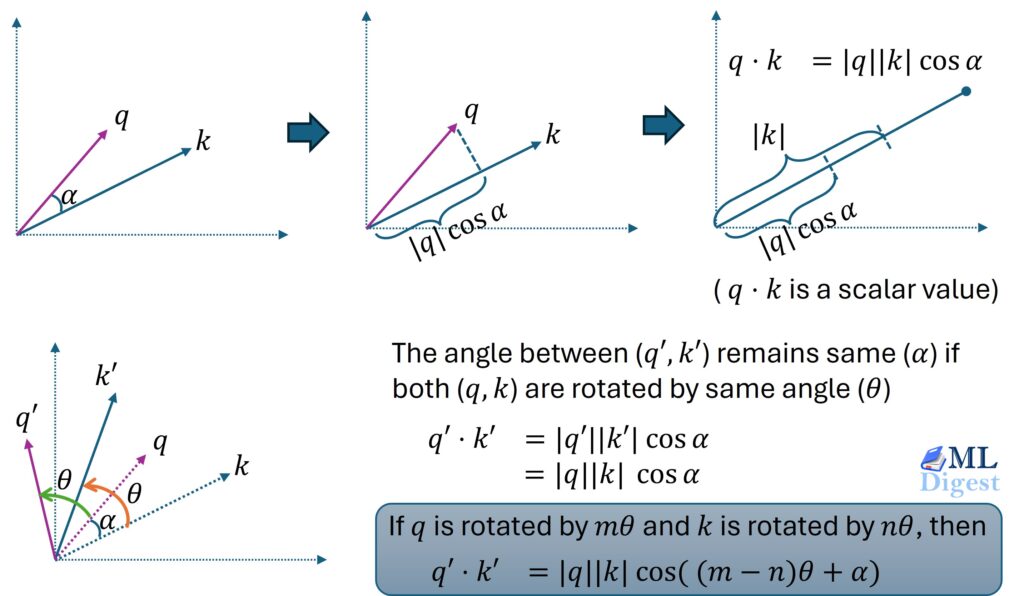
Rotary Positional Embeddings represent a shift from viewing position as a static label to viewing it as a geometric relationship. By treating tokens as vectors rotating in high-dimensional space, we allow neural networks to understand that “King” is to “Queen” not just by their semantic meaning, but by their relative placement in the text.

Rotary Positional Embedding (RoPE): A Deep Dive into Relative Positional Information Read More »

absolute-position-embedding

A Guide to Positional Embeddings: Absolute (APE) vs. Relative (RPE)

Think of a bookshelf versus a long hallway: absolute positional embeddings (APE) assign each token a fixed “slot” on the shelf, while relative positional embeddings (RPE) care only about the distance between tokens — like how far two people stand in a hallway. This article first builds intuition with simple analogies and visual descriptions, then dives into the math: deriving sinusoidal APE, showing how sin–cos interactions yield purely relative terms, and explaining how RPE is injected into attention (including T5-style relative bias). Practical PyTorch examples are provided so the reader can implement APE and RPE, understand their trade‑offs (simplicity and extrapolation vs. relational power), and choose the right approach for real-world sequence tasks.

A Guide to Positional Embeddings: Absolute (APE) vs. Relative (RPE) Read More »

Gradient Boosting: Building Powerful Models by Correcting Mistakes

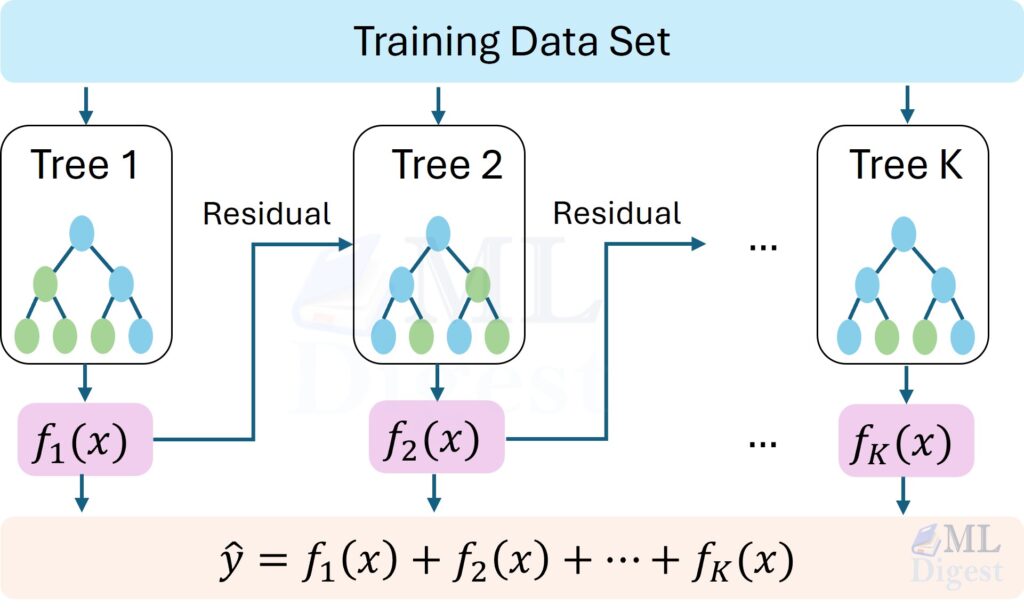
Gradient Boosting is more than just another algorithm; it is a fundamental concept that combines several key ideas in machine learning: the wisdom of ensembles, the precision of gradient descent, and the power of iterative improvement. By building a model that learns from its mistakes in a structured, mathematically-grounded way, it has rightfully earned its place as one of the most effective and versatile tools in a data scientist’s toolkit.

Gradient Boosting: Building Powerful Models by Correcting Mistakes Read More »

A Stakeholder’s Guide to the Machine Learning Project Lifecycle

This guide provides a comprehensive overview of the machine learning (ML) project lifecycle, designed to align stakeholder expectations with the realities of ML development. Key takeaways include:

Iterative, Not Linear: ML projects are cyclical and involve continuous refinement. Early stages are often revisited as the project evolves.

Data is Foundational: A significant portion of project effort, typically 60-70%, is dedicated to data collection, cleaning, and feature engineering. The quality of the data directly determines the success of the model.

Early Feasibility is Crucial: A preliminary study can de-risk projects by validating the approach and identifying data gaps before major resource commitment.

Success is a Partnership: Clear communication, defined business metrics, and stakeholder involvement at each stage are critical for achieving project goals.

A Stakeholder’s Guide to the Machine Learning Project Lifecycle Read More »

Scroll to Top